
China’s humanoid robots move from exhibition floors to real-world applications
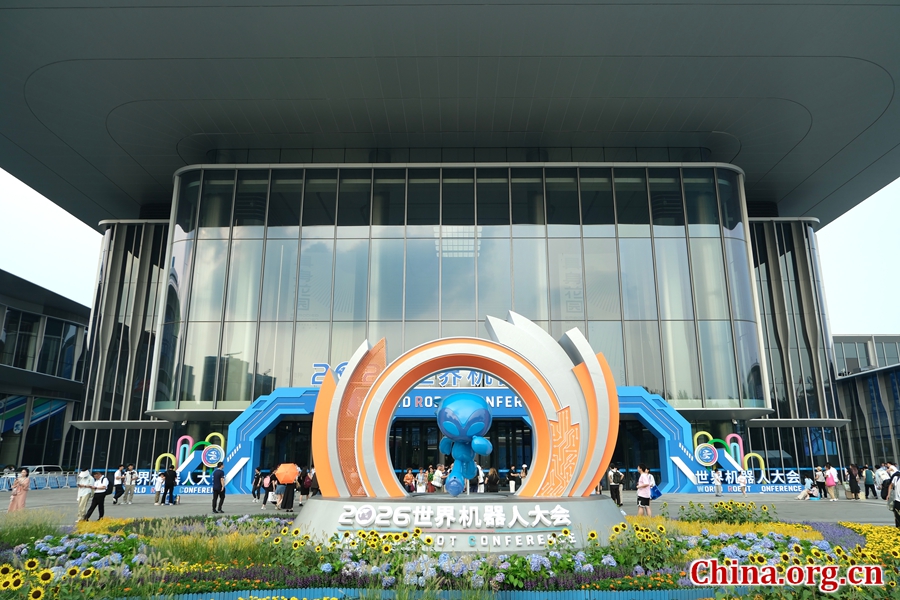
The 2026 World Robot Conference (WRC), held from Aug. 19 to 23 in Beijing, is showcasing the rapid development of China’s humanoid robot industry, with robots moving from small-batch production toward routine deployment and large-scale applications.
The 2026 WRC is underway in Beijing, Aug. 20, 2026. [Photo by Liao Jiaxin/China.org.cn]
China shipped more than 40,000 humanoid robots in the first half of 2026, accounting for 97% of global shipments, according to the 2026 Humanoid Robot Industry Development Report, released Thursday at the WRC. The report said the sector is accelerating its transition toward routine deployment and real-world applications at scale.
The trend is reflected in a growing range of use cases, from emergency response and household services to industrial production and pharmaceutical logistics.
Following its official launch on Aug. 18, the LINGLOONG v2.0 firefighting humanoid robot was showcased at the conference by the National and Local Co-built Humanoid Robotics Innovation Center, which describes it as the world’s first firefighting humanoid robot.
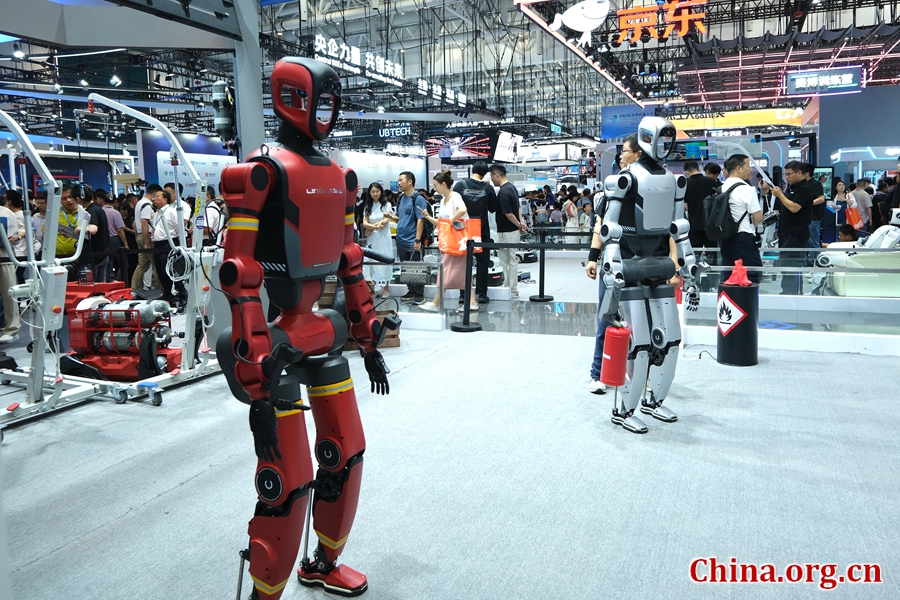
LINGLOONG v2.0 firefighting humanoid robots perform a demonstration at the 2026 WRC in Beijing, Aug. 20, 2026. [Photo by Liao Jiaxin/China.org.cn]
According to a staff member, the robot can use computer vision to locate fire sources, autonomously carry and operate a fire extinguisher, and complete simulated firefighting tasks.
“It mainly serves as an auxiliary tool, but with future development, we will gradually enhance the robot’s autonomous operating capabilities and further reduce the risks of firefighters entering dangerous areas,” the staff member said.
At the booth of robotics company Galbot, one robot was carrying out industrial tasks such as depalletizing and palletizing, managing payloads of up to 50 kilograms. The company also showcased its Galbot G1 in a pharmacy fulfillment scenario, where it is used to pick medicines for online orders before they are collected for delivery.
“We didn’t design anything specifically for this exhibition. We brought here what we have already deployed,” a company representative said.

The Galbot G1 performs a demonstration at the 2026 WRC in Beijing, Aug. 20, 2026. [Photo by Liao Jiaxin/China.org.cn]
The company said its Galbot S1 robots have already been deployed in industrial settings, including at CATL, Bosch and automobile manufacturers. The S1 can independently plan routes, determine how to pick up and place objects, avoid obstacles and even replace its own batteries, according to a company representative.
“It is truly extending human capabilities,” the representative said. “It is a 24-hour worker.”
Applications of humanoid robots are also extending into scenarios closer to everyday life, including companionship and social interaction.
UBTech Robotics, meanwhile, showcased its ultra-bionic U1 Pro humanoid robot, which drew particular attention from visitors.

U1 Pro humanoid robots on display at the 2026 WRC in Beijing, Aug. 20, 2026. [Photo by Liao Jiaxin/China.org.cn]
The lifelike robot is equipped with an emotion-aware large language model, biomimetic neck structure, complex facial muscle system and eye-tracking technology to support more natural interactions.
According to exhibition staff, the U1 Pro is designed for mass production and could be used in areas including elderly companionship, emotional support, reception and cultural exhibitions.