

China delays Chang’e-7 lunar south pole landing mission launch
HELSINKI — China has postponed its Chang’e-7 robotic lunar south polar landing mission just hours ahead of a scheduled launch, potentially delaying the mission into 2027.
The Chang’e-7 spacecraft stack was rolled out atop its Long March 5 launch vehicle to the pad at Wenchang Satellite Launch Center Aug. 19, with airspace closure notices indicating a planned launch no earlier than late Aug. 23 Eastern time (Aug. 24 UTC).
However, the presence of Typhoon Narra in the area appears to have ended hopes of launch within a narrow launch window, having initially already pushed the launch back a day to Aug. 24 Eastern time (Aug. 25 UTC). High winds either at the surface or at high altitude are a common cause for launches being scrubbed. Wenchang is a coastal spaceport specifically exposed to South China Sea tropical systems, with typhoon season running from June to October.
The China Manned Space Engineering Office (CMSEO) announced the postponement of the launch, stating that, based on the principles of prudence, reliability, and absolute safety, and after comprehensive assessment, the Chang’e-7 mission does not meet the launch requirements and cannot be carried out within the scheduled launch window this year. State media reported the announcement, repeating that the “launch therefore cannot take place during the planned window this year.”
It is not immediately clear if the ambiguous language referring to a “planned window this year” indicates a 2027 launch and rules out use of a backup window within 2026. Thailand’s NARIT astronomy institute announced just hours prior to the CMSEO statement that the Chang’e-7 launch has been postponed by around a month. NARIT contributed the MATCH space weather instrument to the mission, and the announcement coincides with an apparent Chang’e-7 international payloads workshop Aug. 23. The International Lunar Observatory Association (ILOA), a Hawaii-based group behind the ILO-C camera payload flying on Chang’e-7, attended the meeting and posted regarding the delay, stating it was “looking forward to Chang’e-7 when it happens… great workshop with the international lunar teams!”
In absence of clarity, mission objectives and specifics provide some insight into why the mission has limited launch windows. Journal papers related to the mission have indicated that Chang’e-7—which comprises an orbiter, lander, rover and flying/hopping spacecraft—was, after reaching the moon, to remain in lunar orbit for a period of weeks or months in order to obtain imagery of candidate landing sites ahead of the planned landing attempt. The target site is thought to be an area referred to as Peak Near Shackleton near the lunar south pole, an elevated area receiving periods of extended sunlight.
Wu Weiren, chief designer of China’s robotic lunar program, has previously told state media that some areas at the lunar south pole are illuminated for more than 100 days, and would allow unprecedented, continued operation in daylight on the moon. An optimal launch window could, therefore, provide insertion of Chang’e-7 into a polar lunar orbit to begin collecting remote sensing data, in preparation for a landing at the start of a period of extended solar illumination at a particular site. A new launch window one month later could, therefore, provide a backup opportunity for Chang’e-7 while reducing time available in orbit before a landing attempt by the same amount. Additionally, alternative sites could also provide other opportunities for continuous operation.
At the same time, the ambiguous CMSEO announcement stating the mission does not meet the launch requirements does not preclude issues other than the weather which potentially have delayed the mission. In the case of a September launch window being approved, airspace closure notices will soon be issued for the flight.
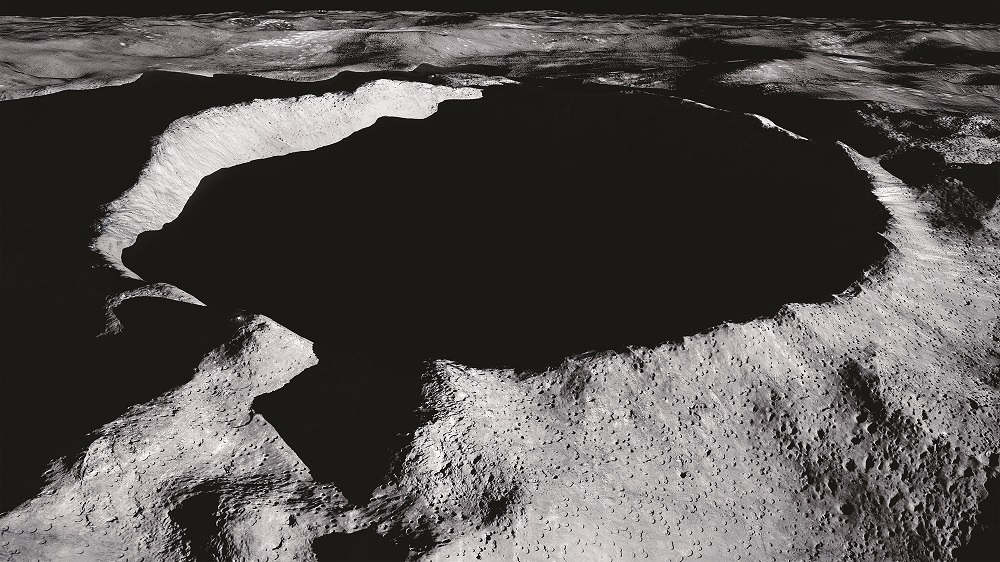
When it does launch, Chang’e-7 will focus on questions regarding the potential presence, volume and accessibility of volatiles such as water-ice caught in shadowed craters at the south pole, acting as cold traps, using the mission’s flying/hopping spacecraft to access and assess shadowed regions. The spacecraft also carry a wide range of payloads for ambitious science objectives.
The mission is being described as a precursor mission for the China-led International Lunar Research Station. A Chang’e-7 detection indicating substantial water-ice at the lunar south pole could have big implications for science and the future of lunar exploration.
Clive Neal, a professor of lunar geology at University of Notre Dame, told SpaceNews in the build up to the expected launch that the mission could deliver profound science results.
“These ices could contain prebiotic organics that seeded Earth and gave rise to life here. The presence of water and prebiotic organics remain to be verified by ground truth data. The south pole also represents part of the rim of the South Pole – Aitken basin, so there is potential for dating the age of the SPA basin IF the correct samples can be found,” Neal said.
“They have a very sophisticated mission to evaluate the presence of volatiles with an orbiter, lander, rover, and hopper.”
The delay, if longer than a month, could allow the U.S. to land near the lunar south pole first. Blue Origin is aiming to send its Blue Moon Mark 1 lander to the lunar south pole in 2027. Both China and the U.S. intend to establish lunar bases through the ILRS and Artemis program respectively.