

Brazil’s $1B Dollar Auction: How Reverse FX Swaps Affect USD/BRL
Banco Central do Brasil is scheduled to sell up to US$1 billion of spot dollars and to place up to 20,000 reverse FX swap contracts, worth roughly US$1 billion in notional, in two simultaneous auctions on Thursday 10 September, between 9:20am and 9:25am in Brasília.
The two legs run in opposite directions. The spot auction delivers physical dollars to accredited FX dealers. The reverse swap leaves the central bank holding dollar-linked exposure through a derivative registered at B3.
The official notice ties them together. Accepted swap contracts cannot exceed the notional value of the dollars actually sold in the spot auction, so the structure supplies spot-dollar liquidity while adding an offsetting derivatives position that limits the net change in the bank’s own USD/BRL exposure.
Brazil Pairs a Spot Dollar Sale With Reverse FX Swaps
The BCB announced both auctions on 8 September through two notices issued by its international reserves department, Depin. Communiqué No. 45,893 governs the spot leg and Communiqué No. 45,894 the swap.
The spot auction will accept a maximum of US$1.0 billion and is referenced to Ptax, the BCB’s daily reference exchange rate. Each FX dealer may submit up to three proposals, stating a volume and a differential of up to six decimal places to be added to or subtracted from the USD/BRL selling rate in the auction-day Ptax closing bulletin.
Dealer participation is optional, and the notice states that the BCB may accept only part of the offered volume.
The swap leg offers up to 20,000 SCS contracts, each carrying a notional of US$50,000. The BCB takes the seller position and the financial institutions the buyer position. Contracts start on 11 September and mature on 1 October 2026, a tenor of about three weeks.
Institutions may submit up to five proposals, quoting contracts in lots of 100 and a cupom cambial rate on a 360-day linear basis. Allocation follows a uniform price rule, with one clearing rate applied to all winning bids.
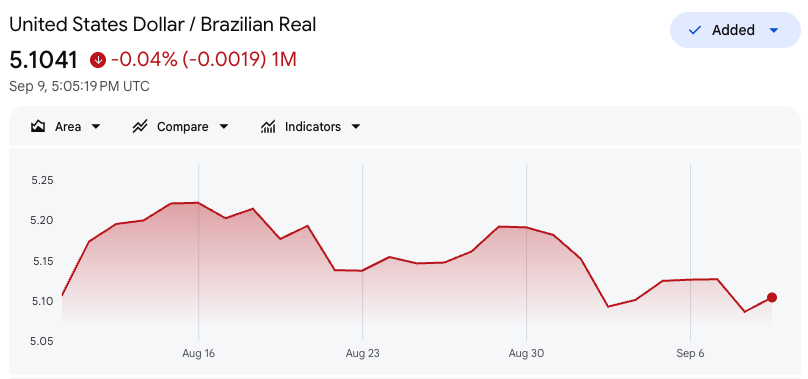
USD/BRL closed at R$5.1114 on Wednesday 9 September, up 0.44%, after ending Tuesday at R$5.0892, its lowest close since 7 August. The dollar is down about 1.35% so far in September and 6.88% in 2026. International reserves stood at US$369.7 billion in July, and the Selic rate sits at 14%.
The BCB will release results for both legs once it completes the auction calculation.
Why the Two Legs Point In Opposite Directions
The spot leg is a currency transfer. Dollars leave the central bank’s foreign-currency holdings and reach dealer balance sheets, where they can be passed on to importers, corporates and other users that require delivery.
The swap leg is not. No notional principal is exchanged. Under the SCS contract, the BCB receives the exchange-rate variation plus the cupom cambial leg and pays the Selic-linked leg. That position is economically similar to buying dollars in the futures market.
The cap is what binds the two. If dealers take only US$600 million of spot dollars, the swap allocation is limited to the equivalent US$600 million of notional. Full allocation on both legs would produce about US$2 billion of gross notional, of which only the US$1 billion spot leg puts physical dollars into the market.
The remainder is derivative notional, financially settled in reais rather than delivered as US dollars. The offset is close rather than exact. The spot sale reduces foreign-currency assets, while the reverse swap carries interest-rate exposure, daily valuation and a fixed maturity.
Why the Structure is Geared Toward FX Liquidity
Demand for actual dollars and demand for dollar exposure are separate things. Brazil has a large, highly liquid onshore FX derivatives market, while the spot auction is conducted with accredited dealers and the onshore cash market is smaller than the derivatives market.
Short-term cupom cambial rates are one gauge of dollar liquidity conditions in Brazil. The swap leg itself is quoted in cupom cambial terms.
The paired structure allows the BCB to supply spot-dollar liquidity while adding offsetting exposure through the derivatives market. Selling reserves on its own would also deliver cash, but would leave the central bank holding fewer dollars and a smaller long-currency position.
Brazil operates a floating exchange rate with no predetermined maximum or minimum level. The BCB says its FX interventions are intended to maintain the regular functioning of the market, avoid liquidity restrictions and provide hedging mechanisms.
Why the Operation Can Still Move USD/BRL
An offset in aggregate does not mean neutrality in each venue. If fully allocated, the spot leg can add up to US$1 billion of dollar supply to the cash market, while the swap leg works on the futures curve, where it can firm pricing and shift hedging costs. Spot and futures are linked by arbitrage through the cupom cambial, so pressure in one market transmits to the other.
The wider backdrop was moving the currency this week. The real strengthened on 8 September, then gave back part of the move on 9 September as Brent crude settled above US$101 and rising Treasury yields pressured risk assets.
Brazilian economists were leaning toward a 25 basis point Selic cut at the 16 September Copom meeting, while US markets were assigning roughly a 60% probability to a Fed hike.
Brazil Has Used This Structure Before
The BCB ran the same pairing on 27 August. Both legs cleared in full, with 12 spot proposals accepted at a cut differential of minus 0.000400 and two swap proposals accepted at 4.5610, maturing on 1 October.
An earlier operation on 26 June also cleared in full, with four spot proposals at a cut differential of minus 0.000300 and six swap proposals at 4.8790. Allocation is not automatic: on 24 April the BCB offered the same size on both legs and accepted no proposals on either.
Thursday’s operation is the latest of several paired auctions conducted during 2026.
What the Auction Result Will Show
The headline figure is the allocation ratio, accepted volume divided by the US$1 billion offered, multiplied by 100. August produced 100%. A full allocation would show that bids at prices acceptable to the BCB were sufficient to absorb the entire offer.
A partial allocation would require reading submitted volumes alongside the published cutoff before drawing any conclusion about liquidity demand, since the bank can reject on price.
The differential is the finer detail. It moved from minus 0.000300 in June to minus 0.000400 in August, a gap of R$0.0001 per dollar, or R$100,000 across a US$1 billion allocation. The new cutoff is worth recording against those two levels as a level rather than as a verdict on dealer urgency, since Ptax, funding and liquidity conditions differ from one auction to the next.
The swap clearing rate should be compared with the contemporaneous cupom curve rather than with August’s 4.5610 in isolation, given the different remaining tenors and the different spot, Selic and FX conditions involved.
The observable outcomes are the accepted amount on each leg, the cutoff levels, the USD/BRL reaction through the session and the behaviour of the cupom cambial into the 1 October maturity.