

Brazil Blocks Trump Officials Who Sought to Discredit Its Voting Machines
Brazil’s Foreign Ministry confirmed the visa denial on Saturday that it denied entry visas to two senior U.S. State Department officials who had applied to travel to Brasília to question the integrity of the country’s electronic voting system. The blocked mission — led by two Trump political appointees with documented histories of cultivating European far-right groups — marks the sharpest open confrontation yet between President Luiz Inácio Lula da Silva’s government and the Trump White House ahead of Brazil’s October 4 presidential election.
The officials denied entry were Riley M. Barnes, an assistant secretary in the Bureau of Democracy, Human Rights, and Labor, and Samuel Samson, a 27-year-old deputy assistant secretary in the same bureau. Samson, who previously worked as a fundraiser for a group aimed at bringing people to America, has since become the State Department’s primary operator for cultivating ties to right-wing parties in Europe, including Alternative for Germany, France’s National Rally, and the United Kingdom’s Reform UK. Barnes and Samson had applied for visas on July 20 and planned to travel from July 27 to 30, as the Washington Post confirmed.
The phrase they planned to use — “election integrity” — carries a specific political genealogy. It has been the framing of choice for politicians working to cast doubt on voting systems without evidence, from Donald Trump’s post-2020 claims in the United States to Jair Bolsonaro’s debunked allegations about Brazil’s machines before the 2022 election. The State Department characterized the planned mission as “routine,” calling Brazil’s interpretation “a baseless lie”. Brazil’s Foreign Ministry, citing evidence of “a renewed attempt to politically exploit the situation” and undermine the electoral system, was not persuaded.
Brazil’s Voting Machines Have No Verified Fraud Record
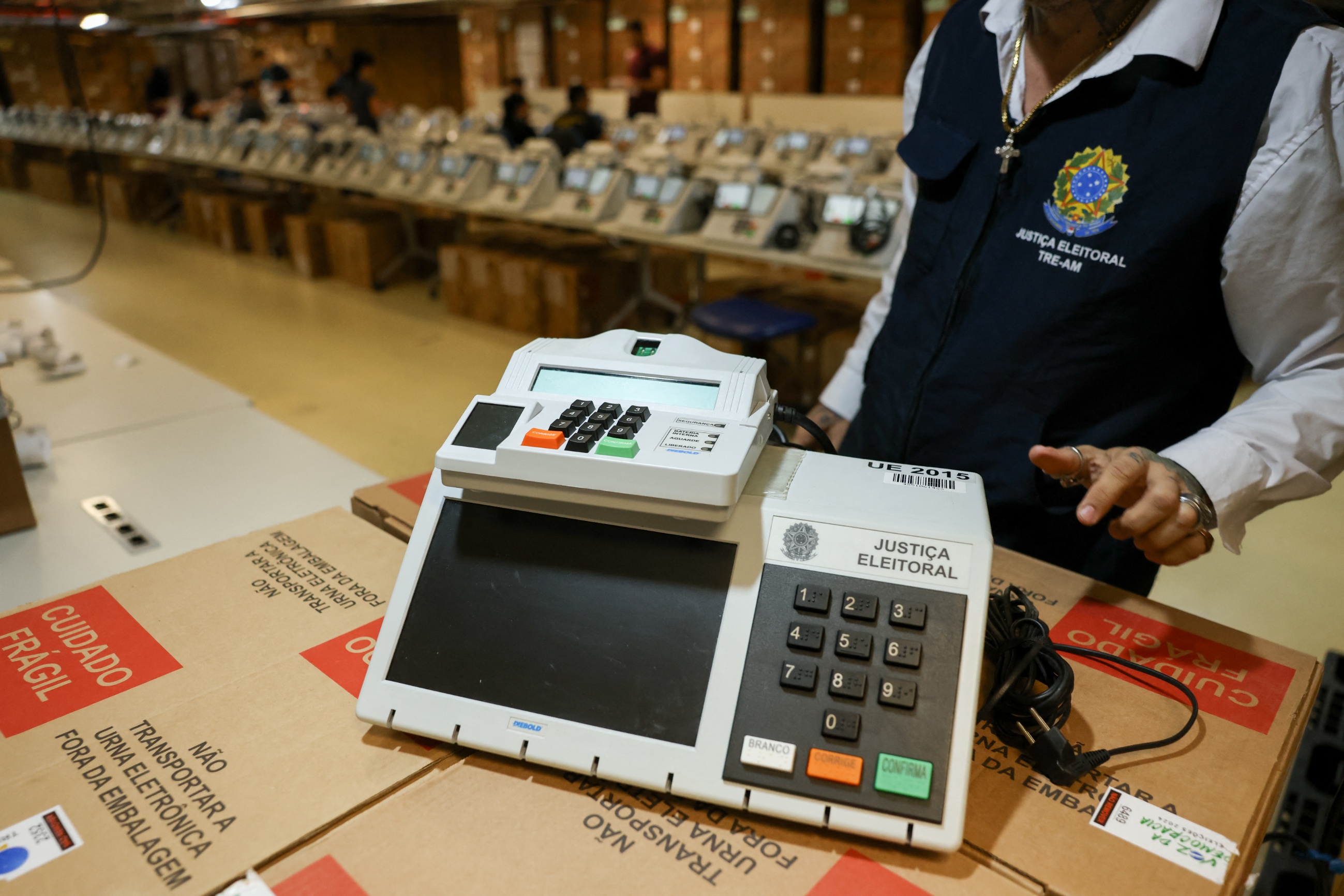
The irony of the mission is technical. Brazil’s touchscreen electronic voting system — the urna eletrônica — is not some fragile or opaque electoral technology ripe for outside scrutiny. It is one of the world’s oldest, most thoroughly audited, and most extensively tested national e-voting systems in existence, as its history on the Wikipedia article on electronic voting in Brazil confirms.
Brazil deployed the machines in 1996 and completed its first fully electronic election in 2000. Brazil is the only country in the world to conduct all elections entirely through electronic voting. The system runs on a custom Linux build known as UEnux, adopted in 2008, and added biometric fingerprint verification in 2012.
Crucially, it includes layered audit mechanisms that operate independently of the voting software itself. Before polls open, a “zerésima” — a zero-count printout — confirms no votes are preloaded. When polls close, each machine generates a “boletim de urna” — a physical printout of results — posted publicly outside polling stations. On election day, randomly selected machines are sequestered and used for a parallel vote audit: party representatives publicly order a specific number of votes for each candidate, and the machine’s software tally must match the party-directed total exactly. If it does not, the election in that state is voided.
The Superior Electoral Court (TSE) also conducts open public security tests open to any Brazilian citizen over 18, during which participants can attempt to break the system using unsealed machines and their source code. As of 2022, all found vulnerabilities had been corrected. In 30 years of operation, no verified case of election fraud has been documented.
When Jair Bolsonaro convened foreign diplomats before the 2022 election to air his unsubstantiated allegations about the machines, the TSE ruled he had abused his position and barred him from seeking public office until 2030.
Who Samson Is and What He Does
Samuel Samson did not arrive at the Bureau of Democracy, Human Rights, and Labor with a conventional human rights background. His official State Department biography describes his mission as championing “the defense of natural rights and the development of policies to uphold America’s western civilizational heritage” and “other regional and structural projects to advance the America-first agenda.”
ProPublica reported in July 2026 that Samson was a key figure in redirecting State Department human rights grant funding toward right-wing causes, including programs targeting white South Africans and European far-right political movements. Sen. Jeanne Shaheen, the ranking member of the Senate Foreign Relations Committee, said the proposed grants suggested the department intended to “select awardees for federal funding based on their political ideology” rather than human rights merit.
Samson has held meetings with senior officials of Alternative for Germany (AfD), France’s Rassemblement National, and the UK’s Reform UK. According to the Washington Post, he had “at times alienated establishment politicians” across the countries he visited while cultivating ties to their far-right counterparts.
The timing of Barnes and Samson’s visa application added to Brazilian suspicions. They applied on July 20, the same day Flávio Bolsonaro — the Liberal Party’s presidential candidate and son of the convicted former president — held a private meeting with foreign diplomats during which he reportedly questioned the voting system’s reliability, according to a Brazilian diplomatic source cited by AFP.
Escalation, Step by Step
The visa denial did not arrive without warning. The U.S.–Brazil diplomatic relationship has been deteriorating systematically since the beginning of Trump’s second term, driven by Washington’s alignment with the Bolsonaro political family.
In March 2026, Brazil revoked the visa of Darren Beattie, a Trump State Department official serving as envoy to South America, after Justice Alexandre de Moraes denied Beattie access to the Brasília prison facility where Jair Bolsonaro was then held. Lula called the revocation a reciprocal measure: U.S. Secretary of State Marco Rubio had revoked visas of Brazilian officials linked to a Cuban medical program in August 2025.
In late May 2026, Flávio Bolsonaro and his brother Eduardo visited Washington and met with President Trump at the White House. Shortly afterward, the Trump administration designated Brazil’s two largest drug-trafficking organizations — First Command Capital and Red Command — as foreign terrorist organizations, a move Lula’s government opposed.
Then came the tariffs. On July 15, 2026, the U.S. Trade Representative announced a 25% tariff on most Brazilian exports under Section 301 of the Trade Act of 1974, targeting what it called unfair practices including Brazil’s state-run Pix digital payment system, a deforestation enforcement dispute, and Brazil’s 18% tariff on U.S. ethanol imports. The tariff took effect July 22, hitting what Brazil calculated as approximately $7.4 billion in exports — roughly 18% of its shipments to the United States. An additional 12.5% forced-labor tariff on a broader set of countries, including Brazil, took effect July 24, raising the potential cumulative burden on some Brazilian products to as much as 37.5%.
In June 2026, a Brazilian Supreme Court panel also convicted Eduardo Bolsonaro of lobbying the United States to interfere in his father’s criminal trial.
Brazil’s government called July 15 “a regrettable milestone in the history of relations between Brazil and the United States.” Lula’s administration has framed the entire escalation — tariffs, FTO designations, and now the visa mission — as a coordinated attempt to tilt October’s election toward the Bolsonaro camp. Lula has accused the Bolsonaro family of helping trigger the tariffs; Flávio Bolsonaro denied this, saying his Washington visit was intended to persuade the Trump administration to delay the tariffs until after the October vote, according to Bloomberg.
Is Washington Helping the Person It Is Trying to Help?
The core paradox of U.S. strategy toward Brazil in 2026 is that it appears to be achieving the opposite of its intended political effect.
Quaest polling published in July 2026 showed Lula expanding his lead over Flávio Bolsonaro — from trailing by a narrow margin in a simulated runoff in April to leading by eight points after the tariff announcement — representing a significant swing. A survey by the same firm found that 47% of Brazilian voters agreed with Lula’s argument that the tariffs were linked to the Bolsonaro family.
“Trump has been a leading figure not only to the Bolsonaros but also to the wide range of extreme-right politicians in Latin America since his first term,” said Gustavo Blum, a Brazilian geopolitics analyst. “Now, with the imposition and re-imposition of trade tariffs, it’s been harder for the Bolsonaros to give a perspective in which Trump is looking out for Brazilians’ interests and not only Americans’ interests.”
Bloomberg reported the tariffs risked becoming a political advantage for Lula. The Washington Post reported they could tip the election in his favor. Americas Quarterly described the tariff announcement as potentially a decisive blow to the Bolsonaro family’s electoral prospects.
Lula’s campaign reportedly planned a “TariFlávio” messaging strategy, using social media to link the tariff hike to Flávio Bolsonaro.
What the State Department Said — and What It Didn’t
The State Department’s public response to the visa denial was brief and defensive. A spokesperson told AFP the two officials had planned to discuss “election integrity, religious freedom and freedom of expression” with Brazilian government officials, religious leaders, and civil society figures, and called the mission “routine.”
The department did not address the specifics of Samson’s track record, the timing of the application relative to Flávio Bolsonaro’s July 20 diplomatic meeting, or Brazil’s cited “evidence” of planned political exploitation. Secretary Rubio had separately characterized Lula’s economic policies as “bad for Americans and bad for Brazilians” and accused his government of failing to negotiate in good faith on trade.
The White House rejected Brazil’s characterization of the visa denial as justified, defending what it called standard diplomatic outreach. It provided no detailed rebuttal to Brazil’s specific concerns about the purpose of the visit.
Flávio Bolsonaro notably did not directly question his country’s electronic voting system at his Liberal Party nomination convention on July 25, even as his father’s debunked allegations about the machines continued to circulate. His 86-page submission to the USTR earlier in July had even defended Pix — Lula’s signature digital payment system — calling it “one of the hallmarks of Jair Bolsonaro’s administration.”
What Comes Next for Brazil and the United States
Both countries will be navigating this dispute in the foreground of an election campaign that now has fewer than 70 days to the October 4 first round. A runoff between Lula and Flávio Bolsonaro, should both advance past the first round, is scheduled for October 25.
The visa denial sets a precedent: Brazil has now turned away three U.S. officials — Beattie in March, and Barnes and Samson this week — under this administration. Each episode has been reciprocal or preemptive, and each has been publicly framed by Lula as a sovereignty defense rather than a provocation. That framing, by available polling, has resonated.
For technology and political observers alike, the episode crystallizes something broader: a certified, three-decade-old electronic voting infrastructure — independently audited, publicly testable, with no verified fraud in its history — has become a diplomatic weapon, not because of any genuine technical concern, but because its integrity is politically inconvenient for one side of an American bilateral relationship. The machines work. That is precisely the problem, from the perspective of those who sent the envoys.
Frequently Asked Questions
Why did Brazil deny visas to the U.S. State Department officials?
Brazil’s Foreign Ministry cited evidence of a renewed attempt to politically exploit the situation and undermine the electoral system. Brazilian officials said the planned mission’s timing — arriving 70 days before a presidential election, on the same day Flávio Bolsonaro held a private diplomatic meeting reportedly questioning the voting system’s reliability — indicated the visit was not a routine diplomatic engagement but a deliberate effort to cast partisan doubt on Brazil’s certified e-voting infrastructure.
Is Brazil’s electronic voting system actually secure?
By all independently verifiable measures, yes. The system has operated since 1996, completed Brazil’s first fully electronic election in 2000, and has no documented case of verified election fraud across 30 years of use. It includes a parallel voting audit on election day in which party representatives publicly direct test votes, and the machine tally must match exactly. The Superior Electoral Court runs open public security tests; all vulnerabilities found have been corrected. When Bolsonaro made unsubstantiated fraud claims about the machines in 2022, Brazil’s highest electoral court ruled he had abused his office.
How are U.S. tariffs affecting the Brazil election?
More than analysts expected — in the opposite direction of Washington’s apparent intent. A 25% tariff on roughly $7.4 billion in Brazilian exports took effect July 22, 2026, with an additional 12.5% forced-labor tariff adding a potential total burden of up to 37.5% on some products as of July 24. Quaest polling published in July 2026 showed Lula expanding from a narrow deficit in April to an eight-point lead over Flávio Bolsonaro in a hypothetical runoff. Lula’s campaign plans a “TariFlávio” messaging strategy linking the tariffs to Flávio Bolsonaro, and 47% of Brazilian voters polled agree with Lula’s framing.
What is the “election integrity” phrase, and why does it matter here?
In American political discourse since 2020, “election integrity” has been used consistently as a framing device by politicians seeking to cast doubt on electoral outcomes without evidence — most prominently by Donald Trump regarding U.S. elections, and by his ally Jair Bolsonaro regarding Brazil’s. For Brazilian officials, hearing the same phrase used by two Trump-appointed officials — one of whom had built a record of cultivating European far-right parties and redirecting human rights funding toward politically aligned causes — was not a neutral description of diplomatic intent. It was a recognizable political signal.