

Bauchi Guber candidate Yakubu Adamu’s Cameroonian PhD

Cameroon’s regulators say no private institution may train students at the doctoral level. The man Adamu names as his thesis supervisor appears in the university’s own records as a student.
Yakubu Adamu, the Bauchi State Governorship candidate of the Allied Peoples Movement (APM), who served as a commissioner in the Bauchi State government, presents himself as a holder of a Doctor of Philosophy. He uses the title “Dr” and says he earned the degree in 2020 from the International University of Bamenda, a private institution in Cameroon. Adamu always introduces himself as ‘Dr. Yakubu Adamu, PhD’—a redundant doubling.
The International University of Bamenda, the Cameroonian institution Adamu says awarded his degree, has never been authorised by Cameroon to train students at the doctoral level. It was not authorised in 2020 when his thesis is dated, as shown in the government’s own approval records and in an April 2026 communiqué from Cameroon’s Ministry of Higher Education.
The university’s Secretary, Mary Fusi, said the institution has no satellite campuses in Nigeria and that any college awarding degrees in its name does so without approval. She said the institution does “not have anything to do with Nigeria,” and that “whoever is doing so is doing so at his or her own risk.”
Mary Fusi, who WikkiTimes understands is the daughter of the late Patrick Chefu Fusi, the founder of the university, said in a telephone interview that the institution had issued a formal disclaimer years ago. She said copies were sent to “the Youth Council in Nigeria, to the Nigerian Consulate, to the Ministry of Education in Nigeria, to the Ministry of Higher Education here in our country,” adding that IUB wanted no satellite campus in Nigeria.
She said students who came to her claiming admission through a Nigerian centre were told plainly that they were being scammed. She described a prospective student who said his friends were already studying at an IUB centre in Nigeria. She told him they were being deceived. “He never followed up,” she said. “Some of them are comfortable to be duped.”
But the records contradicting her are published by the university itself. IUB’s own website carries an alumni roster that is overwhelmingly Nigerian, listing serving and former officials of Bauchi State institutions by name, position and registration number. The thesis Yakubu Adamu submitted in 2020 records her late father, Patrick Chefu Fusi — the university’s founder and the promoter named on its government approval documents — as its external examiner. And the man Adamu names as his supervisor appears on the same roster, not as a supervisor but as a doctoral student.
WikkiTimes’ checks on the MINESUP registry, the official Cameroonian government database of accredited private institutions, found two approval orders for the university: a creation order No. 11/00507/MINESUP/SG/DDES dated 5 October 2011, and an opening authorisation No. 12/0363/MINESUP dated 17 August 2012. None of the approvals allows for Masters and PhDs. The institution’s authorisation never covered doctoral training in 2011, 2012, and June 2020, when Adamu’s thesis was submitted. No version of the university’s licence has ever permitted the degree he holds. The approval document lists Patrick Chefu Fusi as the institution’s promoter and includes the same telephone number that WikkiTimes used to contact Mary Fusi.
Furthermore, on June 1st, Cameroon’s regulator for private higher education told WikkiTimes that no private institution in the country is permitted to award doctoral degrees.
Gabriel Djankou Nkuissi, National Executive Secretary of the National Association of Private Higher Education Institutions of Cameroon (ANIPES), told WikkiTimes in writing:
“Even before any verification, which would only confirm the principle, no private higher-education institution is to date authorised to train at the PhD level. The IUB is a recognised private higher institution, authorised to operate in Cameroon. But it cannot train at the doctoral level, nor host doctoral training.”
Before then, in a press release dated 13 April 2026, signed by the Minister of State for Higher Education, Professor Jacques Fame Ndongo, the Ministry of Higher Education, known by its French abbreviation MINESUP, equally said no private higher-education institution in Cameroon is authorised to deliver training at the doctorate level. The Ministry said no “offshore” doctoral programme is authorised anywhere on Cameroonian territory, and that certificates resulting from such programmes cannot be recognised in Cameroon. The International University of Bamenda is a private institution. Under the ministry’s rule, a private doctorate awarded in Cameroon is not recognised.
A registered institution, closed by Cameroon’s regulator
National Commission for Private Higher Education, known by its abbreviation CNESP, has sanctioned the International University of Bamenda. On 28 August 2024, the Commission closed its 30th session by sanctioning nine private institutions, in a communiqué signed by Fame Ndongo. The International University of Bamenda was one of them.
Cameroon Tribune, the state-owned daily, reported on 3 September 2024 that the university was sanctioned for the “issuance of false diplomas and the refusal to compensate a learner,” and was closed for three years. The Guardian Post, an English-language Cameroonian newspaper, reported the same action on 5 September 2024, citing similar reasons. The closure took effect in 2024.
Yakubu Adamu’s thesis’s abstract matched a project sold online
Yakubu Adamu has not published his complete thesis anywhere. Rather, he published an abstract and redacted the rest of the thesis, saying, “The contents of the thesis are for internal users only.”
The dissertation’s abstract submitted under Adamu’s name matches a study found on a commercial platform that sells theses and dissertations to students online. The thesis, titled: “The Impact of Risk Management on Organisational Efficiency: A Case Study of Plateau State Inland Revenue Service, Jos, Nigeria,” was submitted to the International University of Bamenda in June 2020. WikkiTimes used two separate plagiarism checks—Turnitin and Copyleaks to examine Adamu’s thesis abstract. On one check, the abstract returned similarity scores of up to 91, 86, and 91 percent in three instances. On another check, it returned a similarity score of 64 percent.
WikkiTimes notes that similarity scores alone do not constitute a finding of plagiarism. Turnitin, the world’s leading academic integrity platform, states explicitly that “the relationship between a similarity score and plagiarism is often misunderstood,” adding that “many assume that a high similarity score automatically signifies plagiarism, but that is not always the case,” and that “determining whether plagiarism has occurred requires more than looking at the score.” The scores documented by WikkiTimes — ranging from 64 to 91 per cent across multiple checks of the dissertation’s abstract — are presented as indicators warranting further scrutiny, not as a conclusive determination of misconduct.
WikkiTimes formally requested access to Adamu’s full, unredacted thesis to allow for a complete and fair assessment of the work beyond its abstract. Adamu did not respond.
A substantial part of his abstract matches a pre-written research project on the same subject — risk management and organisational efficiency — applied to a different organisation, Dunlop Nigeria Plc, which was sold to students on the commercial website projectclue.com.
Adamu’s thesis records that Dr Alhaji Kawugana supervised it, that a committee including Nbifor Cletus certified it, and that Professor Patrick Chefu Fusi, the institution’s founder, examined it externally. WikkiTimes traced Kawugana to the Federal Polytechnic, Bauchi. Unlike other supervisors, Kawugana’s name does not appear on IUB’s website as a supervisor or examiner.
When the same PhD thesis, purportedly written by Yakubu Adamu, appeared in the International Journal of Social Sciences and Management Research in 2020, the authorship order had changed. Kawugana was listed as the lead author, and Adamu and Abdallah as co-authors. In standard academic practice, a student publishing his own thesis is credited as first author, with the supervisor named second. The journal version also reproduces a passage stating that the study “has been completed in the context of [the] Pakistani software development industry” — a description inconsistent with a Nigerian case study, further raising suspicion of plagiarism.
Yakubu Adamu has more than 20 papers in a single year
In 2025, while Adamu held public office as a commissioner for Finance in Bauchi State, WikkiTimes counted more than twenty research articles he purportedly co-authored with Alhaji Kawugana. Several were presented as conference papers attributed to institutions WikkiTimes could not confirm exist. A significant number of the articles appeared in journals published by the International Institute of Academic Research and Development (IIARD), a platform that charges authors $20 per article for online publication — a fee that must be paid before a paper goes live. IIARD’s own homepage states that papers will be “published within 48 hours after the payment confirmation.”
IIARD’s indexing disclosure page lists only Google Scholar and ResearchGate — the latter populated by authors themselves — as its current databases, while acknowledging it is “actively pursuing inclusion in additional indexing services.”
The process sits outside normal academic practice. In management and business research, the path from submission to publication takes, on average, just under 18 months. Most active academics publish a low single-digit number of peer-reviewed papers per year. In one study of research productivity, faculty averaged about 2.1 publications per year, and the most productive member managed 10.3 per year. Twenty papers in 12 months is an average of one new paper every two and a half weeks, sustained over a year during which the listed author was running a government ministry. High-volume output published in low-scrutiny journals is a recognised feature of predatory journals, which produce large quantities of poor-quality research.
Unlike other graduates, Yakubu Adamu’s record on IUB website is missing
The institution’s own records do not list Adamu among its graduates. WikkiTimes examined its published student lists, its LinkedIn alumni listing, which records 1,115 alumni, most of them registered as based in Nigeria, and its published alumni roster. Adamu’s name does not appear on any of them.
Despite the presence of many Alumni from Bauchi State on IUB’s website, Adamu’s name is conspicuously absent. An alumni list may be incomplete, and the absence of a name is not by itself conclusive.
IUB has an overwhelmingly Nigerian roster; Many are from Bauchi
The institution’s alumni roster is overwhelmingly Nigerian. For a university located in Bamenda, Cameroon, that houses almost entirely Nigerian alumni raises suspicion. A large share of the listed figures is drawn from Bauchi’s public sector.
The IUB website listed several high-profile names in Bauchi, including Ali Gali, who it says was a rector at the Abubakar Tatari Ali Polytechnic. Other names listed include Ibrahim Buba, registrar; Friday Achimugu, bursar; and the head of accounting, M.D. Aliyu, and a lecturer, Ibrahim Adamu Saleh, all from the same Abubakar Tatari Ali Polytechnic. The roster also lists Adejoh Apeh Mathew, recorded as an examination officer at the Federal Polytechnic, Bauchi; Egwuemi Dennis Knights and Tijani Abubakar, recorded as staff of the Abubakar Tafawa Balewa University, Bauchi; Stephen Abubakar, recorded as a general manager of the Bauchi State Development Board; Mohamed Aminu and Lanze Sumaila, recorded in connection with the UNDP office in Bauchi; and Abdullahi Abba and Nasiru Yaro, recorded as the managing director and an accountant of a Bauchi microfinance bank. The appearance of these individuals on the roster is not, by itself, evidence of wrongdoing on their part.
The roster shows that the institution draws its examiners from its own graduates and reuses a small group of them across unrelated disciplines. One person listed as a 2009/2010 doctoral graduate later appears as the lead examiner on a series of doctoral defences in fields as varied as public administration, procurement management and human-resource management.

The institution publishes its doctoral defences with a column it labels “discussants” — the people IUB records as having sat each defence. Across 20 doctorates and master’s degrees in unrelated disciplines, the same handful of names fill that column, and a single telephone number, 0806XXX786, appears on eight separate doctoral defences. It belongs, each time, to Prof. Dorcas Igonoh, a former Vice Chancellor of Salem University, Lokoja, Kogi.
WikkiTimes reached Prof. Dorcas Igonoh at the telephone number listed against the research papers she published. Asked directly whether she earned her doctorate from the International University of Bamenda and whether she supervised doctoral students there, Igonoh did not answer. She asked instead what the question was for. Told that the information was meant for the public and that many Nigerians had earned PhDs from a university not permitted to run them, Igonoh said: “I don’t know anything about the university being authorised to run this thing or not. I can’t speak on that.”
Pressed a second time on whether she earned her PhD there, Igonoh said she does not speak to strangers and asked the reporter to send questions in writing. “Send me a text. Send your details,” she said — then ended the call abruptly, mid-conversation. WikkiTimes did as she requested. She did not respond as of press time.
Igonoh alone is listed discussing doctorates in procurement management, educational planning and administration, management technology, human resource management, and public administration — five fields that ordinarily demand five different specialists. Prof. Ben Wara Furu appears in defences in procurement, international business, philosophy, and public administration. Dr Promise Eseh is listed on a medical biochemistry doctorate, an economics doctorate, and a public-health master’s. A fourth name, rendered variously as “Dr Augustine A.,” “Dr Augustine A.,” “Dr Austine All.” and “Dr Austine Ogbeh,” carries most of the remainder.
The roster cannot hold its own names or titles steady. Igonoh is “DR Dorcas, Omanyo Igonoh,” where she appears as a graduate, and “Prof,” where she appears as a discussant. The same upgrade befalls Audu Dangana, listed as “Dr” among the alumni and “Prof” on the defence he discusses.
The reason the titles slip is that several of these discussants are not external authorities. They are the institution’s own graduates. Igonoh is recorded on IUB’s list as a 2009/2010 doctoral graduate in business management (entrepreneurship), registration IUB/2009/2010 — and then reappears as lead discussant on a series of later doctorates. A.E. Dangana is listed as an IUB doctoral graduate in entrepreneurship at the telephone number 0802XXX2967 and resurfaces as “Prof Audu Dangana,” a discussant, at the same number. Dangana is mentioned here and here as professor of a “Entrepreneurship and Strategic Leadership in the Department of Business Administration”, Kogi State University, Anyigba.
WikkiTimes also reached Audu Dangana on the telephone number that appeared against his name both as an IUB doctoral graduate and as a discussant on a doctoral defence. He told WikkiTimes he was not in the country and ended the call. Follow-up calls and an email sent to him went unanswered.
Adejoh Apeh appears three times in the same document: as Examination Officer at the Federal Polytechnic, Bauchi; as the holder of an IUB doctorate in business management; and as “Dr Adejo Apeh,” discussant on a master’s defence.
The circle is small enough and turned inward enough that the institution’s doctorates are produced and reviewed by the same few people who hold its doctorates.
Alhaji Kawu Gana, Adamu’s supervisor, appears in entry 32 as “ALHAJI KAWU GANA, Ph.D Financial Management, IUB/2014/2015/AKG/001.”
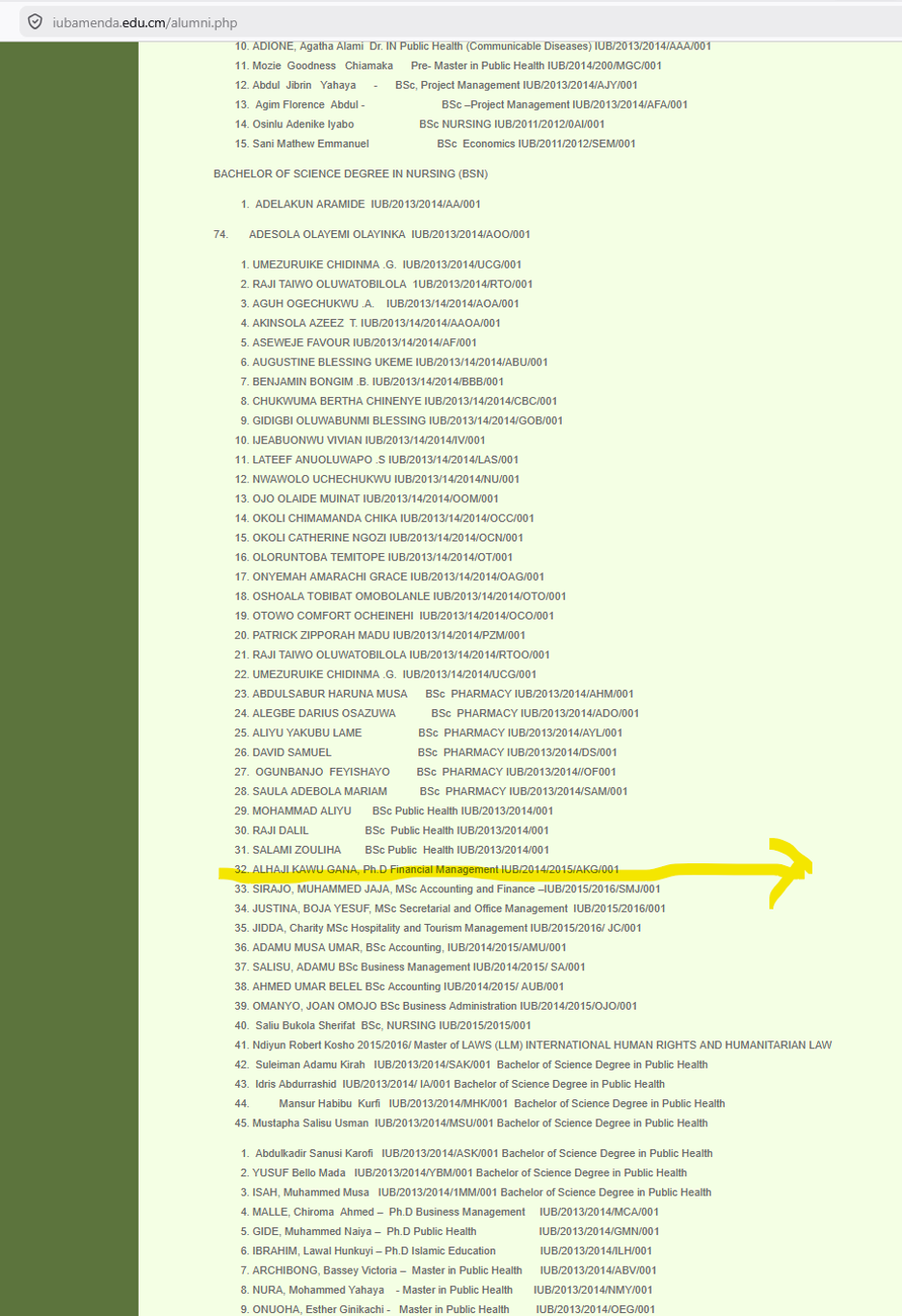
He is listed as a doctoral student of the institution, under a student registration number, IUB/2014/2015/AKG/001. He does not appear in the discussants column and was not recorded as a discussant, an examiner, or a supervisor of any defence, anywhere in the document. Yet Yakubu Adamu names this same Kawu Gana as the supervisor of his PhD thesis.
Kawugana responded to WikkiTimes
Kawugana responded to WikkiTimes in two separate letters. In the first one dated June 7th, he confirmed supervising Adamu’s thesis, saying he did so “in accordance with the arrangements and academic procedures communicated to me by the institution.” He also disclosed that he holds his own doctoral degree from IUB, the same institution whose doctoral authorisation Cameroon’s regulators have since found to be non-existent.
When WikkiTimes sought to follow up by telephone, Kawugana declined. Over WhatsApp, he directed WikkiTimes to contact Tanko George, whom he described as the programme coordinator at IUB, providing a Cameroonian telephone number.
When WikkiTimes contacted George, he said he was not a coordinator but a teacher at the institution. Under questioning, George said the questions WikkiTimes was raising would be better answered by Mary Fusi. When WikkiTimes put Kawugana’s description of George to Mary Fusi, that he was the programme coordinator, she said George had not worked with the university for approximately three years.
Asked in a second letter what steps he took to verify IUB’s accreditation before supervising a doctoral candidate, Kawugana, on June 8, said his “understanding was that the International University of Bamenda was operating as a recognised higher education institution in Cameroon” and that he “was not aware of any regulatory finding, sanction, or official declaration” at the time.
On the question of whether his own IUB doctorate is subject to the same invalidity finding, Kawugana said he “continues to regard the qualification as valid unless and until an authorised body determines otherwise.”
He listed the IIARD journal article, identical in title and subject to Adamu’s thesis, among his own publications. When asked why Adamu, the doctoral candidate, appeared as second author on a publication derived from his own thesis research, Kawugana said the authorship order “was determined by the contributing authors and reflected the arrangement agreed upon at the time of publication.” He did not explain what that arrangement was.
He offered to provide his supervisory appointment letter, but had not done so by the time of publication. In his final letter, he asked WikkiTimes to send no further correspondence, saying the exchanges were “disrupting his official assignment.”
Adamu ignores WikkiTimes
WikkiTimes sent Yakubu Adamu an email, placed telephone calls, and sent WhatsApp messages to his known number, asking him to respond to the findings in this report and to provide his full thesis. He did not reply to any of them. WikkiTimes also reached out to people close to him, asking them to notify him of the pending interview request. None facilitated a response.

What OSINT records tell us about IUB’s thin and inconsistent digital footprint
Using Open-Source Intelligence methods, WikkiTimes tested the institution against the records it would leave in the open if it operated as it claims. The institution’s digital footprint is thin and inconsistent. On a page at iubamenda.edu.cm, the university states that its official website is now iubamenda.org.

That address did not load when WikkiTimes followed it, returning a “Server not found” error over several days and across different browsers.

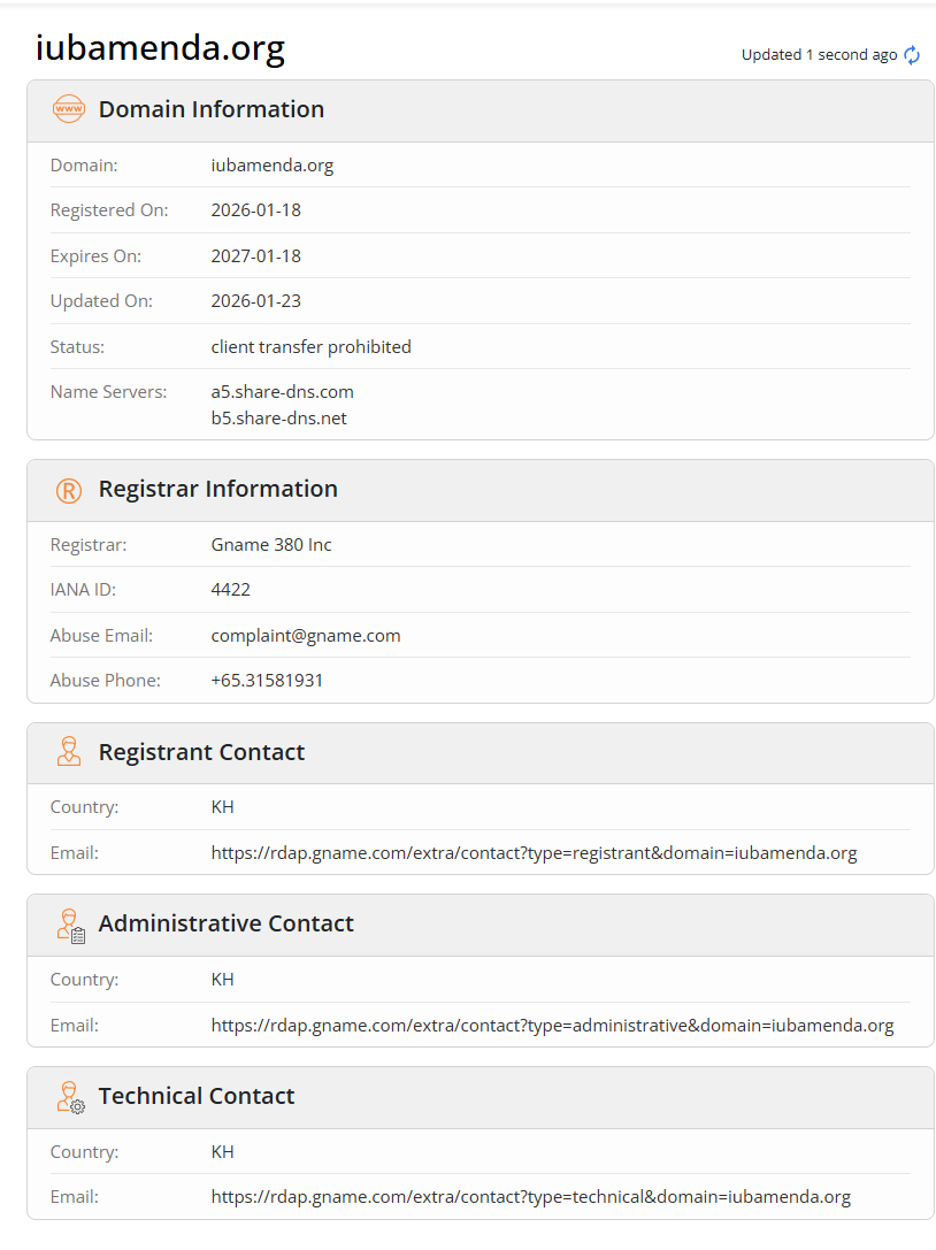
The registration record for iubamenda.org — the address the institution itself gives as official — shows that the domain was registered in 2026, in Cambodia with a Singaporean telephone number.
On Facebook, WikkiTimes tracked several pages attributed to the university. On one of the pages, it carries 522 followers and five photographs, and has been mentioned by a user from Sokoto only once. The user in 2016 described the picture as “inspiring,” noting Professor Patrick Chefu Fusi addressing students in a packed room. A second page, created in September 2022, has 173 followers and 11 photos.

Its account on X, opened in 2022, has 44 followers. Its main website gives its founding year as 1990; its X (formerly Twitter) profile gives 1981. Its LinkedIn page states that its website is under construction.
Many of the site’s subpages do not function. For instance, clicking “See admission lists” returns a server error, as of June 1, when WikkiTiems checked.

The International University of Bamenda occupies an ambiguous position in higher education indexing systems. It appears in the major directories but carries no substantive ranking data in any of them. On uniRank, which lists it as officially recognised by Cameroon’s Ministry of Higher Education, the institution holds no country rank and no world rank. This profile contrasts sharply with Cameroon’s public universities, including the University of Bamenda and the University of Buea, which carry full ranking scores on the same platform. Times Higher Education only holds a shell entry for IUB: a name and a location, with no ranking position, no impact score, and no published statistics. The institution does not appear in the AD Scientific Index’s Cameroon research-output table, from which both the University of Bamenda and the Catholic University of Cameroon are listed with faculty publication records. Its absence from Webometrics, the research-impact ranking on which Cameroon’s public universities carry full profiles, is consistent with this pattern, though direct verification of that absence was not possible.
The private institution shares part of its name with the University of Bamenda, the public university created in 2011, and the two are easily confused. On examination, the research that appears under the Bamenda name traces to the public university and other Bamenda institutions, not to the institution Adamu names. An absence of indexed research is not, by itself, proof that none was done.
The standing of a degree from the International University of Bamenda in Nigeria with the National Universities Commission (NUC) is unsettled. To verify the degree’s standing, WikkiTimes filed a Freedom of Information request with the NUC. The commission had not responded for several days after the request was sent. Its spokesperson, Mr Okoronkwo Ogbonnaya, directed WikkiTimes to a separate email address and asked that the same request be resubmitted. WikkiTimes did so; there was no response as of press time.
What the Nigerian Law says about fake degrees
The Nigerian law provides for criminal liability where a certificate is found to be forged. Bauchi State operates under the Penal Code, whose Sections 362 to 364 prescribe up to 14 years’ imprisonment for forgery and make the knowing use of a forged document a serious offence.
Section 182(1)(j) of the 1999 Constitution, as amended, provides that a person who presents a forged certificate to the Independent National Electoral Commission is not qualified to contest for public office.
Under Nigerian law, electoral exposure does not depend solely on what a candidate submits to INEC. In the case of Adamu, for instance, acknowledging holding a doctorate from the International University of Bamenda on multiple occasions, including during his screening for nomination as a commissioner, could be costly.
Screenings are formal proceedings in which the declaration of academic credentials carries legal weight. Even if he has not presented his International University of Bamenda doctorate to the Independent National Electoral Commission, those prior acknowledgements establish a pattern of knowing use of the document as genuine, which is precisely the conduct Section 366 of the Bauchi State Penal Code criminalises. He also remains liable for forgery under Sections 362 to 364 — offences that carry up to 14 years’ imprisonment.
Section 182(1)(d) of the 1999 Constitution, as amended, bars any person sentenced to imprisonment for an offence involving dishonesty or fraud from contesting any elective office. The offence of forgery under Section 366 of the Penal Code and the offence of uttering a false document both carry custodial sentences upon conviction.
This story is produced with Support from WikkiTimes Media Foundation and Civic Media Lab.
Credit: Source link