

Applying the Olympus Mons Problem-Solving Model to Defeat Iran in the Gray Zone — Global Security Review
Published: June 3, 2026
In an age of persistent great power competition, the fight for influence is the decisive precursor to any potential conflict. Adversaries like Iran, who cannot compete symmetrically with the U.S., have poured resources into the information domain, recognizing it as the critical battlespace. As detailed in “In an Asymmetrical War, Iran Seeks an Edge With Its Information War,” Iran is waging a sophisticated offensive to win the war of perception first, shaping the cognitive battlefield to paralyze U.S. decision-making. This poses a direct challenge to the U.S. Department of War’s core focus on “maximum lethality,” as outlined in the 2026 National Defense Strategy. That goal, however, is unachievable if the information battlespace is lost. Cognitive dominance in the operational information environment is not a distraction from lethality; it is the fundamental prerequisite for it. To win, the joint forces must complement their pursuit of kinetic overmatch with a mastery of the cognitive domain.
Iran’s gray zone strategy, a mix of proxy warfare and calibrated escalation detailed in analyses by CSIS and Michael Eisenstadt, is designed to create dilemmas and exploit the seams in Western military thought. The U.S. response was to elevate “Information” to a joint function, a critical doctrinal step. But as then-Brigadier General Grynkewich noted when introducing the concept, doctrine-on-a-shelf changes nothing without a corresponding shift in the force’s “cultural mindsets.” The real work is building cognitive architecture to apply it.
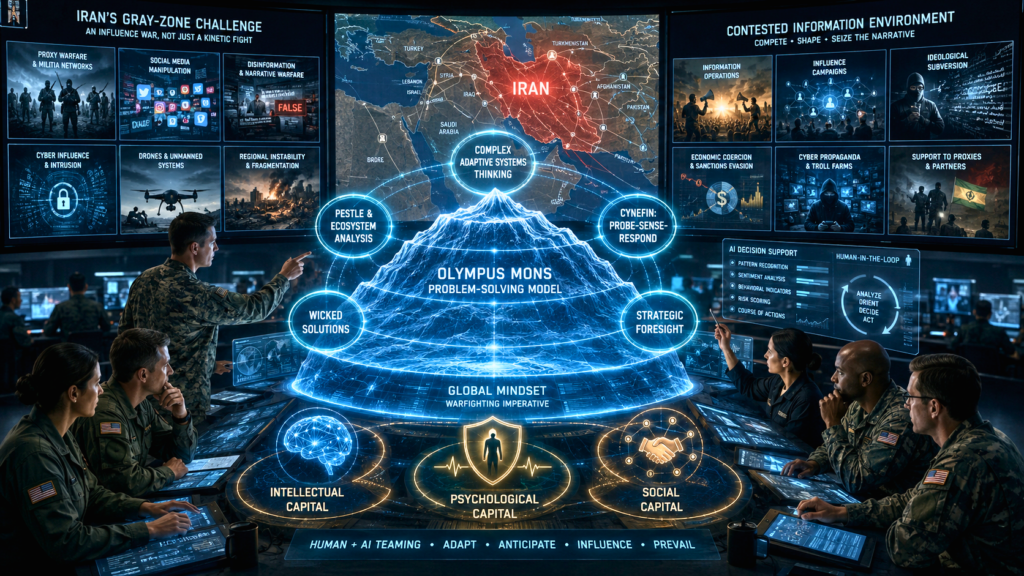
This is where a “Global Mindset,” defined by scholars in “A Whole New Global Mindset for Leadership” as “the capability to influence others unlike yourself,” becomes a warfighting imperative. This mindset is not an abstract virtue, but a tangible capability built on three pillars: (1) Intellectual Capital: The cognitive horsepower to understand the complex web of political, cultural, and social factors in a contested environment. (2) Psychological Capital: The resilience and fortitude to operate effectively in ambiguous, long-term struggles, countering an adversary’s “long game.” (3) Social Capital: The behavioral skill to build trust and show intercultural empathy, allowing for the creation of authentic partnerships and resonant counter-narratives.
Yet, how do you build this mindset at scale? The answer lies in a structured, teachable framework. The Olympus Mons Problem-Solving Model, a methodology developed at The Air University and Defense Information School. It was designed specifically to make the abstract actionable. It provides a repeatable process for planners to solve “wicked problems” in the information domain. Its five core elements are:
(1) Complex Adaptive Systems Thinking: This foundational mindset shifts planners from linear predictable models to seeing the information environment as a dynamic ecosystem. It allows them to anticipate ripple effects and identify high-leverage nodes in an adversary’s network.
(2) PESTLE and Ecosystem Analysis: Using a structured analysis of the Political, Economic, Social, Technological, Legal, and Environmental domains, this step builds the deep situational awareness required to uncover the root grievances an adversary like Iran exploits.
(3) Cynefin Sensemaking Framework: This framework helps leaders correctly categorize the environment. The gray zone is a “Complex” domain, where the only effective approach is to “Probe-Sense-Respond,” in essence to conduct small-scale, reversible actions, see how the system reacts, and adapt accordingly. This neutralizes an adversary’s probing tactics and reduces the risk of miscalculation.
(4) Wicked Solutions for Complex Problems: This approach is the engine for building social capital. It forces planners to see the problem from the diverse perspectives of all stakeholders, enabling the creation of sustainable, locally resonant strategies that can “flip the script” on an adversary’s propaganda.
(5) Strategic Foresight: This element breaks Iran’s “long game” advantage by shifting the U.S. focus from short-term reactions to long-term competition, allowing planners to anticipate future conflict domains and build strategic patience.
Defeating our adversaries in the gray zone is a cognitive, not purely a kinetic, challenge. To achieve the Department of War’s goal of decisive lethality, we must first win the war of ideas. The time has come for U.S. military leaders to stop treating information as a supporting effort and recognize it as the central battlefield in modern competition. This requires a deliberate, sustained investment in the intellectual and cultural readiness of our warfighters. We must integrate cognitive frameworks like the Olympus Mons model into professional military education and operational planning. This is not just about improving human decision-making today; it is about future-proofing our force. The structured, logic-based nature of this model is the most compatible framework for integration with the Information Advantage large language models that will define the next generation of warfare, allowing our warfighters to serve as the critical ‘human-in-the-loop’ for AI-enabled operations in the information environment.
The character of conflict is evolving, but the core of American strength, the ingenuity and adaptability of its warfighters, remains unchanged. The next generation of warfare will not be won by military might and technology alone, but by those who can master the cognitive battlefield of the Operational Information Environment which includes the complex human terrain where influence is wielded and will is broken. Frameworks like the Olympus Mons Problem-Solving Model do not replace the warrior’s ethos; they sharpen it, forging leaders who can out-think, out-maneuver, and out-compete our adversaries in the war of ideas. Seizing this cognitive high ground is the ultimate expression of ‘peace through strength.’ The tools to build this future are within our grasp; what is required now is the vision and the will to forge the victory of tomorrow.
Oshawn Jefferson is a national security professional and strategic communication expert with over two decades of experience in the U.S. military and academic sectors. He is the creator of the Olympus Mons Problem-Solving Model and a leading voice on developing cognitive readiness and a global mindset within the Joint Force. The views of the author are his own.

Oshawn Jefferson
Oshawn Jefferson is a national security professional and strategic communication expert with over two decades of experience in the U.S. military and academic sectors. He is the creator of the Olympus Mons Problem-Solving Model and a leading voice on developing cognitive readiness and a global mindset within the Joint Force.