

Angola: Cotton Revival In Busia – Hope Grows Amid Small Farms, Dry Spells And a Silent Ginnery
The roads leading into the interior of Busia County tell a story of a region that is slowly changing, but perhaps not fast enough.
From Luanda to Bumala and Finyula, the journey is punctuated by dusty roads, boda bodas and stretches where getting to the farms is an exercise in patience. Away from the main roads, infrastructure remains a challenge, with motorcycles often providing the only practical means of reaching some farming areas.
It is here, amid small farms and modest homesteads, that cotton is quietly making a comeback.
But unlike Lamu County, where cotton farmers are taking advantage of the revival of the industry to expand production, farmers in this part of Busia are still growing the crop on very small pieces of land.
Most farmers cultivate no more than two acres, according to Bonventer Barasa, an accountant and manager at Luanda Farmers Cooperative Union.
“Currently, not more than two acres. Very small acreage hence low production despite what our modern ginnery can handle,” Barasa says.
For a crop whose revival is being seen as an opportunity to reconnect farmers to a market that once supported entire communities, the small acreage presents a major challenge.
Without enough cotton coming from farmers, the ginnery cannot operate at full capacity. And without a reliable market and attractive returns, farmers have little incentive to increase production. It is a cycle that the region is still trying to break.
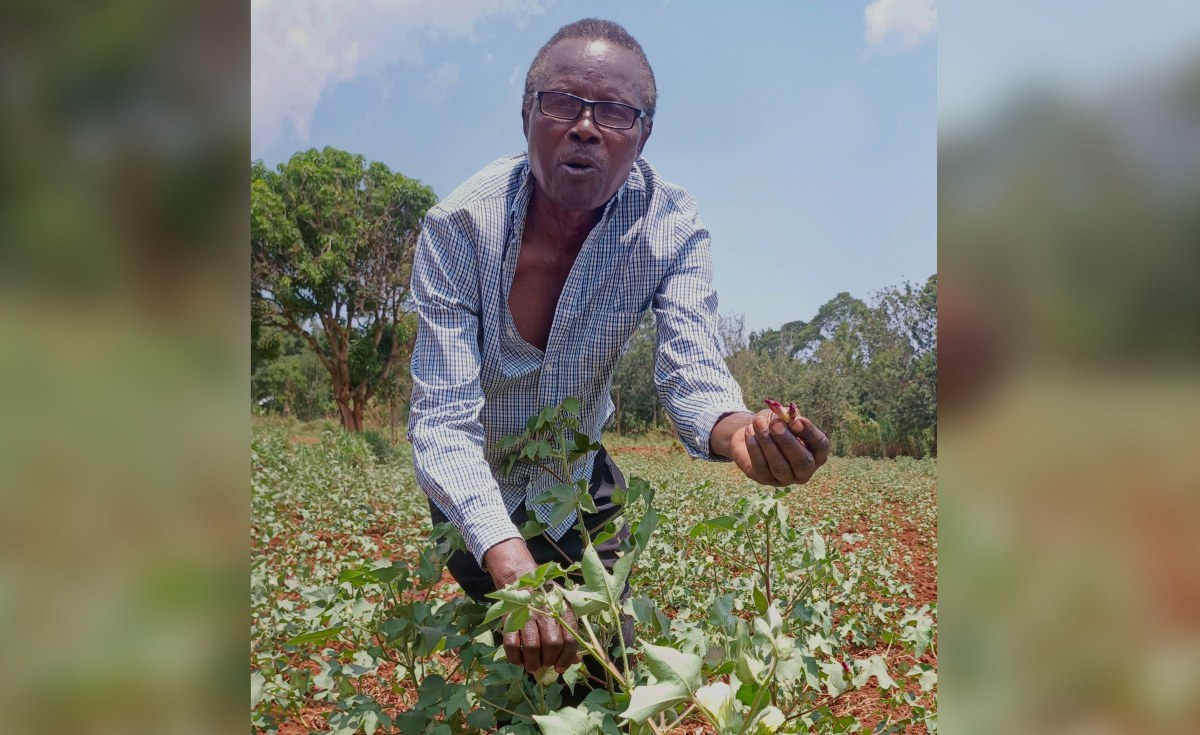
For Vincent Okumu, however, cotton is more than just another crop. The farmer has grown cotton for more than two decades, taking over the enterprise from his parents. What began as a family livelihood became an important investment in his own future. Cotton proceeds helped him pursue his education. Today, he is using the same crop to educate his children. Two of his children have already graduated from university, while another is preparing to enrol.
For Okumu, this is proof that even small-scale cotton farming can change a family’s fortunes when the crop performs well and farmers receive a fair return.
He farms about one and a half acres and expects to make at least Sh100,000 in profit from the current crop.
He also chairs Bwiri Farmers Cooperative Society, where he says the benefits of cotton are becoming visible beyond individual households. Livelihoods in his village, he says, have improved, with the gradual disappearance of thatched-roof houses among families whose incomes have increased. The transformation may not be dramatic, but it is visible. The same crop that helped one generation access education is now helping another pay school fees and improve their homes.
Yet Okumu’s experience also exposes the limitations holding cotton farming back in Busia. He would like to increase his acreage from one and a half acres to five. But expanding production is easier said than done.
One of the biggest challenges is mechanisation. Land preparation is still largely done manually, making cotton production expensive and time-consuming. The county’s available machinery cannot meet the demand from the number of farmers seeking the service.
The problem is particularly important in cotton because timing matters. Okumu says delayed distribution of seed affects production because farmers are working within a narrow planting and growing window.
By the time some farmers receive seed and prepare their land, they may have already lost valuable time.
It is a challenge that echoes concerns raised by the cooperative leadership.
Bernard Ojiambo, chairman of the Luanda Farmers Cooperative Union, says the cooperative has been seeking machinery, including tractors that farmers can hire to prepare their land. Without tractors and other equipment, farmers can fall behind the rains. “When it reaches time for planting farmers can hire, they go and plow to make it earlier plantation. We delay because we don’t have machines like tractors and other things to support farmers,” Ojiambo says.
The consequence is a chain reaction of delays in planting and harvesting. The rains hold the key This year’s crop has also had to contend with insufficient rainfall.
The cotton plants are about two months old, but the season has not been ideal. The dry conditions have affected the crop, with farmers now looking to the rains for a turnaround. During the visit, temperatures climbed to around 30 degrees Celsius. The heat was compounded by dusty roads and the dry conditions in the interior. Yet farmers remain hopeful. Ojiambo says the area’s soils and climate can support cotton when rainfall comes at the right time. “It is the soil itself and the climate, though we don’t have much rain, but once we get it between April and August, the harvest comes out well,” he says.
For farmers like Okumu, a good harvest could provide the incentive to expand.
He praises the cooperative’s buying price of Sh76 per kilogram, saying the price offers farmers a reason to remain in the crop. His own target of at least Sh100,000 in profit from one and a half acres shows why the crop continues to attract interest despite the difficulties.
At Luanda Ginnery, however, there is currently little evidence of the activity associated with harvest. The machines are silent. The last season ended about four months ago, and the ginnery is now waiting for the next crop to mature.
Inside the modern facility, the process is straightforward. Once cotton arrives, it is weighed and stored before being fed into the machinery. A suction system moves it from the store to a bale opener, where compacted cotton is loosened.
The cotton then passes through a pre-cleaner that removes dust and separates poor-quality cotton from the good lint. The good cotton is taken to the ginning machine, where the lint is separated from the seed.
The seed moves through a conveyor while the lint is transferred to a press, where it is compressed and tied into 200-kilogram bales ready for collection. But the ginnery’s ability to operate depends entirely on what farmers bring from their fields. “If they don’t grow cotton, then we don’t have raw materials. That means we won’t move on,” Barasa says. It is a simple relationship: the strength of the ginnery depends on the strength of the farmer.
Cotton has a long history in Busia. Ojiambo says cotton growing in the region dates back decades, when the crop was promoted among local farmers. But the industry eventually declined, with farmers becoming discouraged by delayed payments and poor returns. When cotton lost its appeal, many turned to maize. But maize also requires adequate rainfall, while cotton, Ojiambo argues, remains better suited to the area’s conditions. “Cotton is more of a value than maize,” he says. With maize, the small acreage available to farmers is often used to feed the household. Cotton, on the other hand, is primarily a cash crop. Once harvested and sold, the money can be directed towards school fees, food and other household needs. That distinction is important in an area where many families are still farming on very small plots.
The challenges extend beyond production. Barasa says farmers also struggle with access to chemicals and implements, while limited working capital makes it difficult for both farmers and the ginnery to operate efficiently. The ginnery has also struggled to add value to cotton seed. A machine supplied by the Agricultural and Food Authority to process cotton seed has not performed efficiently, according to Barasa. He says a better-performing machine could allow the facility to produce cottonseed oil, seed cakes and soap. Such value addition would give the crop additional economic importance and potentially create more income from the same harvest.
The ginnery has, however, received a major boost through investment in solar energy. Barasa says the government provided solar panels worth Sh40 million. The move has reduced the facility’s monthly electricity bill from about Sh150,000 to approximately Sh75,000. But the question remains whether there will be enough cotton to keep the machinery busy.
Busia’s cotton revival is therefore a work in progress. The crop has a history here. Farmers know it. Cooperatives understand it. The ginnery has the machinery to process it. What is missing is scale. Farmers are still cultivating small pieces of land. Seed distribution needs to be timely. Mechanisation remains inadequate. Rainfall is unpredictable. And the market needs to offer farmers sufficient confidence to invest more.
For Vincent Okumu, however, the argument for cotton is already settled. The crop paid for his education and is now paying for his children’s education. He believes the same opportunity exists for his neighbours. As chairman of Bwiri Farmers Cooperative Society, he is encouraging other farmers to return to cotton and take advantage of the improving fortunes of the crop. His own ambition is to move from one and a half acres to five. But for that ambition to become reality, the tractors must arrive, seed must reach farmers on time and the market must remain attractive.
For now, the cotton plants are still young. The ginnery remains quiet. The roads remain dusty and difficult. But the clouds are gathering, and with them comes the possibility of a better harvest. In the small farms of Busia, cotton may not yet be the booming commercial enterprise seen elsewhere. But for farmers like Okumu, it has already proved that a small farm can produce something much bigger than cotton—a pathway to education, better homes and a more hopeful future.
Credit: Source link