

ALIO:Baidoa’s democratic moment: Why South West state’s election matters for Somalia’s future
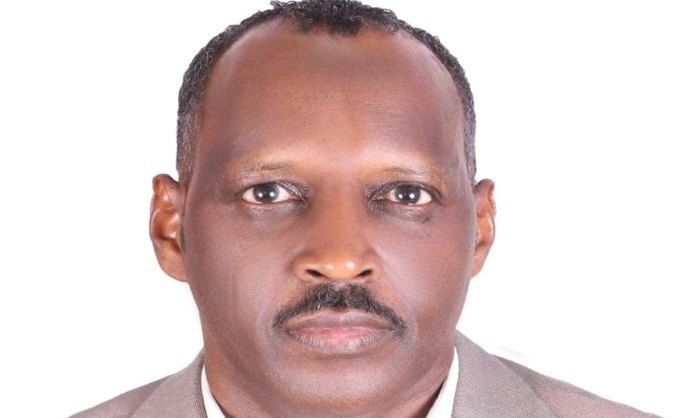
The election of H.E. Adan
Mohamed Noor (Sheikh Adan Madobe) as President of South West State marks a
defining moment not only for the people of Kofur Galbeed but for Somalia as a
whole.
Celebrations witnessed across Somalia following the conclusion of the
presidential election in Baidoa are understandable. They reflect more than
support for an individual leader; they symbolise hope in a democratic process
that many believed was beyond Somalia’s reach.
For the first time since the
collapse of the government of Siad Barre in 1991, Somalia has witnessed a
genuine attempt to move toward universal suffrage through a one-person,
one-vote electoral process. What was once dismissed as politically impossible, insecure,
and premature has now become a reality in Baidoa and across the thirteen
districts of South West State.
The peaceful transfer of power
from interim president and Deputy Prime Minister of Somalia, H.E. Jibril Haji,
to the newly elected President Adan Madobe at the State House in Baidoa
represents an important democratic milestone. Across Africa and the developing
world, the true test of democracy is not merely conducting elections but
ensuring orderly transitions of power. South West State has demonstrated that
such transitions are achievable even in environments previously characterised
by fragility and political uncertainty.
The significance of the June
10, 2026 elections extends far beyond regional politics. They represent the
rebirth of democratic confidence in Somalia and signal the beginning of a
gradual transition away from indirect clan-based electoral arrangements that
have dominated Somali politics for decades. While those systems may have served
as necessary stabilising mechanisms during difficult periods, they often
limited the direct participation of ordinary citizens in determining their
political future.
The National Independent
Electoral and Boundaries Commission deserves recognition for successfully
organising and managing the electoral exercise under challenging conditions.
Conducting elections in Somalia requires far more than administrative competence.
It demands institutional courage, political commitment, public trust, and
effective security coordination. The commission’s performance has demonstrated
that Somali-led democratic processes can succeed when supported by national
ownership and local participation.
Equally deserving of praise
are the people of South West State, particularly the communities of Bay,
Bakool, and Lower Shabelle. At a time when skepticism, political tension, and
security concerns dominated national discussions, they chose participation over
fear and democratic engagement over political paralysis. Their willingness to
embrace universal suffrage has transformed South West State into the testing
ground for Somalia’s democratic future.
The reported voter turnout and
the orderly participation of political organisations demonstrate a growing
public demand for accountable governance and direct representation. For many
Somalis, especially younger generations born after state collapse, the election
provided an opportunity to experience a democratic process that previous
generations often took for granted. Citizens standing patiently to cast ballots
may appear routine elsewhere in the world, but in Somalia, it carries profound
political and historical significance.
The victory of the Justice and
Unity Party (JSP), which secured a parliamentary majority and subsequently
propelled Sheikh Adan Madobe to the presidency, will naturally generate debate
and differing opinions. That is the essence of democracy. Some opposition
groups have expressed concerns regarding aspects of the electoral process and
whether the outcome reflected a level playing field. Such concerns should
neither be ignored nor dismissed. Strong democratic institutions are built
through scrutiny, transparency, accountability, and constructive criticism.
At the same time, criticism
should not overshadow the monumental achievement that has been realised. No
democracy emerges perfect during its first major experiment. Every established
democratic system evolved through multiple electoral cycles, reforms, and
institutional adjustments. What matters most is the establishment of a credible
foundation upon which future improvements can be built.
The election of Sheikh Adan
Madobe also carries symbolic significance. A seasoned statesman, speaker of
Somalia’s Federal Parliament, and one of the prominent figures associated with
the Rahweyn Resistance Army that emerged during Somalia’s state collapse, he
brings extensive political experience to the presidency of South West State.
His election now places considerable responsibility upon his administration to
demonstrate that democratic legitimacy can translate into effective governance,
service delivery, security improvements, and economic development.
Yet the broader story is not
about one politician, one party, or one electoral victory. The larger narrative
is Somalia’s democratic awakening.
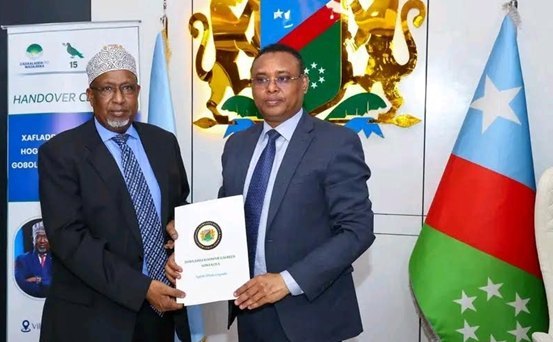 The Newly Elected
President of South West State of Somalia, H.E. Adan Mohamed Noor (Sheikh Adan
Madoobe) (right), receiving exit notes of the immediate former Interim President
of South West State Hon.Jibril Haji at the Baidoa State House of KFG Somalia
today 11/06/2026 (Picture Courtesy of KFG-State House)
For decades, Somalia’s
political discourse has revolved around insecurity, state-building challenges,
clan competition, and constitutional disputes. The events in Baidoa provide a
different conversation. They offer evidence that Somali citizens are prepared
to participate directly in democratic governance when given the opportunity and
institutional framework to do so.
The international community
should take note. The United Nations, the African Union, the World Bank, the
Intergovernmental Authority on Development, and other development partners must
now provide practical support to strengthen this democratic transition. Election
observation missions, technical assistance, civic education programmes,
parliamentary strengthening initiatives, and institutional capacity-building
efforts will be essential in ensuring that the gains achieved in South West
State are consolidated rather than reversed.
Somalia’s democratic progress
cannot succeed in isolation. Sustainable democracy requires investment in
electoral institutions, judicial independence, accountable governance systems,
local government structures, and citizen participation mechanisms. International
partners should view the South West experience as an opportunity to support a
Somali-owned democratic process rather than impose externally driven political
solutions.
Special recognition must also
be accorded to Baidoa itself. Over the past decade, the city has increasingly
emerged as a centre of governance, reconciliation, political dialogue, and
institutional development. The successful conduct of these elections further
strengthens Baidoa’s position as a strategic hub for democratic transition
within Somalia. Expanded investments in infrastructure, governance programmes,
education, and economic development would reinforce the city’s growing
importance.
Most importantly, the
elections have changed perceptions. For too long, Somalia has appeared in
international headlines associated with conflict, terrorism, drought, famine,
and political instability. The images emerging from South West State tell a
different story: citizens peacefully participating in shaping their future
through the ballot box.
That image matters. It sends a
powerful message to Somali youth that democracy is possible. It reassures
regional neighbours that Somalia’s state-building project continues to advance.
It strengthens confidence among investors and development partners. Above all,
it reminds Somalis themselves that national recovery is achievable when
leadership, public participation, and institutional commitment converge around
a common purpose.
The election of President Adan
Madobe will ultimately be judged by what follows. Governance, inclusivity,
reconciliation, and service delivery will determine whether this democratic
breakthrough becomes a lasting success. Nevertheless, regardless of future
political contests, South West State has already secured its place in Somalia’s
modern political history.
Kofur Galbeed has set the
pace. Baidoa has demonstrated what many thought impossible. The challenge now
is for the rest of Somalia to build upon this momentum and continue the journey
toward a democratic future shaped not by fear or division, but by the will of
its citizens.
By Hon.Salah Maalim
Alio-Governance, Peace and Security Management Specialist-Horn of Africa.
Credit: Source link