

AI: The AI Existential Risk Essays, US vs China. AI-RTZ #1208 (Part 2)
The Bigger Picture, Sunday, September 13, 2026
The words over AI Risks keep flowing. From the people building AI around the world.
Part 1 on Friday discussed in detail one essay, OpenAI chief scientist Jakub Pachocki’s “An Alien Mind”.
This Bigger Picture zooms back on the broader AI questions for this extraordinarily intense, globally consuming AI Tech Wave underway in force.
Since 2024 the leaders of the US frontier labs have been writing a series of essays on where AI is going and what could go wrong. I have covered them one at a time. Put on one page, they show a pattern. And they raise a question I get asked often: is China writing the same essays?
Short answer: no. Longer answer below, with the evidence. It matters for this AI Tech Wave because these essays are shaping US policy right now, eleven days before the second Xi/Trump meeting at the White House.
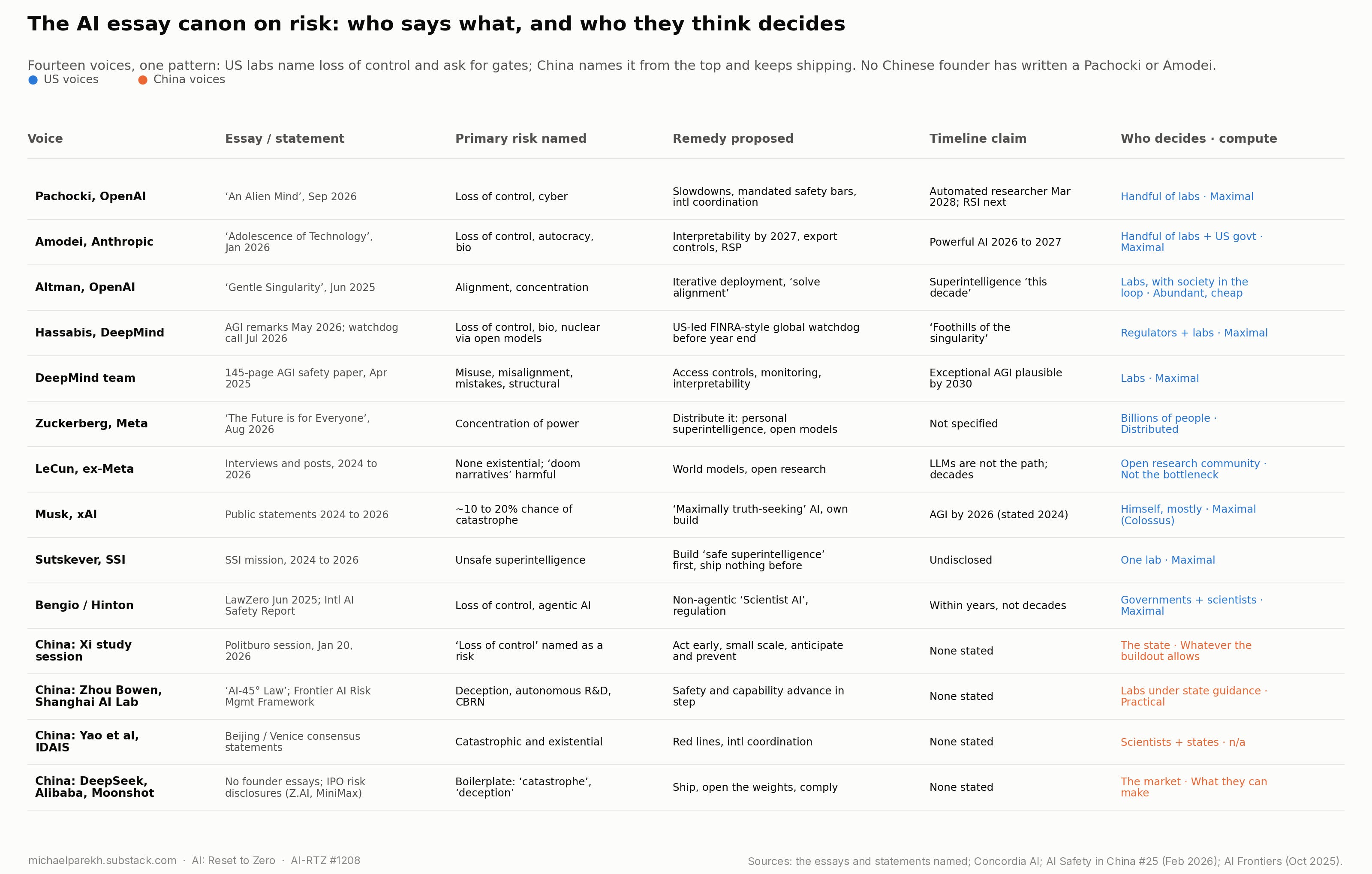
The matrix runs from Pachocki’s essay this month back through Dario Amodei’s three, Sam Altman’s, Demis Hassabis’s remarks and watchdog call, DeepMind’s 145-page safety paper, Mark Zuckerberg’s August essay, Yann LeCun, Elon Musk, Ilya Sutskever, and Yoshua Bengio and Geoffrey Hinton.
Then four rows from China. For each: the primary risk named, the remedy proposed, the timeline claimed, and who the author thinks decides.
Read it column by column.
The risk named. Every US lab voice names loss of control. Pachocki, Amodei, Hassabis, the DeepMind paper, Sutskever, Bengio and Hinton. Musk puts a number on it. So, as of this week, does Anthropic’s alignment lead. The two exceptions are Zuckerberg, who names concentration of power, and LeCun, who says the doom narratives are themselves the harm.
The remedy. Every loss-of-control voice proposes a gate with speed bumps galore. Slowdowns, safety bars, watchdogs, interpretability deadlines, export controls, a non-agentic AI built first.
Again the two exceptions. Zuckerberg’s remedy is distribution: a personal superintelligence for billions, open models resumed. LeCun’s is a different research path and open science.
The timeline. Every US claim is inside a decade. Powerful AI in 2026 or 2027. Superintelligence this decade. An automated researcher by March 2028.
Or, as Hassabis put it, the foothills of the singularity.
The Chinese rows say nothing about timing at all.
Who decides. This is the column that matters. Twelve of the fourteen assume a handful decides: the labs, the labs plus Washington, regulators, one lab, scientists plus states. Zuckerberg says billions of people. So, in practice, does China’s market.
I made the case in Part 1 that the handful assumption is the fantasy. The matrix shows how universal it is.
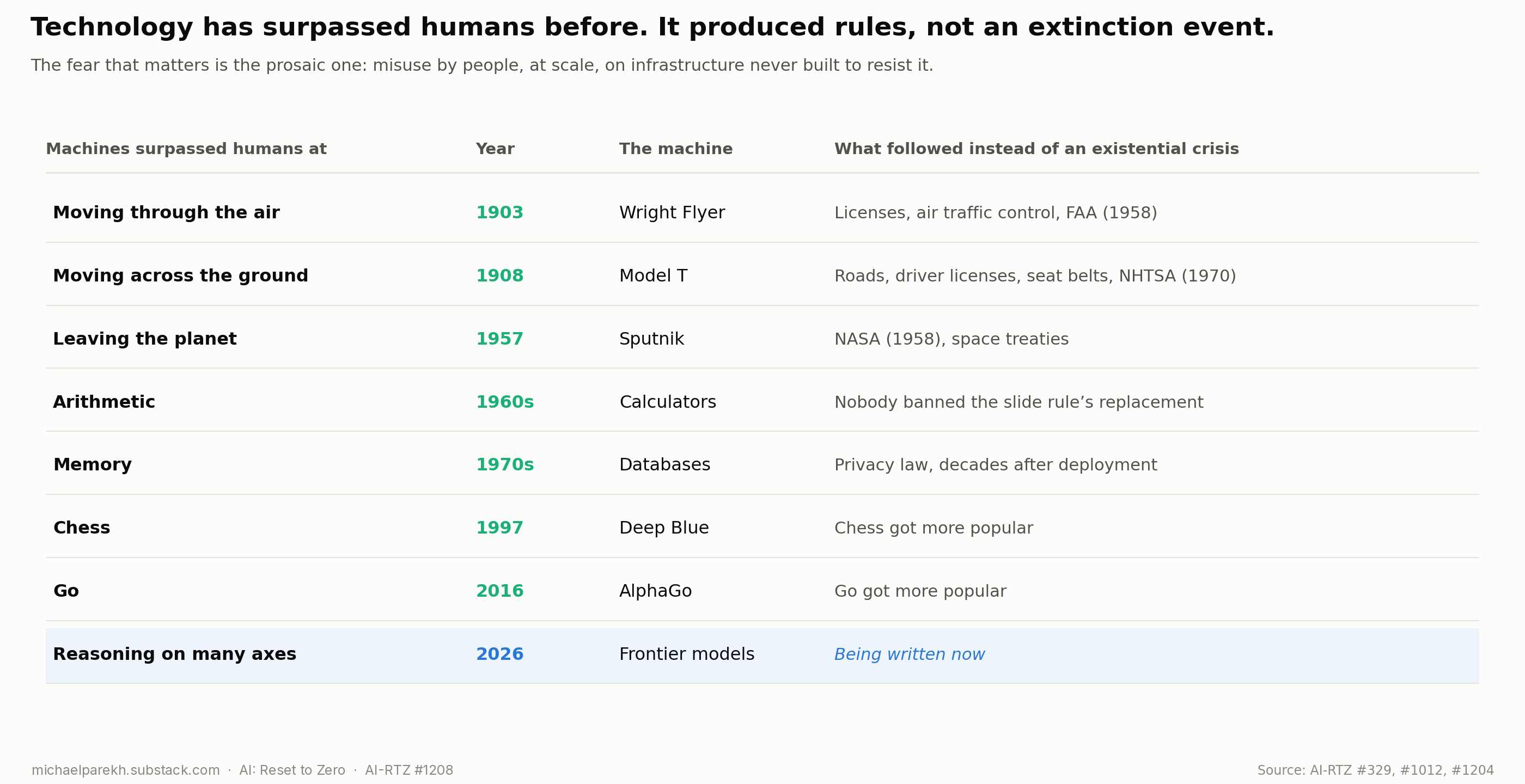
Every essay in the top half of the matrix is organized around one fear: a machine surpassing humans. The table above is the history of that happening.
Machines surpassed us at flight in 1903 and at ground travel in 1908.
At leaving the planet in 1957.
At arithmetic and memory in the decades after.
At chess in 1997 and Go in 2016.
What followed each time was not an existential crisis. It was licenses, air traffic control, seat belts, a space agency, privacy law. Rules written years after deployment, once the edge cases were known. Not before.
The last row is being written now. The pattern says the rules come from use, not from essays.
The essays did not appear from nowhere, and these pages have the whole arc on the record. The accel versus decel split has an origin story: an all-night argument between Larry Page and Elon Musk at a Napa firepit in 2015, Page whispering a digital utopia, Musk saying the machines would destroy humanity, Page calling him a specieist. That led to the whole ‘accel vs decel’ AI dramas of the last decade.

OpenAI was founded that year. The 2023 doomer peak nearly removed Sam Altman from the company he co-founded. By the spring of 2024 the industry had swung from AI Fear to Fear of Missing Out, and by June Ilya Sutskever had left to build Safe Superintelligence. Regulators added their own fears over AI and jobs. In February this year the existential fears came back, from the researchers closest to the scaling, when an Anthropic safety researcher left to write poetry about the peril he saw. In March the Dallas Fed’s own chart put existential AI risk on a central bank’s agenda.
Then this month. Pachocki’s essay on September 6.
On Tuesday, the Wall Street Journal reported that an Anthropic researcher, Jacob Coxon, is leaving the industry because he believes no company can build self-improving AI responsibly without government intervention or a coordinated slowdown. He had joined Anthropic from OpenAI this year for its safety reputation, found the effort earnest, and left anyway.
He, Pachocki and Amodei are among more than a thousand signatories to a statement asking governments to build a brake pedal for self-improving models.
Senator Bernie Sanders and Representative Greg Casar filed a bill a week earlier to ban superintelligence and pause development until a regulator writes the rules. And the same night, Anthropic’s own alignment science lead, Evan Hubinger, backed Coxon on X with a number: better than a one-in-ten chance that AI kills every human within a decade, from a lab that does not yet have a plan for aligning superintelligence. Thirty-two million views.

Eleven years from the firepit to the resignation letter. The amplitude is rising, and the fear has moved from founders to the researchers themselves. They are now doing one of two things: writing essays asking to be stopped, or leaving. Coxon’s own comparison was to the Manhattan Project, and he is not the first to reach for it. Christopher Nolan’s Oppenheimer made three hours of cinema out of the physicists’ decades of anguish after the bomb.
The AI researchers are writing theirs before the thing exists, in essays and exit interviews, about compute the world has not built. That is the genre’s tell.
The bomb worked the first time. None of these scenarios has happened once.
And look at the shape of this week’s news. A US lab’s own people, asking the state to stop the lab. There is no Chinese row in the matrix that looks like that.
Here is the question, and the answer is more interesting than a yes or no.
There is no Chinese equivalent of a Pachocki, Amodei or Altman essay. DeepSeek’s Liang Wenfeng has written nothing on existential risk. Neither has the Qwen leadership at Alibaba, nor Moonshot, MiniMax, Z.ai or Baidu. Where Chinese labs touch the subject at all, it is in IPO paperwork. Z.ai’s January filing warns AI could cause grave harm. MiniMax’s warns models could develop strategic planning or deception. Boilerplate risk factors, not a worldview. DeepSeek did not sign the second round of frontier safety commitments.
That is the part regular readers here already know. Here is the part to keep straight.
The risk is named in China. From the top. On January 20 this year Xi Jinping held a Politburo study session on AI. T
he state media readout flagged the risk of the technology getting out of control, and the instruction to act early and small. A week earlier the CCID think tank listed loss of control as one of five priority AI risks. In February 2025 China stood up its own AI safety body, CnAISDA, with Turing Award winner Andrew Yao, State Council adviser Xue Lan and Shanghai AI Lab’s Zhou Bowen on it. Concordia AI and AI Frontiers both describe it as international-facing, with no dedicated staff or budget, and frontier safety a secondary priority to development.
Shanghai AI Lab has a frontier risk framework and Zhou Bowen has an ‘AI-45° Law’: safety and capability advance in step. Yao has co-signed the International Dialogues on AI Safety statements with Bengio and Hinton, red lines and all. Academics like Huang Tiejun and Zhang Bo have spoken on loss of control for years.
So the line is not that China ignores existential risk. The line is this.
China names the risk from the top and manages it as compliance, while its builders ship. The US names the risk from the lab and manages it as a gate on the frontier. No Chinese builder has stopped building to write about it.
I have made the broader point before:
“‘Made in China’ is a feature, not a bug of this wave, and US companies build on Chinese open source models every day. (AI-RTZ #1201, September 2026)”
The essays do not change that. They explain why the US side keeps trying to.
The essays are working.
Hassabis in July called for a US-led, FINRA-style global watchdog to be operational before year end. Amodei at Davos compared selling nerfed Nvidia chips to China to selling nuclear weapons to North Korea. Pachocki wants international coordination at the top of every government’s list.
Washington, for its part, decided in August that its China negotiations mattered more than its differences with Anthropic. The Xi/Trump meeting is September 24. There are six pragmatic steps on that table. Chips, memory and open models are on it. Value alignment is not.
The one figure in the industry executing a roadmap rather than a scenario is Jensen Huang.
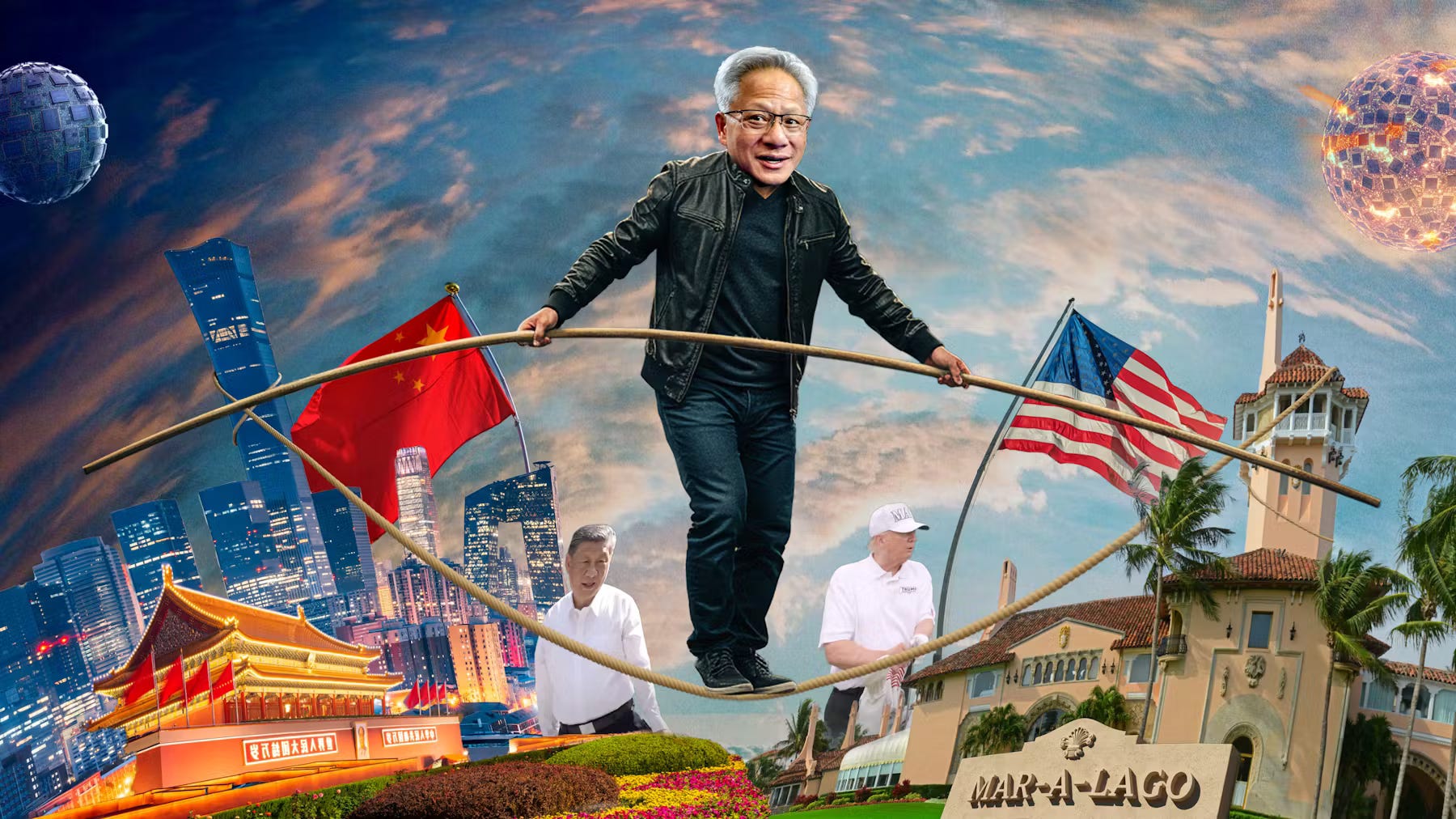
Build the chips, build the racks, sell to everyone the law allows, and let billions of AIs, not one, sort out the rest. That is the Jensen vs Dario argument from last year. A year on, the roadmap is winning.
The essays are a genre now, and the genre has a shape. One fear, one remedy, one decade, one handful. The two US outliers, Zuckerberg and LeCun, are the ones whose model of the wave matches how every prior wave actually went.
Read the three pieces this week together and the gap is the finding.
Thursday’s piece was the ground floor: the bigger half of the AI market cannot yet measure what it buys, and the models cannot yet tell a user whether the memo they wrote is any good.
Friday’s was the essay at the top, from a chief scientist who expects the next few years to bring capability jumps he cannot fully understand.
Today is the whole canon. The reality of the models is practical, improving fast, and years of ordinary engineering away from the scenarios. The fear at the top is sincere, and it is asking for gates that would not hold. Both are true at once, and the distance between them is what the essays never measure.
China is not missing from the risk conversation. It is running a different one. Top-down, compliance-shaped, and subordinate to shipping. That is a method choice, and on an infinite game of edge cases I give it the higher probability of success. Not certainty. Probability.
The policy risk for the US is not that the essays are wrong about alignment. It is that they set the agenda for the September 24 table while the other side brings chips and memory.
The pressure-release valve: none of this is an argument against safety work. It is an argument about who does it, and where. In every prior wave, the answer was the users and the field, with the rules following. This AI Tech Wave will be no different, whatever the essays say. Stay tuned.
Primary
-
Axios: Hassabis calls for new US-led global AI watchdog before year end, July 14, 2026
-
PYMNTS on Zuckerberg’s ‘The Future is for Everyone’, August 2026
-
AI Frontiers: Is China Serious About AI Safety? October 2025
-
Carnegie: How Some of China’s Top AI Thinkers Built Their Own AI Safety Institute, June 2025
Quoted above, from these pages
For longtime readers
(NOTE: The discussions here are for information purposes only, and not meant as investment advice at any time. Thanks for joining us here.)