
AfCFTA urges South Sudan to fast-track trade agreement ratification
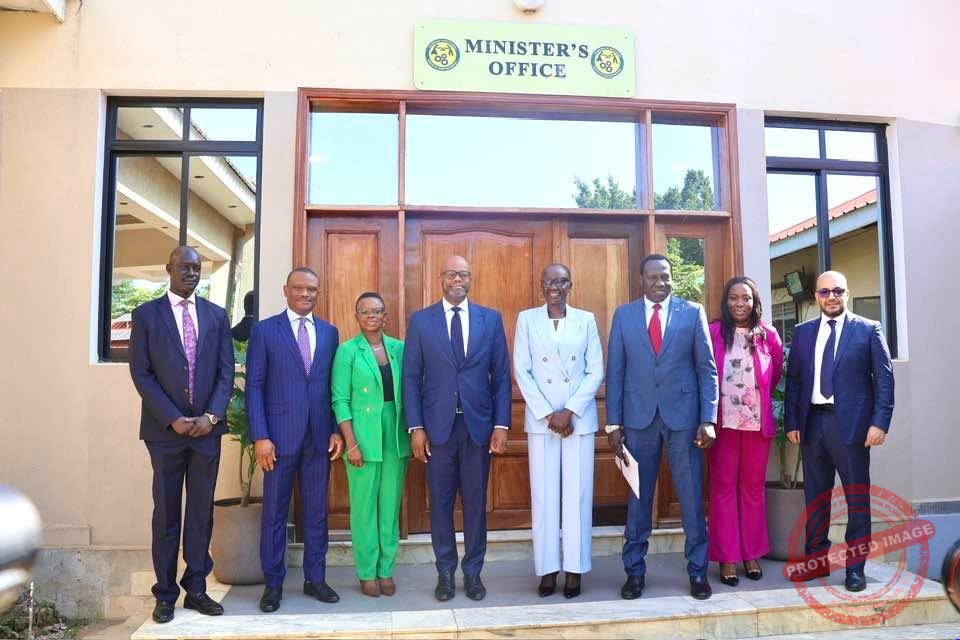

AfCFTA Secretary-General Wamkele Mene and his delegation with Trade Minister Margaret Labanya Mathya in Juba. Photo: Ministry of Trade and Industry.
The African Continental Free Trade Area (AfCFTA) Secretariat has urged South Sudan to accelerate ratification of the AfCFTA Agreement, saying the move would open the country’s businesses to a continental market of more than 50 African countries and create new opportunities for trade, investment, and industrialization.
Speaking at a press conference in Juba on Thursday after a one-day visit by AfCFTA Secretary-General Wamkele Mene, the Director of Private Sector Engagement and Communications, Cynthia Gnassingbé-Essonam, said South Sudan has shown strong political commitment to the continental trade agenda but now needs to complete the ratification process.
She said the Secretary-General’s visit was aimed at engaging the government and private sector on the implementation of the agreement and encouraging the country to take the next legal step toward full participation.
“The objective of this visit was really to engage the Government of South Sudan on the implementation of the AfCFTA and encourage the country to ratify the agreement so that its businesses can fully benefit from the continental market,” Gnassingbé-Essonam said.
The AfCFTA, adopted by African Union member states in 2018, seeks to establish a single African market by removing tariff and non-tariff barriers, promoting industrialization, and boosting trade among African countries.
According to Gnassingbé-Essonam, 50 African countries have now ratified the agreement, while only Eritrea has yet to sign it.
She said Africa still trades more with the rest of the world than within the continent, a trend the AfCFTA aims to reverse by doubling intra-African trade by 2035.
“In the current global context, where supply chains are being disrupted and protectionism is increasing, Africa must strengthen its internal markets and create value within the continent instead of exporting raw materials,” she said.
During the visit, the AfCFTA delegation met with Minister of Trade and Industry Margaret Labanya Mathya, senior government officials, and representatives of South Sudan’s private sector, including the Chamber of Commerce, manufacturers, exporters, and women entrepreneurs.
Gnassingbé-Essonam described the discussions as productive and said the Ministry of Trade and Industry had demonstrated a sense of urgency to complete the ratification process.
“I wouldn’t say there has been a delay because every country has its own internal process. What we have seen is a strong commitment by the Ministry of Trade and Industry to accelerate ratification in the coming months, and the AfCFTA Secretariat stands ready to support that process,” she said.
She explained that once South Sudan ratifies the agreement, customs authorities will begin incorporating AfCFTA tariff schedules into the country’s customs system, allowing exporters and importers to trade under preferential continental tariffs.
The AfCFTA official said South Sudan has significant export potential, particularly in agriculture and natural products, that could find markets across Africa once the legal framework is completed.
“We have seen that South Sudan has products that are in demand across the continent. Once ratification is completed and businesses are supported on standards, packaging and certification, South Sudanese products will be able to access new markets,” she said.
Gnassingbé-Essonam said the private sector is at the centre of the continental trade agreement, describing businesses as the main drivers of trade and economic growth.
“The AfCFTA is for the private sector. They are the ones who trade. They are the ones who invest. Our responsibility is to ensure they understand the opportunities available and have the tools to participate effectively.”
She said the Secretariat has developed several digital tools to support trade, including an electronic tariff book, a non-tariff barrier reporting platform, a rule of origin manual, and the Pan-African Payment and Settlement System to simplify cross-border transactions.
Addressing concerns about the impact of reduced import tariffs on government revenue, Gnassingbé-Essonam acknowledged that some countries may initially experience revenue losses but said mechanisms have already been put in place to support the transition.
She pointed to the AfCFTA Adjustment Fund, which supports member states in strengthening customs administration, improving productive capacity, and helping businesses adapt to the new trading environment.
“Yes, there may be short-term revenue losses, but the adjustment mechanisms are there. In the long term, countries stand to gain through increased production, exports and industrial growth,” she explained.
She also highlighted infrastructure as one of the biggest challenges to expanding trade across Africa, saying investment in roads, railways, ports, energy, and logistics will be essential if the continent is to realize the full benefits of free trade.
While noting that the AfCFTA Secretariat does not directly finance infrastructure projects, she said it works with governments and development finance institutions to mobilize investment in strategic transport corridors and trade-related infrastructure.
Gnassingbé-Essonam encouraged South Sudanese entrepreneurs to think beyond the domestic market and build businesses that can serve customers across Africa.
“Don’t think only nationally, think continentally,” she said. “When you start a business today, ask yourself which African markets your products can reach. Use technology, build partnerships, participate in trade fairs and prepare your products to meet continental standards.”
She added that South Sudan’s Gum Arabic industry, fisheries, and agricultural value chains present significant opportunities for growth under the AfCFTA once the country completes ratification.
The AfCFTA Secretariat said it will continue working with the Government of South Sudan and the private sector to support the country’s integration into Africa’s single market and help local businesses benefit from growing trade opportunities across the continent.
Court allows Machar, co-accused to continue oral defence