

“A Rare Piece Of Brazilian Video Game History” – How Capcom’s Sega-Powered ‘Slip Stream’ Almost Starred Ayrton Senna
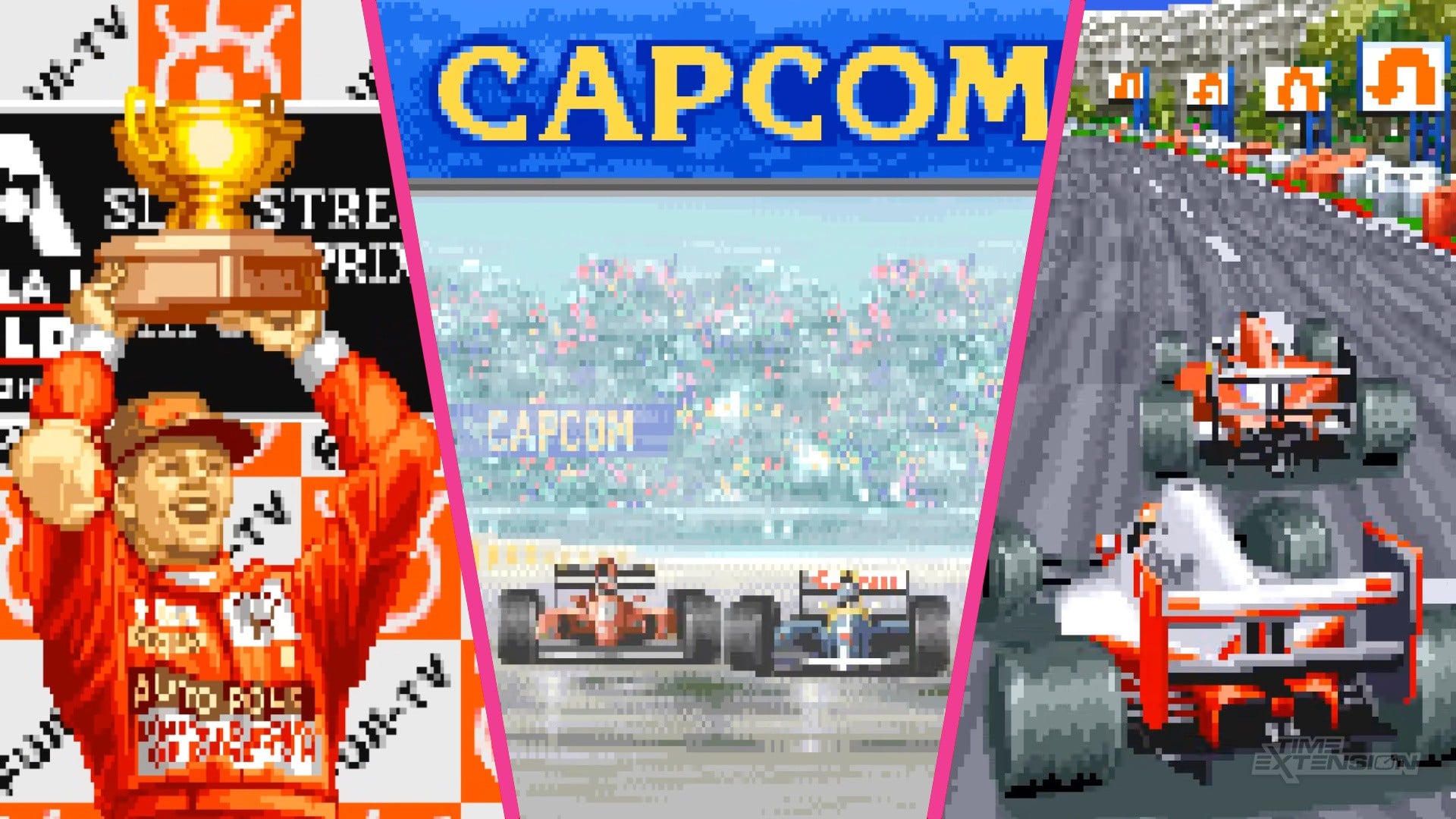
As someone who covers retro games for a living, I find myself constantly on the lookout for lesser-known titles with fascinating stories to delve into. And Slip Stream definitely fits that bill.
Developed by Capcom in Japan as the only third-party game for Sega’s System 32 hardware, it is a Super-Scaler F1-style arcade racing game believed to have been released only in Brazil (and potentially, other Hispanic countries) at a time when 3D games like Ridge Racer and Daytona USA were already on the market.
Also, to make matters just a little more interesting, only a limited number of PCBs were ever produced, with arcade enthusiasts online often touting that this number was likely as low as 150. Because of this, there are likely many people out there, some of whom may consider themselves Capcom superfans, who have never heard of the game or had the chance to play on a proper machine.
I first heard about Slip Stream when I first came across footage of the game being played online a couple of years ago, but didn’t begin looking into the arcade oddity until earlier this year.
Having completed an article on Nintendo in Brazil, I was eager to find more stories to deepen my understanding of the country’s gaming past, which is when I remembered the YouTube video I had seen.
Immediately inspired, I drew up a plan to reach out to Yoshiki Okamoto, the producer of the game (whom I’ve interviewed in the past about his time at Konami) and contacted Pablo Miyazawa, my source for the Nintendo article, to see if he may have any potential leads he’d be willing to share.
Sadly, Okamoto-san had to politely decline being involved, reluctant to chat without Capcom’s approval (which I was unfortunately unable to get in time for publication), though he did seem genuinely pleased to see the game hadn’t forgotten, describing it as a time in his career he feels particularly “nostalgic” for.
As for Miyazawa, he was yet again an indispensable source of information, connecting me with Fabio Santana, a former EGM Brasil editor and ex-Capcom LATAM public relations manager who owned a few copies of the arcade board and had previously done extensive research on the game.
“When the game was released, I did not have first-hand experience with the game at the time, and my long 10-year stint at Capcom did not give me any particular insight into the making of this particular game,” said Santana, when I originally reached out to him. “But I can help with the extensive research I have done on the subject (there were articles that mentioned or detailed the game at the time in Brazilian video game magazines, and there’s also an interesting official Japanese source published online a while ago that I could point you to). I’m also a collector and own a few copies of this board, so I can provide pictures as needed”
Santana had a treasure trove of photos, magazine clippings, & videos, which helped get my research off to a good start, drawing my attention first to an article in Acao Games from October 1995. This revealed Slip Stream as one of the Capcom games shown off at Salex (South America Leisure Exhibition), an arcade event held in August 1995 in São Paulo, Brazil, where Capcom had the largest stand at the fair (600 m²), with 90 arcade machines and actors on the expo floor portraying characters from Street Fighter.
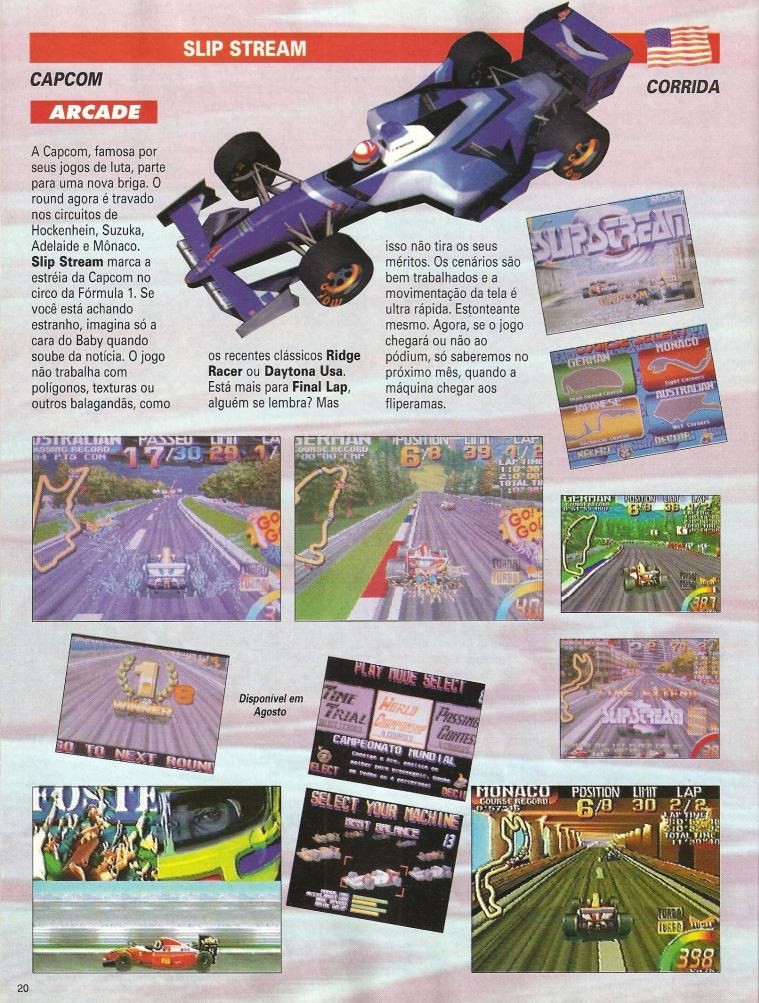
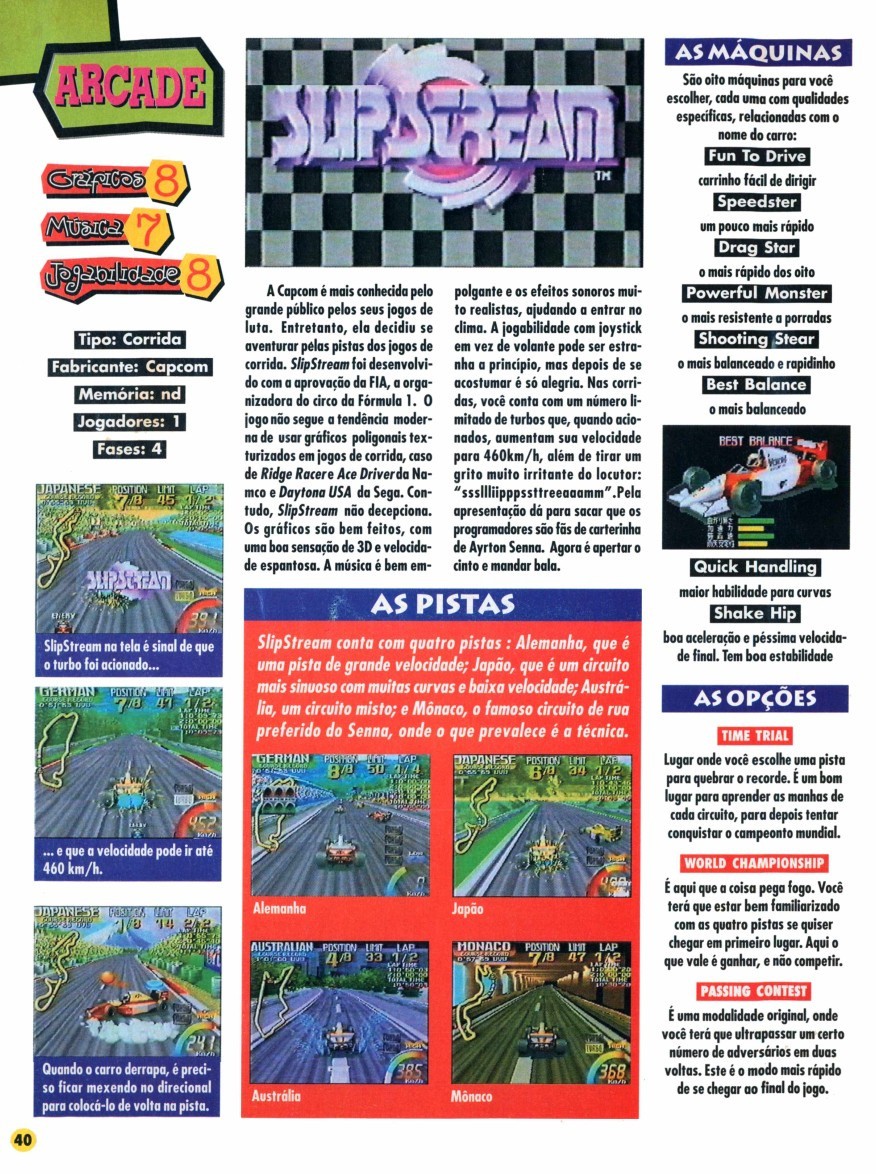
At the event, Slip Stream was one of the new cabinets on display alongside games such as Cyberbots and Street Fighter Zero. It was described by Acao Games at the time as “a racing game set in the 1993 F1 season, which was partly developed by Sega,” and was also previewed in other Brazilian magazines of the time, such as SuperGamePower, which included it in Issue 17 (published August 1995).
In this preview, the magazine expressed its shock that the developer, known for fighting games, was entering the Formula 1 “circus” and noted its lack of “polygons” and “other bells and whistles” compared to other contemporary games like Ridge Racer and Daytona USA, likening it instead to Namco’s Final Lap. It ultimately suggested, however, that this didn’t matter all that much, calling the scenery “well-crafted” and praising the on-screen action as “lightning fast.”
Strangely, looking at the reception to the game, all signs seemed to point to the game being well regarded by journalists when it was released, which makes it slightly more confusing why it has still never seen a release anywhere else in the world. Evidence on the Cutting Room Floor suggests that Capcom at one point intended to release it in the US and Japan. But this never came to be, for unknown reasons.
Perhaps Capcom simply felt people outside of Brazil would be less forgiving of its 2D graphics, which have, ironically, aged extremely well in the decades since. Or perhaps the fact that it was even released at all was spectacular in itself. A reference on an old Capcom website, for instance, stated that development of the game was at one point stopped, but it was later revived after the company was asked to do so.
Inevitably, I wanted to know more about this strange game. So, Santana introduced me to Cleber Marques, another proud owner of a Slip Stream machine and the author of a book on Street Fighter, who had previously written a chapter on the game.
“I first heard about Slip Stream back in the ’90s,” said Marques, “In a Brazilian video game magazine from that time, but I never actually got to see this arcade cabinet to play it anywhere. I only heard about it again when I met Silvio Puertas and interviewed him to explain this story for a book I was going to release through WarpZone. Then, in 2018, I found one of these cabinets at an arcade centre in the Brazilian countryside. I didn’t think twice, I bought it, and it’s still with me today, in my store, Mundo WarpZone. I even took the Slip Stream cabinet to my event, RETROCON, in one of its editions, but I don’t do that anymore.
“When I learned about it, I thought the story was really curious, and Silvio told me a lot of interesting details. It’s a rare piece in the history of video games in Brazil. It’s a shame it had such a small distribution. Capcom could really include it in a collection for modern consoles. It would be great to be able to officially play Slip Stream on a Nintendo Switch, for example.”
The Silvio Puertas that Marques mentions above is the former marketing & licensing coordinator for Romstar do Brazil, a subsidiary of Romstar Inc. (headquartered in San Jose, CA) and Capcom’s official representative in Brazil. He was on a list of people Santana recommended I reach out to, as someone directly responsible for introducing Slip Stream to the Brazilian market; if anyone had answers, it would be him.
Unfortunately, though, my attempts to reach out to him independently were unsuccessful. This is where Marques thankfully stepped up to help, offering to act as an intermediary between Puertas and me, and relaying my questions in hopes of getting some of the answers I was after. With this act of kindness, it didn’t take long to hear back from Puertas with some more fascinating info, starting with a little more insight into how Romstar operated in the region.
“When it began operations in 1993, the only business model in place was a shared-operation model,” said Puertas, “in which the company (Romstar) owned the machines and leased them to operators, who in turn placed them at various locations (arcades, bars, etc.). Revenue from the games was then split between Romstar, the operator, and the establishment where the machines were installed. Subsequently, Romstar began offering PCB leasing and direct sales options.
When asked about why Capcom opted to use Sega hardware, he, unfortunately, told me he couldn’t remember the precise “strategic considerations” that went into this decision, but did offer up one potential theory — a joint venture between Romstar do Brazil and Sega’s representative in the region, Tec Toy, which never came to pass.
“The two companies [went as] far as to outline a joint venture to open and operate a chain of arcades,” said Puertas. “This game would be one of the titles installed in these arcades, along with others that didn’t necessarily use Capcom software. The franchise chain would be called Sega Arcade. In Brazil, work began on establishing the first location at the Beto Carreiro World theme park, in partnership with Tec-Toy, Sega’s representative in Brazil. I don’t know what strategic reasons led to the partner’s withdrawal, but the project eventually became Planet Arcade and was later revamped again, becoming a sports-themed arcade chain called Sports Arcade.”

Having previously spoken to Stefano Arnhold, the former Tec Toy CEO, I ran this by him, and he confirmed that Tec Toy “once discussed with Romstar about the possibility of opening Arcade Shops in Brazil,” but sadly told me, “I do not remember many details.” As a result, it was clear Puertas was still my best chance at getting to the bottom of this Slip Stream’s many mysteries.
Curious, I asked Puertas if there were any concerns about releasing a 2D racer into the market, at a time when Ridge Racer and Daytona USA were already well-established, and he told me, “Not that we at Romstar do Brasil were aware of it. This game was a more economically viable option than the more sophisticated 3D games and simulators emerging at the time.
“In other words, it targeted a different market. When it comes to the Brazilian market—which I have some specific knowledge of—the limitations were, in fact, logistical (transportation and space), since the cabinet took up more space at the arcade and in transport vehicles. This is one of the reasons why pinball machines gradually lost ground in smaller arcades.”
In fact, he stated that the cabinet’s large size is the reason so few machines were ultimately made, noting, “production was made-to-order, and the machine used a cabinet that wasn’t easily adaptable to most popular arcades.” Because of this, some of the only confirmed locations where the game was distributed include Romstars’ own Sports Arcade, which had fewer than 10 locations in the country, according to another Romstar source, Mitikazu Lisboa.
Asked why Puertas believes the game stopped development, only to be picked up later, he theorised that this likely had to do with “trademark licensing issues,” stating, “When it comes to F1, licensing costs are extremely high, and there are several teams with demands that are sometimes quite specific, which makes negotiations difficult.”
This definitely sounds plausible, as the finished game is actually unlicensed, but there’s clear evidence to suggest it was at one point intended to be F1-approved, with the game featuring recreations of the 1993 Benetton, McLaren, Ferrari and Williams cars, as well as four tracks based on Hockenheim, Suzuka, Adelaide, and Monaco, courses included in the 1993 racing season.
Perhaps, following Tec Toy’s withdrawal from the “Sega Arcade” deal and the difficulties in negotiating with the licensor, Capcom in Japan simply felt it wasn’t worth continuing the project, deciding to revive it only once Romstar’s own arcades were up and running, and with a reduced scope (The Cutting Room Floor has also found evidence of additional Belgian and USA tracks).
These are all theories I hope to run past Okamoto-san at a later date (if you’re a Capcom PR manager who can help with that, please get in touch), but for now, they seem to be our best explanations for why the title ended up becoming such a strange oddity in Capcom’s arcade back catalogue.
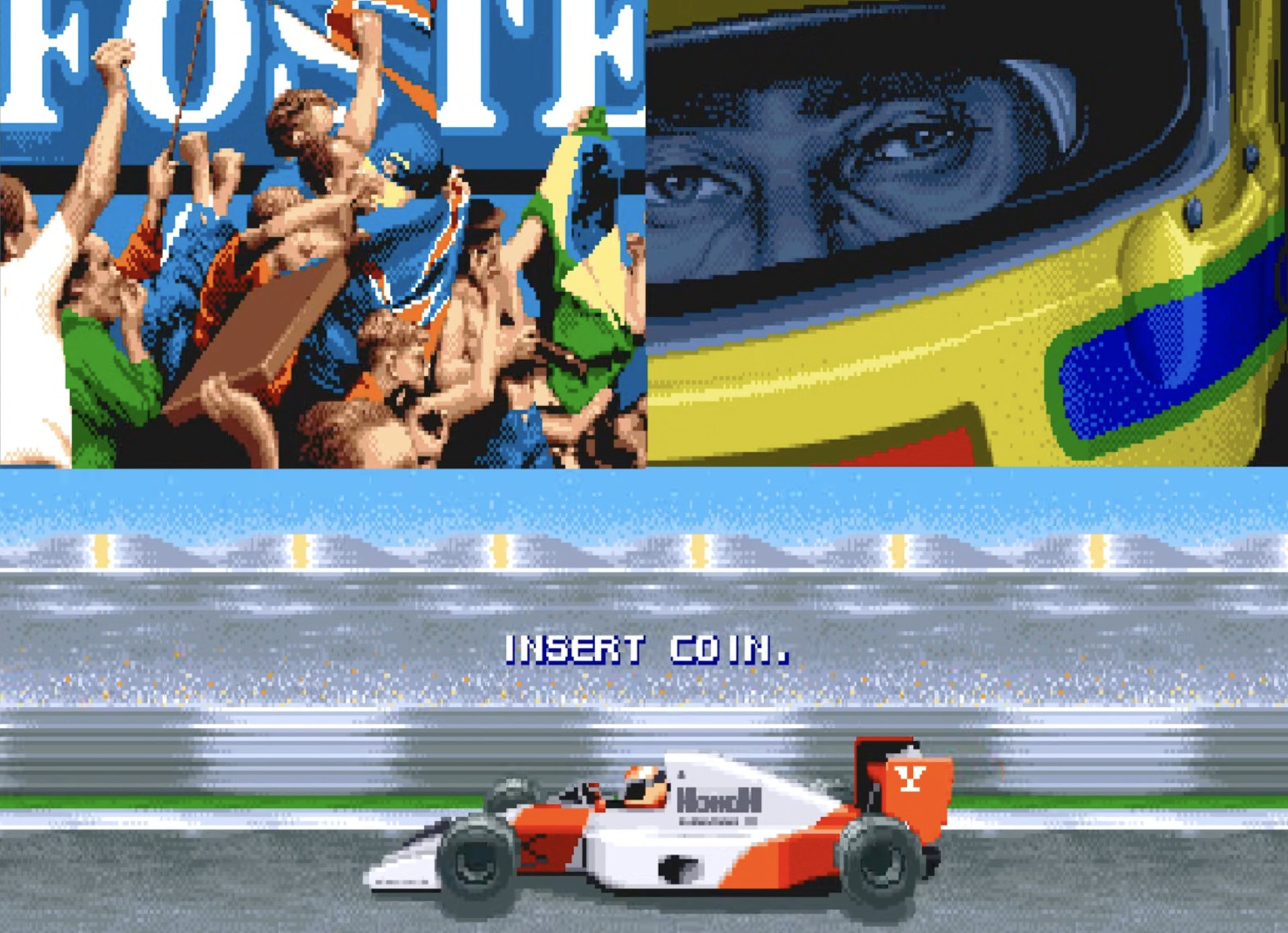
Remarkably, though, as Puertas told me, this wasn’t the only missed opportunity when it came to licensing on the project, with the team actually reaching out to Senna Brands to include a Senna voice clip to be played over a demo of the game.
“Yes, there were negotiations with the then-Senna Licensing (now Senna Brands) to include an audio clip of Ayrton Senna narrating a lap around the Interlagos circuit,” said Puertas. “The highlight of which was when he said, “Now we’re entering the turn… Whose turn? Senna’s!” This narration had been recorded for a sports program a few years earlier. It was to be shown as a “demo” for the machine.
“It was an option initially intended for Brazil and perhaps Japan, where he had many fans. But in fact, those negotiations took place after his death. I don’t recall, nor do I know, all the details of the negotiations (because they were handled by Capcom, not Romstar), but I can say in short that the project wasn’t viable for financial reasons. It’s worth noting that in addition to the negotiations with Senna Licensing, the audio would also have had to be negotiated with TV Globo, which held the rights to the recording.”
Senna obviously has a history with video games, being the star of Sega’s Ayrton Senna’s Super Monaco GP II, and later lifting the Sonic trophy at the Sega-sponsored 1993 Formula One European Grand Prix, at Donington. It’s interesting to think, though, that Capcom was considering including him in another game little more than a year after his death.
Satisfied I’d learned pretty much all I could about Slip Stream (at least for the time being), I decided to end my research there, on that discovery. But, much like the developers did with the original arcade machine that inspired this piece, I may return to this subject at a later date, hopefully with more concrete information about the game.
If you want to try out the game for yourself, sadly, as Marques mentions, it has never been rereleased (c’mon Hamster, what are you playing at!), but it is playable via MAME, ensuring it isn’t completely lost to the ages, despite its incredible rarity.