

Baltimore-area Colombians pray, mobilize aid after deadly earthquake
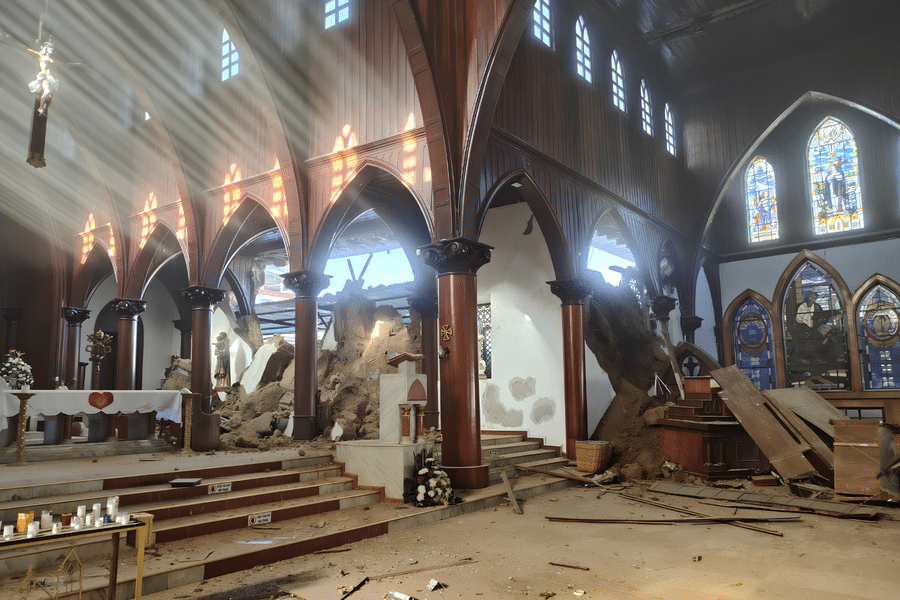
When Julia Lopera heard that a major earthquake had struck Colombia, she knew her family could be in danger. One of her sisters lives and studies in Pereira, one of the cities hardest hit, while one of her brothers, a Claretian priest, serves as principal of a Hogares Claret school in Cali.
“Their school collapsed,” said the parishioner of St. Francis of Assisi in Baltimore, expressing gratitude that her brother is safe amid the tragedy, during which he continues to work with and for his community.
Lopera’s fears were shared by many Colombians living in the Baltimore area after a 7.4-magnitude earthquake struck Colombia Aug. 10 at 7:34 a.m. The quake, centered near San José del Palmar in the department of Chocó, was felt across much of the country and is considered by the Colombian Geological Service to be the highest-magnitude seismic event recorded in Colombia in the 21st century.
According to the latest official report from Colombia’s National Unit for Disaster Risk Management, the earthquake affected 15 departments and 476 municipalities, impacting more than 284,000 people. The agency reported 321 deaths, 4,595 injuries and 257 people missing, along with extensive damage to homes, schools, health centers, roads, bridges and other infrastructure.
Lopera’s sister in Pereira witnessed the destruction.
“She had to watch as all those buildings collapsed,” Lopera said, explaining what her sister went through after being evacuated with her classmates from the school where she now volunteers.
“From here (Maryland), you feel very helpless because you can’t do anything, and it’s terrifying because I went through that in Pereira during the Armenia earthquake,” said Lopera, who is still moved when she recalls the earthquake that shook the Coffee Region in 1999 and left much of Armenia in ruins.
For Colombians living in the Baltimore area, the earthquake brought the fear of being thousands of miles away from loved ones at a moment when communication was difficult.
Deacon Jhonny Escobar, a transitional deacon for the Archdiocese of Baltimore who serves at St. Joseph-on-Carrollton-Manor in Buckeystown and St. John the Evangelist in Frederick, was able to reach his mother shortly after the earthquake. His family lives in Colombia’s Coffee Region, including the department of Risaralda, which suffered severe damage.
“My mom called me in the morning, right after the earthquake; she was able to reach me,” he said. “She was very scared, but she was OK. However, I had a hard time reaching my dad and my sister afterward – they were in different places – because there was no electricity and no internet,” said Deacon Escobar, who was finally able to confirm that his family members were safe, although his home suffered some damage.
“Not too serious,” he said. “Thank God.”
The earthquake prompted Colombians and members of the Catholic community in the Baltimore area to organize assistance for those affected.
Deacon Escobar noted that Colombian priests and seminarians have coordinated efforts to collect aid for the victims, including a drive organized in Essex Aug. 16 to gather nonperishable food, clothing and personal hygiene supplies for shipment to Colombia. The solidarity of the community and the Colombian families in the area, though few in number in Baltimore, was evident in the three metric tons of aid received.
Father Lenin Suarez, assistant director of vocations for the Archdiocese of Baltimore, was in Colombia, where he was born, when the earthquake struck. He was visiting family in the northeastern part of the country.
“I was having breakfast with my sister on the patio of my parents’ house when, suddenly, the ground began to shake violently,” the priest recounted in an email, as cell service is intermittent.
“At that moment, my sister and I looked at each other and were frozen in place, until, after a few seconds, we reacted and called our mother, who was at work, to make sure she was OK,” Father Suarez said. “Fortunately for us, living in the Santander region, the earthquake wasn’t very strong, although it was certainly felt strongly,” added the priest, who noted that he felt the ground shake “for about two minutes.”
Father Suarez, who on the day of the earthquake received messages from friends in the archdiocese and former parishioners asking about him and his family, asked for prayers for all the families affected by the earthquake, as well as for the displaced and those who perished. He also encouraged anyone who is able to do so to make a donation through Baltimore-based Catholic Relief Services, the U.S. bishops’ international relief agency.
As authorities continue assessing the damage, reports have highlighted the destruction across Colombia’s coffee-growing region and southwest.
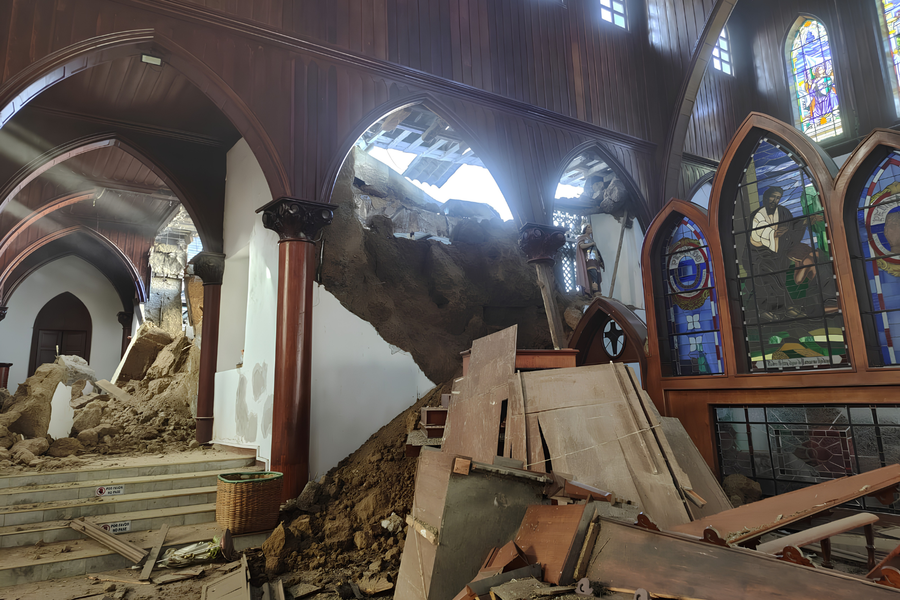
In the city of Manizales, in the department of Caldas, the Cathedral Basilica of Our Lady of the Rosary suffered a partial collapse of one of its towers and sustained severe structural damage.
“The cathedral was severely damaged by the earthquake; it is one of the country’s most iconic cathedrals. Even my parish church in my hometown, Santa Rosa de Cabal – which is a very beautiful basilica – was also severely damaged,” Escobar said.
On its social media accounts, the Archdiocese of Manizales posted: “Beyond the material damage, we lift up our prayers for all the people and families who have experienced moments of anguish. May Our Lady of Victories accompany and protect her people, and may God grant strength, serenity, and hope to the entire community.”
Also see
Copyright © 2026 Catholic Review Media
