
Speaker’s office withdraws official portrait directive following media concerns
Author : Memoscar Lasuba | Published: 58 minutes ago

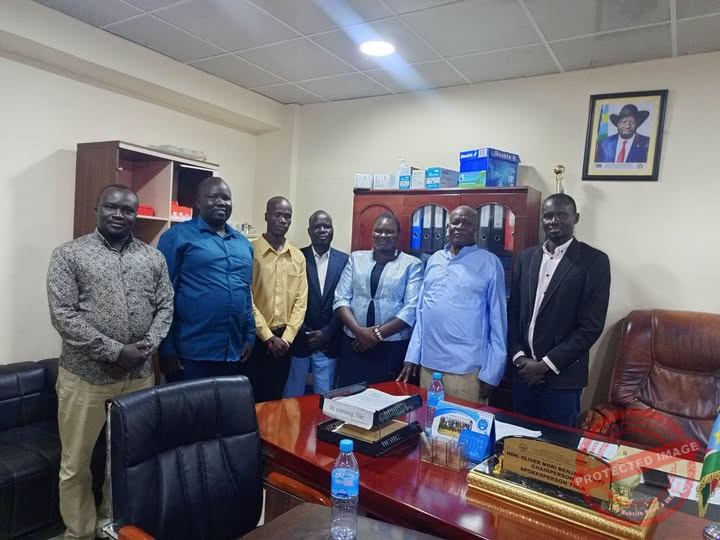
The leadership of the Association of Media Development in South Sudan|Courtesy
The Office of the Speaker of the Transitional National Legislative Assembly (TNLA) has withdrawn a directive requiring media houses to use official portraits of Speaker Joseph Ngere Paciko, following concerns raised by media stakeholders over editorial independence and press freedom.
In a statement issued on Thursday, the Speaker’s Office said the portraits had been circulated to “standardize visual representation across government, media, and public platforms, and to address misrepresentation.”
According to the statement, the move was prompted by “the repeated use of poor-quality, low-resolution, or distorted images of the Speaker in news reports, social media content, and official communications, which undermined the dignity of the Office.”
However, the Office acknowledged concerns raised by journalists and media organizations regarding the implications of the directive.
“Following feedback from media stakeholders on editorial independence and access, and after assessing the impact of standardized portrait use on press freedom and public discourse, the Office directed the withdrawal of the circulated portraits,” the statement said.
The Office further stated that it remains committed to engagement with the media sector.
“The Office of the Speaker remains open to dialogue with the Association for Media Development in South Sudan, the Union of Journalists of South Sudan, and individual media houses,” the statement added.
The withdrawal follows a public appeal by the Association for Media Development in South Sudan (AMDISS), which had expressed concern over a notice posted on the Speaker’s official Facebook page directing media houses to use approved photographs when reporting on the Speaker or the Office of the Speaker.
In a letter addressed to Parliament’s Specialized Committee on ICT and Postal Services, AMDISS described the directive as “a potential infringement on the editorial independence of media houses.”
“The role of the media in a democratic society is to provide accurate, balanced, and independent information to the public,” AMDISS said. “Imposing restrictions on the visual materials used by journalists—such as requiring the use of exclusively ‘approved’ photographs—undermines the ability of the press to maintain its neutrality and fulfill its public mandate.”
The media advocacy organization warned that directives limiting the use of images in news reporting could undermine journalistic independence.
“Journalistic independence is the cornerstone of a vibrant democracy. Directives that limit how media houses depict events, or that dictate the imagery used in reporting, set a concerning precedent for censorship,” AMDISS stated.
The organization also argued that such restrictions could discourage journalists from exercising professional judgment.
“Restrictions of this nature risk creating a frightening effect on journalists, who may fear the consequences of using imagery that has not been approved by official sources,” AMDISS said.
AMDISS called on the Office of the Speaker to review and withdraw the directive, engage in dialogue with media stakeholders, and respect the editorial autonomy of news organizations.
The association welcomed engagement with Parliament and reiterated its commitment to promoting media freedom, professional journalism, and democratic governance in South Sudan.