

Conflict intensifies and instability spreads beyond Burkina Faso, Mali, and Niger
What to watch for in 2025
As we move into 2025, the central Sahel continues to experience persistent high levels of violence, with instability spreading geographically and evolving in nature. Particularly in Burkina Faso and Mali, state forces have reacted to jihadist groups’ escalating activity with retaliatory violence against civilians in an attempt to deter the civilian population from providing support to armed groups. Jihadist groups, for their part, are stepping up their community outreach and preaching efforts. By presenting themselves as protectors against state forces, Wagner mercenaries, and pro-government militias, JNIM and IS Sahel are consolidating their influence over the civilian population, which is increasingly trapped in areas under jihadist control.
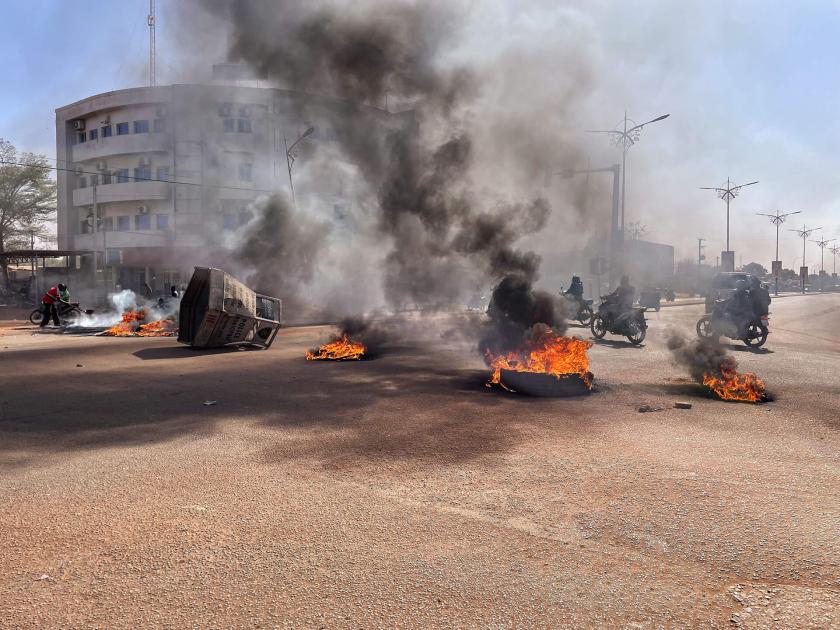
The protracted conflict in the Sahel is increasingly affecting urban centers. This reflects broader regional dynamics in which rapid urbanization and the strategic targeting of these areas maximize the impact of militant attacks. Recent attacks on the capital cities of Bamako and Niamey demonstrate growing vulnerability in these urban environments. The overlap between urban and rural areas creates complex security challenges as militant groups use less secure urban outskirts as gateways. Furthermore, technological advances in the conflict, particularly the increasing use of drone warfare and remote violence by non-state actors, pose an additional risk to human security and critical infrastructure.
Indeed, the use of drones by both state actors and non-state armed groups, including Wagner, JNIM, and CSP-DPA, represents a significant change to a conflict that had been characterized by traditional and rudimentary guerrilla warfare. The use of modified commercial drones for offensive operations is becoming more sophisticated and widespread as jihadist groups employ drone warfare not only for surveillance and reconnaissance but also for targeted strikes through drone-delivered explosives, including kamikaze drones. These drone warfare capabilities represent a major tactical advance; although they are emergent, they could be refined to extend operational reach. These capabilities enable precision strikes (in combination with other forms of remote violence), improved surveillance and monitoring, and more impactful media and propaganda operations.
Emerging alliances between Tuareg, Toubou, and other rebels across the borders of Mali and Niger, along with coalition-building between rebels within Niger, represent new variables in the conflict equation. Although these groups currently have limited influence compared to their jihadist counterparts, they could eventually preoccupy or overwhelm the military forces, which already face numerous serious threats.
The ripple effects of this regional instability can be observed in the neighboring states of Benin and Togo, where the advance of JNIM operations presents a deliberate and strategic expansion rather than mere spillover. Similarly, the border areas between Niger and Nigeria are becoming focal points of both JNIM and IS Sahel activity. These areas have served as retreats and safe havens for the two groups. Although both JNIM and IS Sahel are coercively influencing the local populations, JNIM is likely to continue its violent campaign to consolidate its influence in these border areas, especially in the south of Niger’s Dosso region, where the group claimed its first operations in 2024. Meanwhile, the exposure of IS Sahel’s presence in northwestern Nigeria puts pressure on both Nigeria and Niger to take military action, which could also provoke a response from IS Sahel militants who, covertly and overtly, have been infiltrating the region largely unimpeded since at least 2018. The challenge for the region’s governments will be to deal with these evolving threats in a way that prevents further destabilization and protects vulnerable populations from the violence that continues to spread across their territories.
Credit: Source link
Comments are closed.