

Yemen Strengthens Defensive Measures Against Houthi Threat
The escalating Houthi threat is no longer confined to front lines or direct military attacks. It is increasingly targeting ports, economic infrastructure and maritime routes, as the Yemeni government seeks to reorganize the state’s capabilities to confront a threat it sees as extending beyond the domestic conflict to the security of maritime navigation and international trade.
The government measures come amid an escalation along the western coast and the Red Sea. The latest developments in recent hours have included the launch of ballistic missiles toward liberated islands and areas near international shipping lanes, as well as an attempt to deploy a suicide drone. At the same time, the Yemeni navy thwarted an attempt by Houthi boats to approach liberated islands, according to military media.
These developments have placed the Yemeni government before a complex equation. Its institutions are tasked not only with containing military attacks, but also with protecting civilian and commercial infrastructure, securing supply chains and preserving the economy’s ability to function in a country already battered by years of war triggered by the Houthis, as well as financial and monetary fragmentation.
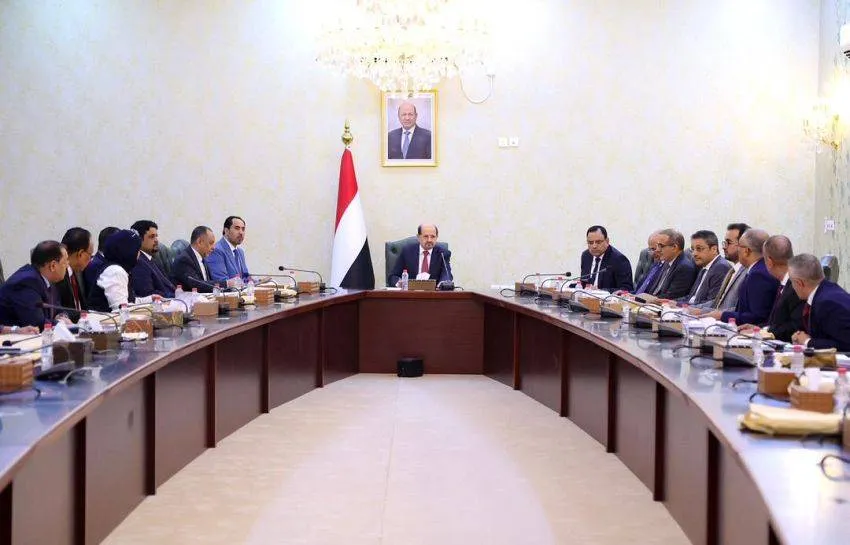
The Yemeni cabinet, at its latest meeting in Aden, treated the Houthi escalation as part of a campaign targeting the foundations of the state rather than as a series of isolated military operations. It focused on Houthi attacks against economic infrastructure and civilian and commercial facilities, foremost among them Mokha Port, viewing them as an attempt to disrupt trade, maritime traffic and supplies.
Mokha’s significance extends beyond its local importance given its proximity to one of the world’s most critical maritime routes. Any threat to the port or surrounding coastal areas therefore affects not only Yemen’s economy, but also adds another layer of risk to maritime security in the Red Sea and the Bab al-Mandab Strait.
Expanding the Confrontation
While the Yemeni government seeks to present itself as capable of managing the confrontation through parallel military, security and economic tracks, the cabinet ordered authorities to maintain the highest levels of readiness, strengthen surveillance, early-warning and response systems, and increase coordination among military, security and civilian agencies. The aim is to enable a rapid response to threats while protecting state institutions, facilities and national interests.
The measures, however, have not been limited to security. The cabinet also discussed electricity and gas supplies, supply bottlenecks, market oversight and supply chains, alongside tighter controls over border crossings and revenues and intensified efforts to combat smuggling and the financing of illicit activities.
The package reflects an attempt to link economic security with military security. The government sees the state’s ability to withstand the escalation as dependent on preventing disruption to markets and supplies while simultaneously cutting off resources that the Houthis could use to finance their military operations.
It also reflects an official recognition that any prolonged escalation in the Red Sea could compound the pressures on an already fragile economy, particularly if it disrupts ports or affects the movement of goods, food and medicine.
Against this backdrop, the Yemeni cabinet stressed that anti-smuggling measures must not become an obstacle to legitimate trade, seeking to strike a balance between cutting off illicit sources of financing and maintaining the flow of essential supplies to the population.
International Partnership
Alongside the government’s moves, Yemen has called for an expanded partnership with the international community, particularly the United States, to address risks that are no longer confined within Yemen’s borders.
During a video conference with US Chargé d’Affaires to Yemen Neil Hop, Presidential Leadership Council member Sultan al-Arada stressed that security in the Red Sea and Bab al-Mandab is a shared responsibility. He said protecting freedom of navigation and global trade routes requires greater political and economic pressure on the Houthis, alongside efforts to cut off their sources of financing and weapons supplies.
Through this rhetoric, Yemen’s leadership is seeking to shift the discussion from the framework of the Yemeni war to a broader question of international maritime security, arguing that continued instability in Yemen has a direct impact on regional security and the movement of global trade.
According to Yemeni state media, the US side reaffirmed its support for the Presidential Leadership Council and the government, and its readiness to continue supporting state institutions and strengthening their capacity to confront security, economic and humanitarian challenges, with a focus on curbing the Houthis’ sources of financing and weapons.