

Yemen becomes latest test of Iran’s regional power
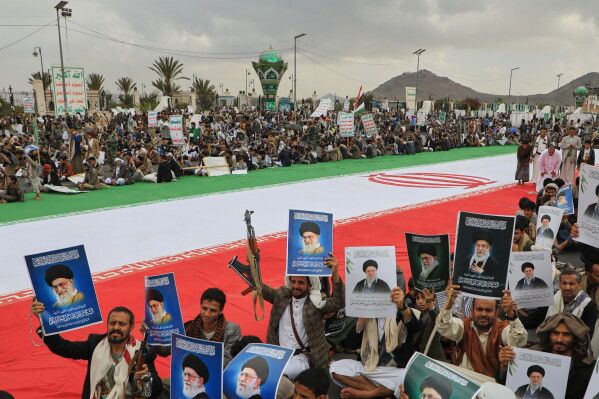
At a time when the confrontation between the United States and
Iran continues without any sign of easing, it is still too early to
say that Washington has achieved all of its objectives. The war is
ongoing, and Tehran retains the ability to resist. However, when
the conflict is viewed from the perspective of Iran’s regional
power, a different picture emerges. As US military pressure
increases, the system of influence Iran has built across the Middle
East is gradually weakening, with its various components
disappearing one by one.
The confrontation between the United States and Iran did not
begin today. Its foundations were laid after the 1979 Islamic
Revolution. Following the overthrow of the Shah’s regime, Tehran
became one of Washington’s main regional rivals. Over the following
decades, Iran expanded its political and military influence beyond
its borders. Its ties with various political and armed groups in
Lebanon, Syria, Iraq, Yemen and the Palestinian territories became
one of the main instruments of Iranian regional policy.
The advantages this model provided Tehran were clear. Iran was
able to create additional threats for the United States and its
allies beyond its own territory. Instead of confronting Iran in a
direct war, its opponents also had to deal with the problems
created by Tehran’s proxies across the region.
However, the weaknesses of this strategy had long been debated.
Iran’s economic capabilities are extremely limited compared with
those of the United States. The US has one of the world’s largest
economies, while Iran has far fewer economic resources because of
sanctions and structural problems. The technological gap is also
substantial. US capabilities in air defense, intelligence,
satellite systems, aviation, precision strikes and electronic
warfare significantly exceed those of Iran.
Against this backdrop, many experts argued that Iran would be
better served by concentrating its resources on its own defense
rather than spreading them across the region. Tehran and its
supporters, however, took a different view. Their main argument was
that the outcome of a war is not determined solely by economic
power and technology. Willpower, long-term resistance and the
ability to inflict sustained losses on the opposing side also play
an important role. Based on this approach, Iran provided political,
financial and military support to its regional allies, creating
multiple channels of pressure against the United States.
In recent years, however, the confrontation gradually evolved
into an open war. With Donald Trump’s return to power, the US-Iran
confrontation reached one of its most intense phases. Washington
began carrying out direct strikes against Iran’s military and
economic capabilities, while Tehran responded with retaliatory
attacks.
The transition to open warfare exposed a fundamental weakness in
Iran’s regional strategy. The network of influence Iran had built
over decades appeared powerful, but its individual components were
unable to maintain their previous positions under intense military
pressure.
First, Hezbollah came under heavy pressure in Lebanon. The
killing of Hassan Nasrallah, who had led the group for many years,
had a major impact on its structure and influence. Hezbollah also
lost some of its previous weight in Lebanon’s domestic political
balance.
Then came Syria. The fall of Bashar al-Assad’s government
removed one of Iran’s most important regional pillars. For years,
Syria had served as a key logistical and political link for Tehran
toward Lebanon. Assad’s departure from the country significantly
reduced Iran’s ability to maintain influence along that route.
Now attention has turned to Yemen.
Yemeni government forces, backed by Saudi Arabia, have launched
a new offensive against the Houthis. Fighting has intensified in
the provinces of Al Jawf, Taiz and Al Bayda. On September 8, the
Yemeni army announced that it had recaptured the Al-Yatmah area in
Al Jawf province from the Houthis. The area is located near the
Saudi border and has strategic importance.
The Houthis remain a powerful force, and it is difficult to
predict that they will be defeated in the near future. In fact,
attacks carried out against cities and energy facilities in
southern Saudi Arabia on September 8 showed that the group still
retains significant strike capabilities. More than 70 people were
reportedly wounded in the attacks.
However, the significance of the latest developments in Yemen
extends far beyond the country itself for Iran. The Houthis are
among Iran’s main remaining regional partners. If Yemeni government
forces achieve their objectives and retake territory currently
controlled by the Houthis, Tehran could lose an important source of
influence along the Red Sea and Bab el-Mandeb.
As a result, Iran’s regional map of influence is undergoing a
series of changes. Hezbollah has been weakened in Lebanon, Iran’s
main ally in Syria has been removed from power, and Hamas has
suffered heavy losses in Gaza. Now Iran’s position is also being
tested on the Yemeni front.
This process could have serious political consequences inside
Iran as well. Tehran has spent years presenting the network of
proxy forces it built across the region as one of the main
instruments of its power. The weakening of these forces and their
loss of territory and influence damages the image of strength
cultivated by the Iranian leadership. Tehran no longer appears as
capable as before of maintaining its influence beyond its own
borders. As the war continues, the economic and military costs also
rise. Iran has to devote substantial financial resources to
military operations, weapons and the maintenance of allied forces.
This creates additional pressure on the government at a time when
the country is already facing economic difficulties.
For this reason, the developments on the Yemeni front should be
seen as part of a much broader process. The Houthis currently
occupy an important position in Iran’s regional strategy. If Yemeni
government forces succeed in retaking territory under Houthi
control, Tehran will lose another important regional pillar. This
would weaken Iran’s influence along the Red Sea and Bab el-Mandeb
and increase Washington’s strategic pressure on Tehran.
This could become one of the war’s most serious consequences for
Iran. Even if the United States does not defeat Iran directly, it
can gradually dismantle the regional defensive network Tehran has
built around itself. As Iran’s regional influence declines, so too
will the tools available to Tehran for resisting US pressure. Yemen
could become the next link in that chain.