

World Cup Panini collectors share the magic behind the stickers
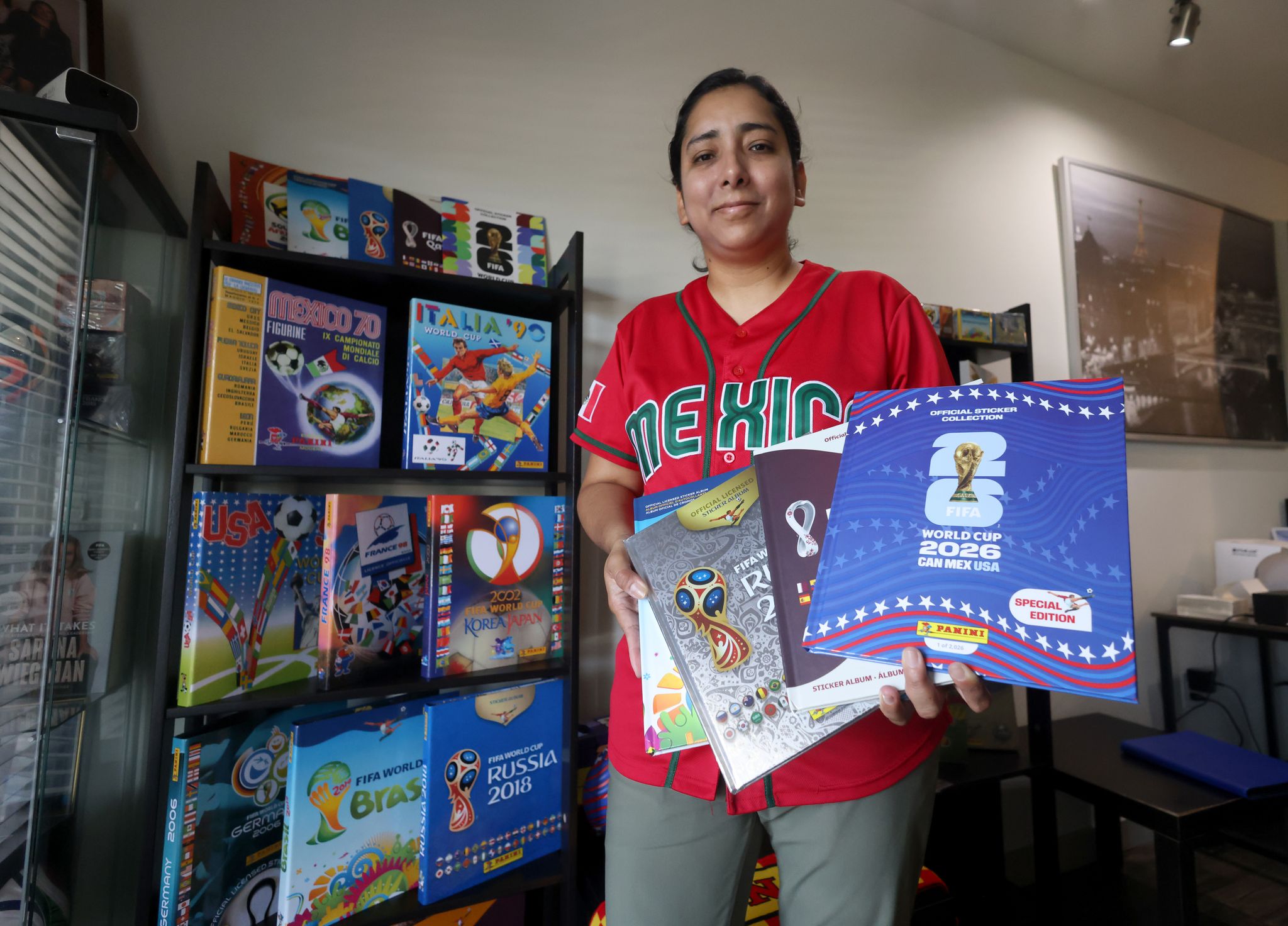

Stephany Rogel, a teacher in Dallas ISD, is an avid collector of World Cup albums and stickers, which are displayed prominently throughout her residence in Dallas on May 4, 2026.
In a small 650‑square‑foot apartment in downtown Dallas, an unexpected treasure lives behind the door.
Shelves and boxes overflow with dozens of albums and thousands upon thousands of stickers — an archive so vast it places Stephany Rogel among one of the most devoted Panini collectors in the region.
Article continues below this ad
“This is my true and real passion,” she said.
Rogel, originally from Veracruz, Mexico, arrived in the United States in 2008, carrying little more than a childhood dream she never quite let go.
Related: Pedaling to Messi: Three friends bike from Argentina to U.S. for World Cup dream
Make Dallas News a preferred source so your search results prioritize writing by actual people, not AI.
Add Preferred Source
Eighteen years later, she has amassed millions of stickers, investing more than $100,000 into her collection.
Article continues below this ad
For millions of soccer fans, Panini albums are more than paper and glue. Since their World Cup debut in 1970, they’ve become a ritual — an international tradition of swapping, searching and celebrating the global game.
Origins of Panini
The tradition began far from Dallas, in the Italian town of Modena, where the Panini brothers — Giuseppe, Benito, Umberto and Franco — grew up. In 1961, Giuseppe and Benito bought a batch of soccer trading cards to resell.
They found unexpected success, which pushed them to create Panini Publishing the following year. Their first official album, dedicated to Italy’s Serie A, became an instant sensation.
Article continues below this ad
Then came the breakthrough. In 1970, Panini secured exclusive rights to produce the official World Cup album, starting with Mexico ’70. That first edition featured 271 stickers — players, teams and stadiums — capturing the world’s most beloved sport in a way no one had done before.
Every World Cup has since brought a new album.

World Cup albums and stickers are displayed prominently throughout Stephany Rogel’s residence in Dallas on May 4, 2026.
The 2026 edition, the largest ever, includes 980 stickers representing the most prominent players from the 48 participating teams.
Article continues below this ad
Panini has produced 15 editions of its iconic FIFA World Cup album since 1970. Across those editions, the collection has grown into a massive cultural artifact: 904 total album pages and 7,705 unique stickers.
For the first time in history, the World Cup will unfold across North America — the United States, Mexico and Canada sharing the stage. And Panini, sensing the magnitude of the moment, designed a collection to match it.
Related: World Cup crowds are coming. Dallas is training tour guides to greet them
More than 10 million albums are expected to be distributed across the U.S. and Canada, signaling just how deeply the tradition has taken root in North America.
Article continues below this ad
Gina Terranova, Panini’s director of digital marketing, said this edition stands apart from anything the company has produced.
“The FIFA World Cup 2026 Panini collection is different because it’s here in North America,” she said. “Our North America cover is only available in the U.S. and Canada. Our local fans will be able to get a one‑of‑a‑kind cover and a one‑of‑a‑kind collection.”
It’s a subtle but powerful gesture that recognizes the sport’s center of gravity is shifting. The United States — once a peripheral soccer nation — is now home to one of the most passionate, fastest‑growing fan bases in the world.
The Latino connection
To understand the emotional weight of this moment is to understand the people who grew up with Panini.
Article continues below this ad
“It’s part of who we are,” said Cristian del Valle, license manager for Panini’s Multisport Department.
Being of Mexican origin and a Panini album collector since 1994, Del Valle knows this passion intimately.
Related: Dallas emerges as a soccer TV stronghold ahead of the 2026 World Cup
“We grew up collecting the album,” he said. “Every four years, as kids, it was the thing we looked forward to — collecting it, trading stickers with your friends at school, during recess, during sports activities.”
Article continues below this ad
Del Valle says the tradition is especially powerful in Latin America, where collecting is practically inherited.
He grew up with the albums, just like millions of others, and remembers how each World Cup cycle brought the same anticipation: the first pack, the first trade, the first page completed.

A selection of player collector cards is displayed in Stephany Rogel’s residence in Dallas on May 4, 2026.
For collectors like Gio Fuentes, now the owner of a restaurant in Carrollton, the ritual of opening a sealed pack still carries the same electricity it did decades ago.
Article continues below this ad
He was born in El Salvador, a place where soccer isn’t just a sport but the background noise of growing up.
Related: Dallas nonprofit sends 98 children to 2026 World Cup spotlight
“Your childhood is basically watching soccer, playing soccer,” he said.
And somewhere in the middle of that — between school recess, street games and weekend matches — came the Panini stickers. They weren’t just collectibles; they were a rite of passage.
Article continues below this ad
“It’s something you carry with you,” he said.
The code of honor
What surprises many newcomers to the hobby is the unwritten code that governs it.
Among collectors, Fuentes explains, fairness is everything.
Article continues below this ad
“There’s a sort of honor,” he said. “We don’t take advantage of people.”
A trade must feel right — player for player, team for team. Even the math matters.
Related: See Mexico’s possible starting lineup for 2026 World Cup opener
“If someone has seven duplicates and asks for a sealed pack in return, that’s considered a fair exchange,” he said. “A sealed pack has seven stickers. That’s a fair deal.”
Article continues below this ad
Inside his restaurant, that code plays out every Saturday afternoon.
Kids negotiate with the seriousness of diplomats. Adults rediscover the thrill they thought they’d outgrown. And Fuentes watches it all with the quiet satisfaction of someone who understands exactly what the hobby means.
“It’s not about the stickers themselves — it’s about the memories they unlock”, Fuentes said as he smiled. “I enjoy it more than you can imagine.”
A childhood dream
Rogel’s connection to Panini began in 1998, during the World Cup in France. She was in elementary school in Mexico when someone gifted her an album. It felt like magic — until reality intervened.
Article continues below this ad
Her family was struggling. Money was tight. Sticker packs were a luxury they simply couldn’t afford.
“It was either buying milk and bread or buying stickers. We were very poor,” she said.
She remembers the longing. The pages she couldn’t fill. The players she never found. The album that eventually disappeared.
Article continues below this ad
Related: ‘People said it was impossible’: Haiti’s long road to the World Cup
Her adult collecting journey began in 2018, when she bought her first album already complete — “ready to paste,” she says with a laugh. But the real turning point came in 2022.
She had saved money to attend the Qatar World Cup, her dream trip, but ultimately decided not to go because it was too expensive. Instead, she redirected that disappointment into something else.

Stephany Rogel holds a FIFA World Cup Qatar 2022 trading card album as part of her collection displayed in her residence in Dallas on May 4, 2026.
“With the money I had saved, I told my brother, ‘Let’s do our first collection.’”
Article continues below this ad
They bought albums, boxes and a special edition released exclusively online in Mexico.
She then discovered the U.S. version of the album included color parallels — rarer versions of the same stickers bordered in blue, red, purple or the nearly mythical green.
Each color signals a higher level of rarity, making it increasingly unlikely for that sticker to show up by chance in a standard seven‑sticker pack.
“One thing led to another,” she said. “I filled myself with stickers because I opened boxes and boxes and boxes looking to complete color collections.”
Article continues below this ad
As the 2026 World Cup approached, Rogel made a decision that stunned even her closest friends.
“I sold my house,” she said. “I sold it to buy my World Cup tickets — and to invest more in my Panini collections.”
Despite selling her home, she ultimately did not buy any tickets. Similarly to 2022, the prices were simply too high.
Related: ‘Heist of the century’: We paid a ton for World Cup tickets. Wait, my seats are where?
Article continues below this ad
Instead, she poured her energy back into the hobby that had shaped her life.
Rogel estimates she has spent more than $100,000 of her own money building her collection.
She says that she owns millions of stickers — some stored in her Dallas apartment, others safeguarded in her family home in Veracruz.
She has even insured her collection, treating it like the cultural archive she believes it is.
Article continues below this ad
Preparing for 2026
With the 2026 World Cup coming to North America, Rogel, a bilingual DISD teacher, is preparing for the biggest collecting wave she’s ever seen.
Outside the classroom, she pours her energy into the community organizing D-FW trading events, crafting helpful checklists for families and showing newcomers how to trade with confidence and fairness.
She knows what this moment means — not just for her, but for every kid who once held an album they couldn’t finish.
Article continues below this ad
“It’s a great time to collect,” she said. “We’ve been waiting three and a half years for this new album.”
Related: ‘Future of soccer’: FIFA World Cup mural unveiled near downtown Dallas
Panini collecting is not cheap — and Rogel doesn’t sugarcoat it.
“The minimum base cost to have enough stickers for the album is $300,” she said.
Article continues below this ad
Three boxes of 50 packs each. Enough to fill about 70–75% of the album. The rest must be traded — fairly, ethically and with an understanding of rarity.

Stephany Rogel shows off her collection of soccer player cards, including João Cancelo, at her residence in Dallas on May 4, 2026.
“You can’t show up and say, ‘I’m missing Cristiano Ronaldo, and I’ll offer you this player from Iran, Iraq, or Congo.’”
She laughs as she says it, but she means it: The Panini economy has its own logic.
Article continues below this ad
And yet, for many collectors in the U.S., the cost is worth it. Because the hobby is not just about stickers — it’s about reclaiming something they couldn’t have as children.
“We are nostalgia collectors,” Rogel said, looking at the shelves in her apartment filled with albums, binders and stickers that trace her life from Veracruz to Texas. “When we were kids, we couldn’t collect. Now we can.”
Then she says the words that could serve as the mantra of every collector.
Article continues below this ad
“Panini isn’t about completing a book. It’s about completing a part of yourself.”
Crédito: Link de origem