

World Cup: Morocco — know thy foe, Canada

Here’s what Canada is up against when they take on Les Lions de l’Atlas this Saturday morning
Article content
We independently select everything we recommend. Buying through us may earn us a commission, which supports our work.
There is what writers call the “hero’s journey” — the architecture upon which our greatest stories are built.
Advertisement 2

Article content
The TL;DR version: An ordinary person is called to an adventure, meets a mentor, is tested by enemies, endures an ordeal and overcomes a crisis, and, through sacrifice, returns home transformed (ie: Luke Skywalker, from petulant whiny moisture farmer to sagacious and zen Jedi master, minus one hand and one father).
Article content
Article content
It’s the template the Canada’s men’s soccer team has, thus far, followed perfectly.
In his rousing post-game speech after Canada beat South Africa on Sunday, head coach Jesse Marsch anointed his players “heroes” for what they’ve accomplished. And now he’s positioning them for yet another hero’s tale: as David vs. Goliath.
Canada will be facing what the coach has called “a modern giant” this Saturday in Morocco.
“I feel like it’s a free hit,” he said. “We’re going to go after it and do everything we can to see if we can find a way to get a win.”
Marsch was on hand at El Gigante de Acero, the Monterrey Stadium, on Monday to see first-hand which giant his team was going to face. The “traditional giants,” as he deemed the Netherlands, or the modern one in Morocco.
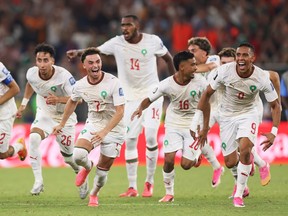
It will be the Atlas Lions, who triumphed over the Dutch in a penalty kicks — a game sent to an extended period after yet another injury-time goal in this World Cup.

Canucks Report
Article content
Advertisement 3
Article content
Here’s five things to know about the game …

HEROES ARE BRAVE
Marsch’s first takeaway will be: don’t be a coward. Heroes are brave. Ronald Koeman wasn’t. the Netherlands coach decided to eschew the offensive total football his program had invented and embraced, opting for a defensive posture with a five-man back line. He feared being opened up by Morocco, and all but ceded the ball to them. The Dutch had 30 per cent possession, and a minuscule xG of 0.24.
His strategy ultimately cost him the game, and his job, as he resigned Tuesday following the loss.
“If I had to do it again, I’d do it all the same way,” he told media post-game. “As the Dutch coach, when the equalizer is scored I am always going to be scolded for the fact I chose five defenders. But you criticize, which is your right. You watch from the sidelines, I’m here with the team. And, once again, I’d do it again.”

THIS ISN’T THE OLD MOROCCO
It will be the second straight World Cup that Canada has faced Morocco. They lost 2-1 in Qatar — though nearly tied it through an Alistair Johnston header that crept over the bar.
“(I think about it) probably more than I’d care to admit,” Johnston told Postmedia. “That’s the reality of a massive game like that: every moment feels magnified because you wait your whole career for those opportunities. But I also think those experiences helped shape this group.
Advertisement 4
Article content
“We left Qatar proud of certain things, but also knowing we had left something on the table. That feeling has fuelled us ever since and helped create the belief that we can achieve something special at the next one.”
That was the start of Morocco’s ascension. They entered that tournament ranked 22nd; a run to the semifinals, ultimately ended by France, saw them jet up to 11th.
Thanks to a 31-game unbeaten streak, they’re now sixth — the first time they’ve been inside the top 10 in history.
Issa Diop, the Moroccan centreback whose 91st minute header sent the game to extra time, wasn’t taking the Canadians lightly.
“We’re into the next round. It’s game by game,” he said. “Now we’re going to recover well and be focused for the game against Canada. They’re a very good team, we’ve seen the game against South Africa, we’ve seen their group stage games, and now we’re gonna work on them and be focused on this game.”

BETWEEN POSTS AND COUNTRIES
Diop was one hero for Morocco. Goalkeeper Yassine Bounou was the other. His distraction tactics and casual stand-up save on Crysencio Summerville proved decisive in the penalty shootout.
Advertisement 5
Article content
And he could have played for Canada.
The 35-year-old was born in Montreal to Moroccan parents, but moved to Casablanca as a child. “Bono,” as he’s known, has been a fixture with the national team since 2013.
FAST AND PHYSICAL
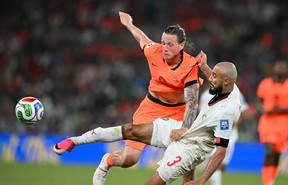
Canada’s strengths lie in a well-organized defence and speed to hit on the counter. Morocco patiently dissected an arguably superior unit, generating five big chances, and have pace equal or superior to Canada’s.
Example A: Morocco’s Noussair Mazraoui. He made two goal-saving tackles, tracking down the speedy Summerville twice, had a game-high 19 defensive contributions, and was a perfect 5-5 on ground duels.
“We played a great, great game against this team, because otherwise you cannot beat them. They are way, way too good,” he said after. “Without the fighting spirit we showed today, you’re not going to make any game. Not against Netherlands, not against Haiti, not against nobody, because everybody comes here to win for the, for themselves, for the nation.”
If outrunning the opponent isn’t an option, perhaps size is. Dutch sub Wout Weghorst, the 6-foot-6, 190-pound striker proved himself a matchup problem for Morocco. Promise David — 6-5, 200 pounds — is equally as imposing.
Advertisement 6
Article content
DON’T THROW IN THE TOWEL
Morocco’s game is beautiful to watch. Only four teams have been more accurate with their passing, and same with their big chances per game.
But they can be a hard watch (for anyone not a Morocco fan). They are masters of agitation and delay tactics. Kicking balls away from free kicks, tossing balls away from throw-ins, stealing goalkeepers’ towels … they are agents provocateurs.
Their Africa Cup title comes with an asterisk, as it was awarded retroactively. Senegal, enraged by the tactics and entirely questionable officiating, walked off late in the championship game. They returned to the field, and eventually won 1-0, but the Confederation of African Football (Caf) overturned the result two months and handed Morocco the title.
Read More


Article content
Credit: Source link