

With GDP Up 4.9% in 2025, Akhannouch Tells OECD Morocco Aims to Grow Stronger
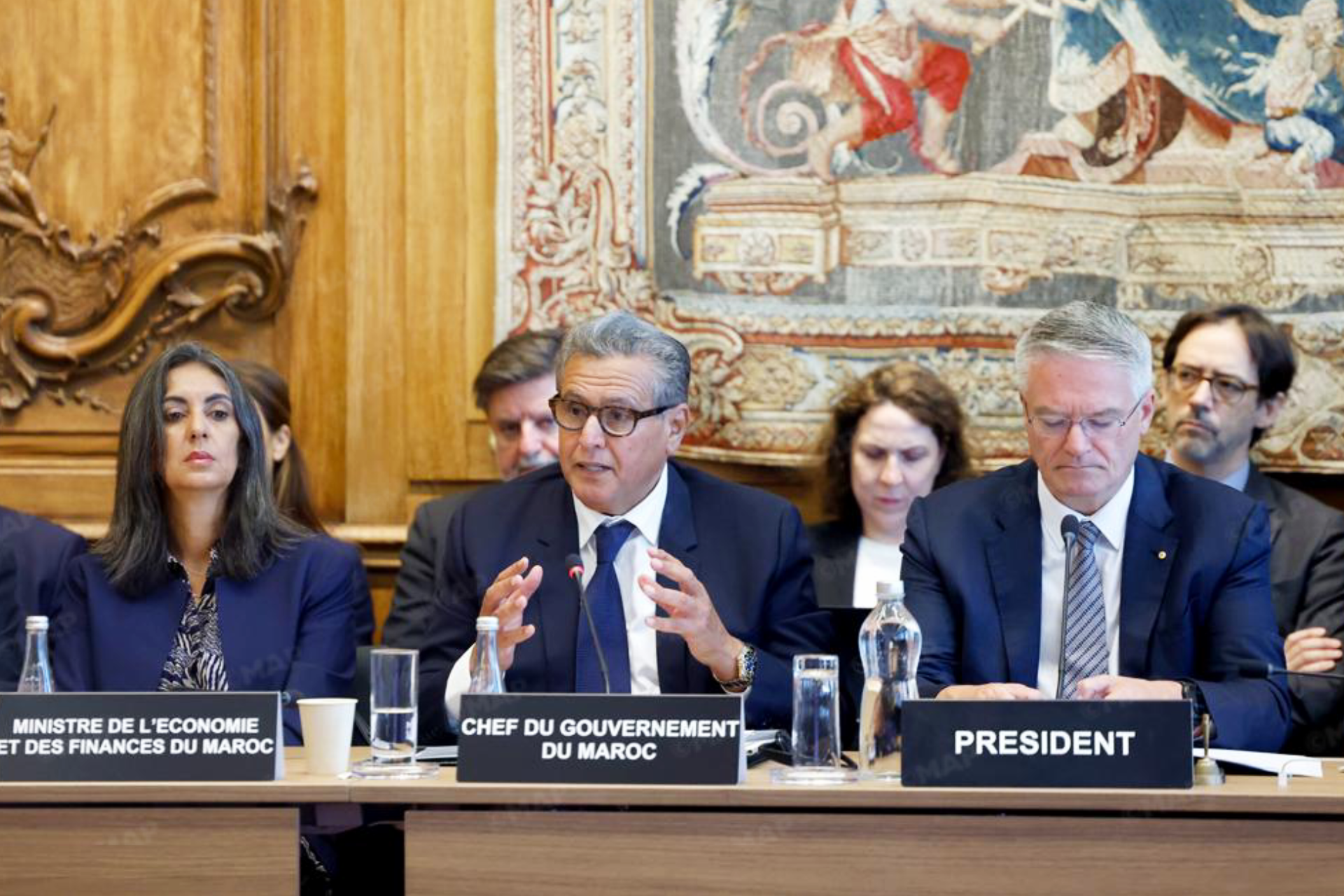
Marrakech – Head of Government Aziz Akhannouch told the Council of the Organization for Economic Cooperation and Development (OECD) on Monday that Morocco’s ambition is to become a stronger and more competitive country, and a pole of stability and prosperity for its neighborhood, Africa, and the euro-Atlantic space.
Addressing the Council in Paris, Akhannouch tied the North African kingdom’s economic and social momentum to the leadership of King Mohammed VI, whom he described as the guarantor of continuity in public policy. He pointed to an upward trajectory that allows Morocco to protect its citizens, preserve its balances, invest in the future, and accelerate reforms at the same time.
He framed that record against a difficult global backdrop marked by geopolitical tensions, worldwide inflation, and the reconfiguration of value chains. In response, Morocco “chose to stay the course: build the social state, invest in human capital, strengthen our productive apparatus, and preserve our macroeconomic balances,” he told the council.
Accompanied by Economy and Finance Minister Nadia Fettah, Akhannouch reviewed the achievements he credited with placing the country on the path of emerging economies. He cited the “historic generalization of social protection,” monthly assistance to the most vulnerable families, the renovation of primary healthcare facilities, and education reforms.
He backed the account with figures. According to the national accounts of the High Commission for Planning (HCP), GDP growth reached 4.9% in 2025, up from 4.4% in 2024. After the global inflation peak, the country brought inflation down to 0.9% in 2024 and 0.8% in 2025, while the budget deficit stood at 3.5% of GDP in 2025.
Turning to investment and production, Akhannouch reported that 381 projects have been approved since the new Investment Charter took effect, for a combined MAD 581 billion ($58.1 billion), expected to generate 245,000 direct and indirect jobs.
He singled out the automotive sector, now the country’s leading exporter and top employer. Its exports rose from MAD 87.1 billion ($8.71 billion) in 2021 to MAD 154.5 billion ($15.45 billion) in 2025, with production capacity now close to 1 million vehicles per year.
That trajectory, he continued, also rests on connectivity infrastructure that is gradually reshaping the kingdom’s economic geography. He assured the council that the momentum would continue, pointing to Morocco’s co-hosting of the 2030 World Cup with Spain and Portugal.
More than a sporting event, he argued, the tournament will accelerate a transformation already under way, and the infrastructure being built “must first serve our citizens, our territories, and our economy, well beyond 2030.” On the sidelines, he signed the OECD guest book.
Read also: OECD Forecasts 5% Economic Growth for Morocco in 2026
OECD Secretary-General Mathias Cormann, speaking at the same session, called the partnership between Morocco and the organization “profound, dynamic, and mutually beneficial.”
He reiterated the OECD’s intention to deepen cooperation with Rabat and to study longer-term prospects, describing Morocco as a key actor in African economic integration and an engaged partner in the MENA-OECD initiative.
Cormann traced the relationship through a memorandum of understanding signed during his visit to Rabat in September 2024 and the launch of the 2025-2027 action plan in November 2025.
He referred to the OECD country program approved in 2024, which supported reforms in investment, governance, gender equality, and regional development in line with Morocco’s development strategy toward 2035, and to universal social protection as the cornerstone of the country’s new development model.
He also mentioned the “Maroc Digital 2030” program and the second economic survey of the kingdom, which is currently being prepared.
Akhannouch and Cormann held a separate meeting on the margins. There, Akhannouch welcomed the steady strengthening of a relationship Morocco has been building with the OECD since 2005, which has grown into one of the country’s most structured partnerships with an international organization.
He recalled that Morocco was among the first non-member countries to secure a Country Program, since renewed twice, and that it now takes part in 13 OECD bodies and more than 30 of its instruments. The cooperation, he added, matches Morocco’s method: reform, measure results, benchmark against best international practices, and scale up what works.
Cormann, for his part, described Morocco as the region’s oldest partner and welcomed its social reforms and economic outlook. Both sides pointed to a new phase organized around the Morocco-OECD Economic Bureau and the Morocco-OECD-West Africa project, with the aim of turning the kingdom into a junction point between the OECD, emerging economies, and Africa.
In 2025, trade between Morocco and OECD countries reached $87.4 billion and accounted for nearly 68% of Moroccan foreign trade, which makes the dialogue on investment, competitiveness, and value chains especially strategic.
Credit: Source link