

With Cuba in Its Sights, the US Is Resurrecting Cold War Demons
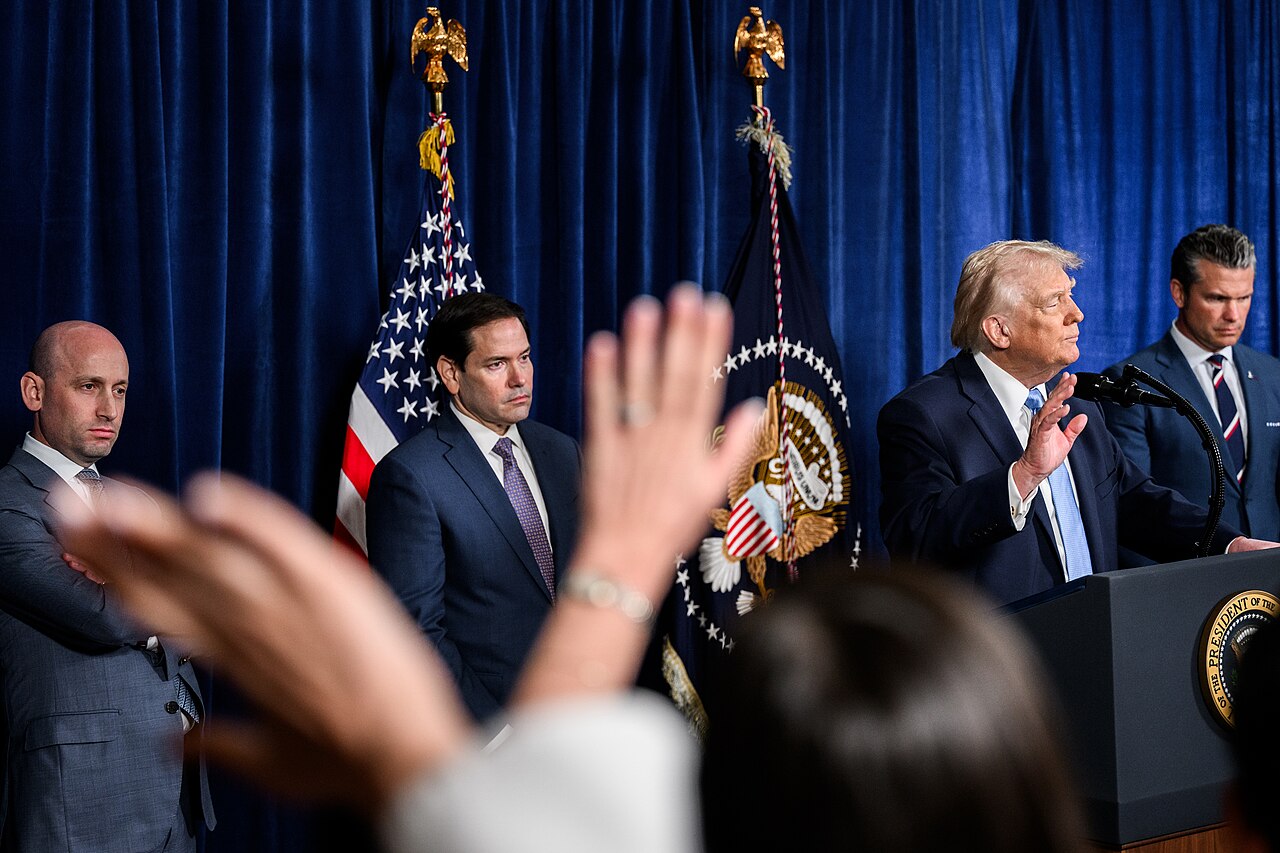
In May, US Secretary of State Marco Rubio faced a now-familiar question: Does Cuba pose a threat to national security? After a long-winded throat-clearing, he claimed that Havana hosts both Russian and Chinese intelligence and weapons. “So, Cuba’s always posed a national security threat to the United States,” he said, alleging that the embargoed island is “one of the leading sponsors of terrorism in the entire region.”
It was a curious, if all too common, framing. After all, Rubio was speaking on behalf of the US, the same country that has time and again attempted to assassinate Cuban leaders, once planned to stage false-flag terror attacks on Cuban soil, and, in one case, dispatched more than 1,400 CIA-trained exiles to invade the island only to abandon them.
Since US President Donald Trump returned to office in 2025, his administration has bombed at least seven countries, threatened regime change in several others, and launched a disastrous joint war with Israel against Iran. Many have speculated that the Trump administration will eventually target Cuba with military action, a fear compounded by the fact that Trump himself has refused to decisively rule it out.
Enter Marco Rubio, who has spent recent months leading the charge to build a public case against Cuba. Rubio, who was once caught lying about the causes of his own parents’ emigration from Cuba, has set about painting the island as one of the world’s chief sources of terrorism and foreign interference. All this comes at a time when Washington’s severe financial sanctions, fuel and oil blockades, and other isolation tactics are already pushing Cubans deeper into what is already one of the island’s worst humanitarian crises in decades.
In July, the US State Department hosted the Ministerial on the Resurgence of Political Terrorism, an event that brought together representatives of dozens of countries and focused almost entirely on what Rubio and others described as surging left-wing terrorism. True to character, Rubio didn’t miss the opportunity to lob more allegations at Cuba, including the bizarre claim that Havana maintains deep ties to contemporary left-wing organizing in the US itself. “The Cuban regime’s sprawling intelligence and ideological network helped build the far left in our country and in our hemisphere,” he said, “and it remains inextricably linked to the far-left groups and movements across and beyond the West.”
The first Marxist party in the US was founded in 1877, more than eight decades before the Cuban revolution brought socialism to the island, but historical accuracy seems to matter little to Rubio.
A few days after the July ministerial, the State Department released a 100-page report titled “Cuba: The Capital of 21st Century Communism.” The report describes Cuba both as a failed state and as the mastermind behind almost seven decades of subversion aimed at undermining the US. It fails to explain how, exactly, this “failed state” managed to achieve “remarkable success” in its supposed campaign of sabotage against what Trump calls “the strongest and most powerful country on Earth.”
In response, the Cuban Ministry of Foreign Affairs (MINREX) issued a statement that rejected the State Department report’s findings and pointed out the obvious: that the US allocates a significant portion of its own annual budget for subversion activities against Cuba. It also dismissed the claim that the Cuban government foments “left-wing terrorism” and insisted that international law dictates its diplomatic approaches to other countries. The report, MINREX noted, “manipulates and distorts Cuba’s widely recognized history of solidarity, anti-colonialist activism, and internationalism, even within the United States.”
Now, the US is tightening the screws yet more. In August, Washington classified Cuba as Priority 1 under the National Intelligence Priorities Framework. (That reclassification was made possible on Jan. 7, 2021, the day after Trump supporters attempted to overthrow an election he had lost, when National Intelligence director John Ratcliffe amended the framework.) In January, Trump signed Executive Order 14380, which declares Cuba “an unusual and extraordinary threat” to US national security and foreign policy. The CIA has also created a clandestine taskforce to sow divisions and exploit rifts among Cuban politicians. The goal? To replace the island’s current leadership with people who are more willing to work with Trump.
For his part, Marco Rubio has never been shy about his hope to see the Cuban government toppled. After the US kidnapped Venezuelan President Nicolás Maduro and his wife, Cilia Flores, Rubio became the de facto “viceroy” of that country. In August, he boasted that, with Cuba cut off from Caracas, Havana was more isolated and embattled than ever. “Every time they create a new mechanism in which they try to get out of the noose, we just close it off,” he told Axios in an interview. “They certainly can’t wait us out. Certainly this isn’t going to go away for the next two and a half years.”
In May, the US Justice Department charged Raul Castro with conspiracy to kill US nationals over a 1996 incident that saw the Cuban air force shoot down two planes belonging to the Miami-based Brothers to the Rescue organization. Founded by a former CIA operative, Brothers to the Rescue routinely conducted flights to find Cubans emigrating on boats and, at other points in its existence, dropped anti-government leaflets on the island. The 1996 incident resulted in four deaths. Cuban officials, including Fidel Castro, had cautioned the US government that these flights violated the country’s airspace, and declassified documents show that the Federal Aviation Agency had repeatedly warned Brothers to the Rescue to stop the “taunting” flights.
The charges against Raul Castro are part of Washington’s pivot back to its Cold War-era playbook against Cuba. That playbook, despite brief moments of thaw, has largely guided American policy toward the island for nearly 70 years. In 1960, only a year after the revolution, the CIA set up its first taskforce aimed at destabilizing and ultimately overthrowing the Cuban government.
Even before the revolution, the US had already set its sights on Fidel Castro — a declassified memorandum notes that the CIA had twice tried to block Castro from ascending to power in 1958. After the revolution succeeded, the US intensified its sabotage campaign. Under President Dwight D. Eisenhower, the CIA set up Branch 4 Task Force in January 1960. Its mandate was to conduct covert operations with the goal of ousting Castro.
But Branch 4 hit its first major roadblock by failing to convincingly sway regional opinion against Castro’s government. In March 1960, Colonel JC King, chief of the CIA’s Western Hemisphere division, complained that US allies in the region were unwilling to “stick their necks further” to back an operation to topple Castro. Unless the US could kill both Castro and Che Guevara “in one package,” he said, the only option was military force. Setting up operations in Miami, Branch 4 conducted reconnaissance missions, operated safehouses, and began plotting to do just that.
In March 1960, the 5412 Committee, which was tasked with overseeing sensitive CIA operations, presented a program for covert action against Cuba. It proposed the creation of a Cuban opposition movement and a paramilitary force that could deploy to the island and coordinate with counterrevolutionary groups. In effect, it laid the groundwork for the Bay of Pigs invasion in April 1961. More than 1,400 CIA-trained Cuban exiles landed on Cuba’s southern coast with the directive to oust Castro, but Cuban forces quickly squashed the assault.
The failed attack marked an astounding embarrassment for then US President John F. Kennedy, but it didn’t stop Washington from continuing its attacks on Cuba. Only seven months after the Bay of Pigs catastrophe, the Kennedy administration introduced Operation Mongoose. Like the Bay of Pigs, its goal was to remove Castro from power, and the means included military, psychological, economic, political, and intelligence operations. It also included plans for the outright assassination of Cuban political leaders, including Castro. The Cuban Missile Crisis, however, led to Operation Mongoose’s suspension in October 1962.
Still, the pressure campaign went on, with frequent attempts to destabilize Havana, and by 2021, the Cuban government estimated that the US embargo of the island had cost Cubans more $144 billion.
Against this backdrop of such an intense and prolonged history of American meddling, the State Department’s recent report on Cuba is as ahistorical as it is confounding. A particularly revealing section describes Havana as effectively attacking the US by supporting anti-colonial and liberatory movements around the world. Unable to defeat the US in armed conflict, the report claims, Cuba is waging “a long war of attrition, organized around espionage, infiltration, sabotage, proxy networks, and a revolutionary infrastructure designed to turn America against itself.”
Beyond ignoring the obvious fact the US needs no help in turning “against itself,” the language is crafted to appeal to an American right-wing that is, according to polls, quickly losing its patience with the Trump administration’s hard swing toward militarism. The report chides Cuba for training guerilla groups in the past, from its military support for African liberation movements to its backing of revolutionaries around Latin America. In fact, Havana had trained more than two dozen Latin American guerilla groups (including some 25,000 people) by the late 1980s, the report notes.
But what the report leaves out is just as important. While it blames Cuba for decades of militancy in countries the world over, nowhere does it mention the School of Americas. A notorious US Defense Department training institute, the School of Americas trained more than 60,000 members of foreign police and militaries, most of whom were from Latin America, in “counterinsurgency” tactics and “combat-related skills.”
Unsurprisingly, many of the school’s graduates have been widely documented for their participation in political repression and serious human rights violations, including torture and murder. During El Salvador’s civil war, US President Ronald Reagan funneled more than $6 billion in military assistance to death squads between 1982 and 1982 alone, and School of Americas graduates were among the perpetrators of disturbing massacres throughout the conflict. By the time that civil war ended, it had killed more than 75,000 people.
While the report mentions Cuban support for revolutionary movements against regimes in South America, it doesn’t mention Operation Condor. Launched in 1975, Operation Condor was a US-backed campaign of brutal political repression and violence by right-wing dictatorships in South America. Its highlights include the targeting of leftists for kidnappings, torture, murders, and forced disappearances. The US played an integral role in this campaign of terror. In fact, a US military base in the Panama Canal Zone housed the Condortel system, the secretive, encrypted communications network right-wing Latin American dictatorships used to share target lists and coordinate operations.
Perhaps most puzzlingly, the State Department report paints a menacing image of Cuba lurking behind nearly every manifestation of left-wing or even simply progressive politics in the modern-day US: It lists filmmakers, media outlets, activists, and nonprofit organizations, among others. Cuba is, in the estimation of Rubio’s State Department, “less a nation-state than an all-encompassing intelligence and subversion operation.”
It would be an impressive accomplishment for an embargoed and economically ravaged country of some 10 million people — were it true. And while Cuba may not be the mastermind behind a supposedly insidious plot to “turn Americans into instruments of their own nation’s undoing,” it is very much in Washington’s crosshairs. US sanctions have led to plummeting humanitarian conditions, and fears are growing by the day that an increasingly war-prone Trump administration will make good on its threats of military action.
For his part, Defense Secretary Pete Hegseth has bragged that Cuba is “certainly no match for the United States of America.” Lest you believe that the Trump administration has the best interests of Cuban civilians at heart, a US general has already proposed refashioning the torture warehouse known as the Guantanamo Bay Naval Base as a site to hold people attempting to flee the country. Trump himself has spoken approvingly of a post-revolutionary island Cuban-Americans could “go back to.”
The fact that the US has failed to unseat the Cuban government across decades of trying doesn’t make its threats any less dangerous. While Rubio and the State Department drum up conspiracy theories that put Havana at the center of a shadowy, global plot against sovereign countries, far more than Cuba’s sovereignty is on the line. War, after all, inevitably leads to death and destruction.