

Win or lose, the World Cup is a turning point for Haitian immigrant community
By Steve Jeffries
Many Haitians waking up on the morning of June 20 did so with some disappointment, having watched the Haitian national football team, in its first FIFA World Cup since 1974, get beaten by Brazil 3-0 the previous night. However, despite the loss, there was a sense of pride and excitement for a brighter future ahead.
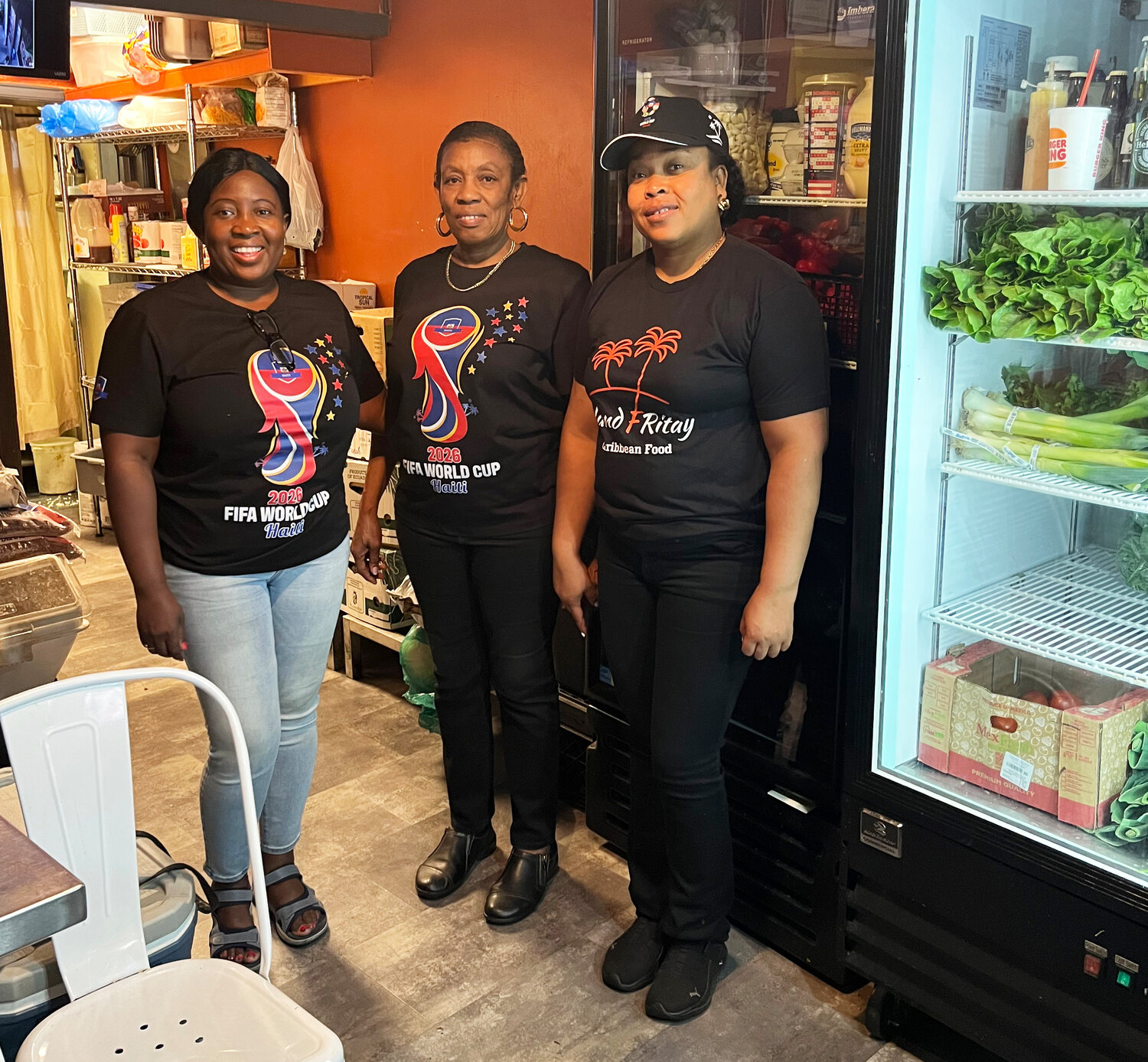
At 7:30 that previous night, Island Fritay Restaurant, a Haitian restaurant on W. Chew Avenue in the city’s Olney neighborhood, was no busier than usual on a Friday night. But an hour later, every seat was taken, and patrons squeezed shoulder to shoulder against every square inch of open wall, eyes glued to the restaurant’s television, in a corner next to the front door.
Haiti’s World Cup comeback is long overdue, given the popularity of soccer on the island. A definite underdog in the tournament, Les Grenadiers (The Grenadiers) stood a hard match against Brazil, one of the teams favored in the tournament.
By halftime, Brazil had put three goals in the back of the net, a lead that effectively knocked Haiti out of the tournament. However, the resilient team kept playing through the last half, and prevented another score from the Brazilians.
Sherline and Jean Constant, the owners of Island Fritay Restaurant, caught what they could of the match as they made sure their patrons were well fed.
“Everyone was in good spirits, even after we lost,” said Sherline. “It was wonderful the way we connected with Brazil. We feel a shared respect.”
Although they won’t make it to the knockout rounds this time, Haiti has become the only Caribbean country to date to make it to two World Cups. They’ll play their final game of this tournament against Morocco on June 24.
Cooking as care
Island Fritay Restaurant is owned and operated by Jean and Sherline Constant, Haitian immigrants who moved to North Philadelphia from New York City in 2009.
At the time, there were far fewer Haitians in the area. Sergeline Constant, Sherline and Jean’s daughter, remembers the area had a far different demographic when she was a kid.
“Growing up, I was the only Haitian kid,” remembers Sergeline. “5th Street is traditionally known as Vietnamese and Korean. Further up, St. Helena, the Catholic school, was Vietnamese and Korean based. A lot of the businesses and properties on 5th Street are owned by Koreans.”
Sherline is a nurse by training, having gotten her license at Eastern Technical Center in 2009, and later studied at the Community College of Philadelphia. During the height of the pandemic, she worked in a long-term care facility.
But before she was a nurse, Sherline always had a love for cooking and sharing food. Her nursing career was an extension of her passion for caring for people. In Haitian culture, preparing food is a deeply rooted form of care and love.
“Haitian cooking is not just throwing stuff together,” says Sherline. “You have to touch it. You have to feel it. You have to taste it. You have to have passion. You want people to enjoy it. It’s a love language. It’s about all the thought that goes into it.”
The Constant’s opened a Haitian restaurant when they first moved to the area, but they had to shut down their business, due to the demands of raising their kids and the lack of Haitians in the community at that time. In 2010, the earthquake in Haiti caused Sherline to have to return home to help and relocate her family on the island.
After working as a nurse through Covid, Sherline wanted to open her restaurant again to reconnect with her first passion, her original way of caring for people in her community.
A tour of ‘Little Haiti’
In the years since their first restaurant closed, the demographics of N. 5th Street have changed substantially. Island Fritay Restaurant is now one of many Haitian-owned businesses in the immediate area.
Adjacent to the Constant’s restaurant is Chez Madame Haitian Store, which stocks food, cosmetics, and medicinal herbal products from Haiti, most of which can’t be found in the aisles of your average store in the U.S.
“A lot of what Haiti produces is from the earth,” Sergeline explains. “It doesn’t go through the same processing that food here in the U.S. does. It tastes different. And people want the Haitian goods because they taste like home. When you get homesick, having that traditional food from home makes you feel good, both inside and out.”
Next to Chez Madame’s, on the corner of 5th Street, is the Loulou Express, a travel agency and multiservice store named after and run by Sergeline’s uncle. The store offers translation services and helps with converting currency to send home.
With many Haitians coming to the U.S. to work and support their families on better wages, the ability to easily send money home is critical. The multiservice also helps recent immigrants process their legal paperwork due to the language barrier.
Jefna Boutique is a clothing store around the corner and further down is La Baguette Royal, a Haitian bakery. Sherline and Jean also have connections to Haitians in the local real estate business, allowing them to connect newcomers who want to rent or buy homes in the area.
The presence of these established Haitian-owned businesses encourages more Haitians to move to the area, knowing that there is a support system in place that they can rely on.
“When people are like ‘I need help with taxes, I need help with my immigration paperwork, I need help with getting money home,’ having systems and structures here, it just created this whirlpool of community,” said Sergeline.
A leader in community through food
As early Haitian immigrants in the area, the Constant’s restaurant and connections have become a central entity for the Haitian community in the area. Island Fritay Restaurant has hosted community events from New Year’s celebrations to back-to-school drives.
“When you’re doing business, it’s not all about money,” said Sherline. “You have to care for people, too. You have to care for the community. If the community is going to do well here, I have to make my input.”
Miranda Alexander founded and directs the Caribbean Community of Philadelphia (CCP). She has long worked on the ground helping Haitians and other immigrants with social services and building a new home in Philadelphia.
Miranda has partnered with Sherline on many projects in previous years in support of the Haitian and local community and says that she is a natural leader.
“She has a heart for leadership,” said Miranda. “I think she has a heart for community, and I think she creates community like I do, so we’re a good partnership.”
What is now being called Philadelphia’s ‘Little Haiti’ by locals attracted many Haitian fans who traveled to the city to watch their national team play to Island Fritay Restaurant.
“I was talking to someone who drove from Boston,” Sergeline said. “I met two people who drove up from South Carolina. Someone came in from Canada. They were here to visit someone in Philly, and then they came to get some food.”
A growing multi-cultural community
In the years since the Constant’s moved from New York, Haitians are far from the only immigrants moving into the area. People from the Dominican Republic, Jamaica, and East Africa have joined the already established East Asian communities.
“We may be from different places, but at the end of the day, we are all immigrants,” said Sherline. “We all look out for each other in a way. They support us and we support them when we shop at their stores. We’re all connected.”
Sherline finds inspiration in the greater numbers of Haitian people who, like her, come to the area to open businesses. Having an established Haitian restaurant encourages other entrepreneurs to open their own businesses in the area — and to rebuild and reimagine their community.
“Nothing is impossible once people can see it’s achievable,” said Miranda. “It will inspire the younger generations. Sometimes the younger generations get a little jaded about being put down. So it helps them to see themselves in Philadelphia a little bit differently.”
Revolution and resilience, and a new spotlight
Haitians have a proud history of being at the forefront of revolution, winning independence from France in 1822, and inspiring a wave of other revolutions across the Latin American nations, often supported by the Haitians.
“They’ve given other people that revolutionary power,” said Miranda. “They’ve inspired, they’ve financed other people’s revolutions. They’ve always been challenged as the first Black republic and the first to revolt successfully against slavery. That act alone continues up to this day to follow Haitians.”
An island nation on a fault line, Haiti has also seen many natural disasters which have left hundreds of thousands dead and displaced. And poverty caused by a history of exploitative systems is also something Haitians have long endured.
Sergeline says these realities should be acknowledged, but that they are part of Haitian life. And while disasters are devastating, people find a way to overcome and move past them. She said her uncle’s account of the 2010 earthquake has shaped her way of thinking of Haiti.
“It was sad, it was devastating, but we’re not unfamiliar with earthquakes,” she explained. “It doesn’t take away from the tragedy of people who lost their homes or have died. But the media has a way of playing that up.”
The Haitian immigrant community has faced many challenges in the U.S., facing racism, prejudice, and an increasingly hostile immigration policy.
“I would say to all Haitians not to give up and stay with the good spirit,” said Sherline. “We’ve been suffering for so long. We’ve been through the earthquake and a president assassinated. But we try to have a good spirit and keep going. We still have hope. Now the world sees us. It’s a good thing, a positive thing for Haiti.”
Competing again in the FIFA World Cup gave Haiti a different media spotlight, one that has brought positivity and inspiration. Miranda says that Haiti’s participation is meaningful far beyond soccer.
“We’re in the news in a historic way,” said Miranda. “In a really vibrant and transformative way, for being different, for taking on someone like Brazil. In the 26 years that I’ve been in Philadelphia, and as long as I’ve been serving Haitians, I’ve never seen us this united. It’s a different level of pride.”
MORE: New data shows FIFA World Cup, Fan Festival’s impact across Philadelphia
Keywords
Haiti World Cup,
Haitian community Philadelphia,
Little Haiti Philadelphia,
Island Fritay Restaurant,
Olney Philadelphia,
FIFA World Cup,
Haitian immigrants,
Caribbean community,
Haiti soccer,
Philadelphia neighborhoods