

Will HOPE/HELP give Haiti’s textile sector a fighting chance?
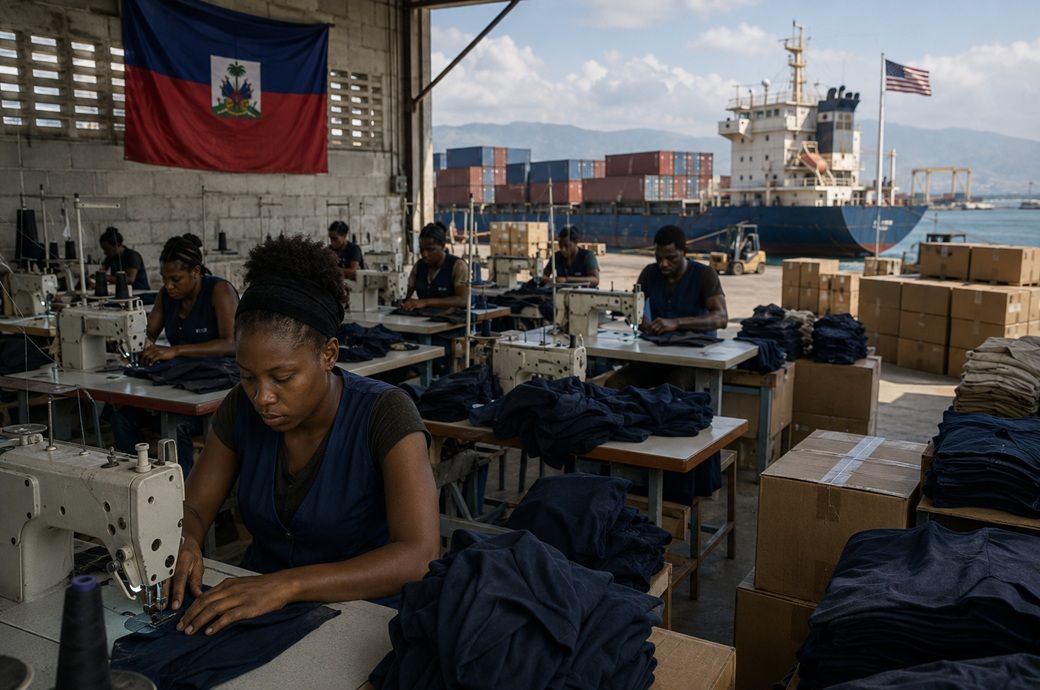
According to reports, US President Donald Trump recently signed H.R. 6500, the Continuing Appropriations and Extensions Act, 2027, into law after the legislation was passed by the Senate on August 8. The bill provides a two-year extension of the Haitian Hemispheric Opportunity through Partnership Encouragement Act (HOPE Act) and the Haiti Economic Lift Program Act (HELP Act), along with the African Growth and Opportunity Act (AGOA).
Now comes the harder question: Can that support help the sector move beyond survival and lay the groundwork for recovery and renewed growth?
A two-year HOPE/HELP extension keeps duty-free treatment for qualifying Haitian textile and apparel products to the USA through December 31, 2028.
Haiti’s textile and apparel employment has fallen from roughly 60,000 workers in 2021 to around 22,000 by end-2025.
The reprieve can protect orders and jobs, but recovery needs security, infrastructure, logistics, investment and stable trade policy.
For Haiti, the significance goes well beyond tariffs. Textiles and apparel are among the country’s most important export industries and a major source of formal employment and foreign exchange. Yet political instability, gang violence, transport and supply-chain disruptions, factory closures, and uncertainty over trade preferences have taken a heavy toll.
The scale of the contraction is stark. The industry employed roughly 60,000 workers in 2021, according to some estimates, while recent data suggests employment had fallen to around 22,000 workers by the end of 2025.
That decline underscores just how severely Haiti’s prolonged economic and security crisis has affected the sector.
Against this backdrop, the HOPE/HELP extension offers something the industry urgently needs: breathing room.
The Haitian government has reportedly welcomed the US decision to continue the trade preferences, pointing to their potential to preserve jobs, support exports, attract investment, and strengthen the country’s industrial base, particularly textiles and apparel. Industry representatives have likewise described the extension as important relief for businesses and workers, while emphasising that a longer-term renewal is needed to give investors and international buyers greater certainty.
That certainty matters. Continued duty-free access for qualifying Haitian products could help manufacturers retain existing orders, protect jobs, and reassure buyers that Haiti remains a viable sourcing destination. It could also give companies greater stability after years of disruption and help preserve the industrial capacity that remains.
But the extension should not be mistaken for a recovery strategy.
The sector’s sharp contraction, declining orders, and factory closures demonstrate how quickly confidence can erode when security, market, and policy risks mount. A two-year extension may help prevent further erosion of the industry, but it is unlikely, by itself, to restore Haiti’s apparel sector to anything close to its former scale.
Duty-free access can improve Haiti’s cost position, but buyers also need confidence that orders can be produced and shipped reliably. In apparel, where sourcing decisions depend heavily on lead times, production continuity, logistics, and scale, tariff preferences cannot indefinitely compensate for factories operating in an insecure environment or supply chains exposed to repeated disruption.
This is where the real test begins. If improved security, functioning infrastructure, reliable logistics, investment and stable trade policy develop alongside the extended preferences, the latest reprieve could do more than keep Haiti’s apparel industry afloat. It could give an industry fighting for survival a genuine opportunity to rebuild its productive base, regain buyers’ confidence and lay the foundations for a broader industrial revival.
Fibre2Fashion News Desk (DR)