

Why Red Cards Have More Than Tripled Since Last World Cup
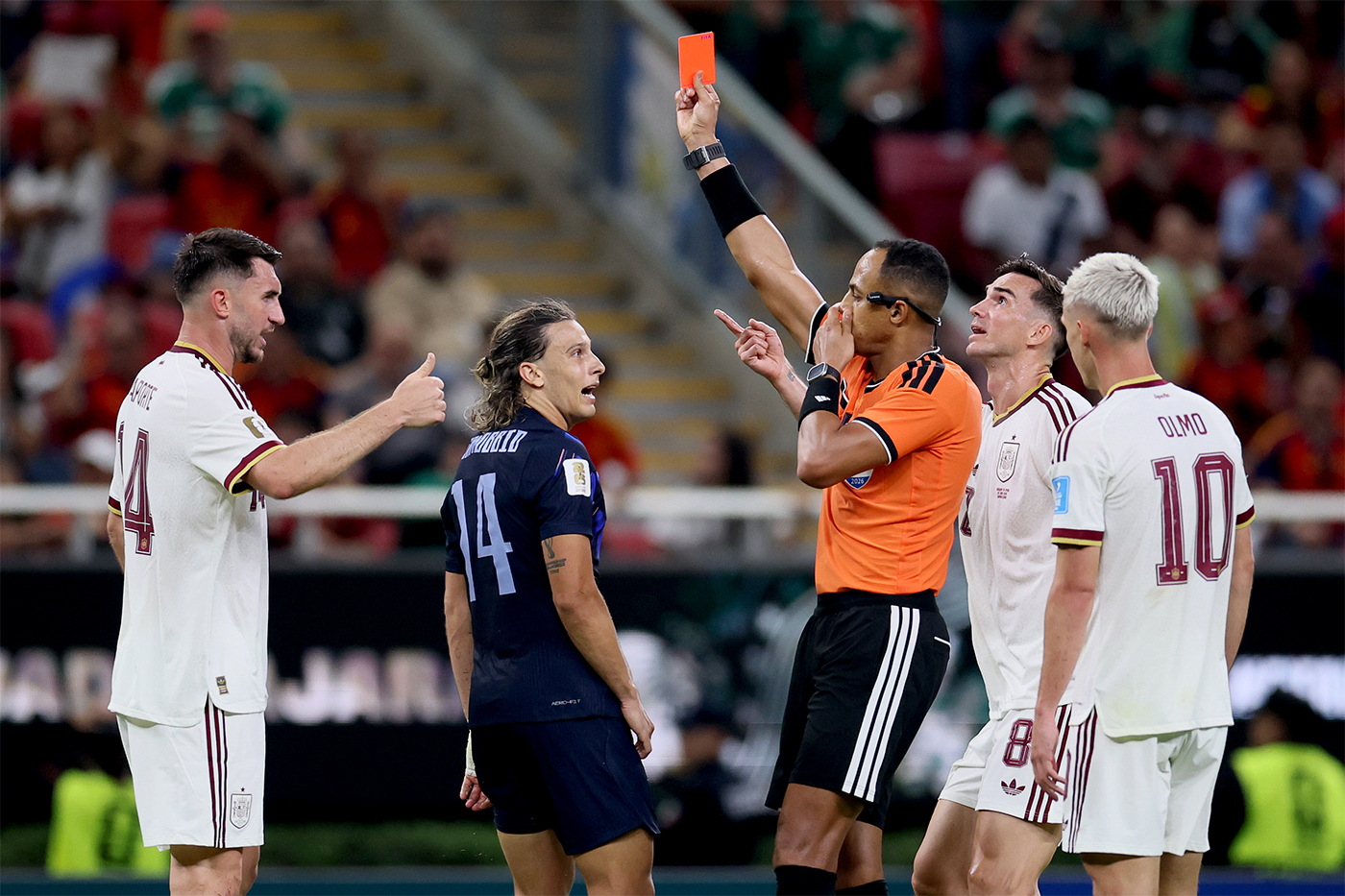
In a reversal on Sunday, FIFA announced that it was suspending U.S. striker Florian Balogun’s one-game red-card ban, which will allow the star player to compete in the U.S.’s World Cup Round of 16 match against Belgium on Monday.
Balogun is far from the only player to have received a red card during this year’s tournament. In fact, according to data reviewed by Northeastern’s NetSI Sport research group, red card issuances have more than tripled compared to the last two World Cups.
So far in this year’s World Cup, 13 red cards have been given. In both 2018 and 2022, only four were issued, according to the data.
In soccer, players are given either yellow or red cards in response to unsportsmanlike behavior. A yellow card is the lesser of the two punishments and serves as an official warning. These are issued to players who perform an illegal tackle, argue with referee, feign an injury, etc. A red card, by contrast, is more serious and is issued to players who commit more egregious actions, including serious foul play, acts of violence, name-calling, spitting and deliberately denying an obvious goal-scoring opportunity, otherwise known as DOGSO.
Players who receive a red card are immediately ejected from the game, and in the World Cup, are banned from starting in the next match. Similarly, receiving two yellow cards in a match equals a red card.
Balogun received his red card during the Team USA Round of 32 match against Bosnia and Herzegovina after stepping on an opponent’s ankle while trying to regain possession of the ball in the second half.
While some defenders argue that Balogun shouldn’t have been given a red card in the first place, critics of FIFA’s decision to suspend Balogun’s ban, including the Union of European Football Associations, or UEFA, say it hurts the tournament’s integrity. On Monday, FIFA dismissed Belgium’s challenge of Balgoun’s eligibility to play.
But why the sharp increase in red cards throughout the World Cup tournament?
Northeastern University NetSI Sport points to a few factors, including advancements in the video assistant referee, or VAR, technologies, which have become faster in recent years and provide slow-motion footage for playback.
Three of the red cards issued, for example, were initially designated as yellow card offenses, but were upgraded after referees viewed the VAR footage, the data shows. Those included Qatar’s Homam Ahmed’s last-man foul on Canada’s Tajon Buchanan in a group stage match on June 18; Qatar’s Assim Madibo’s leg-breaking tackle on Canada’s Ismaël Koné in that same group stage match; and Iraq’s Rebin Sulaka’s DOGSO on Senegal’s Sadio Mané in a group stage match on June 26.
Every red card at the 2026 World Cup
FIFA has also placed more rules and regulations around safe and ethical play, NetSI Sport highlighted.
Two of the 13 red cards issued this year, for example, were given to players who violated FIFA’s new rule that players cannot cover their mouths when talking to their opponents. The first one was issued to Paraguay’s Miguel Almiron in the country’s group stage match against Turkey on June 19, and the second was issued to Ecuador’s Piero Hincapie during the country’s Round of 32 match against Mexico on Tuesday, June 30.
Conversely, yellow cards and fouls are down across the board, which Northeastern’s NetSI attributes to FIFA allowing for games to flow more smoothly without stopping for minor skirmishes.
Data analysis provided by Brennan Klein, director of Northeastern University’s NetSI Sport research group.
Crédito: Link de origem