

Why did Xi choose to visit Egypt amid the US-Iran tensions?
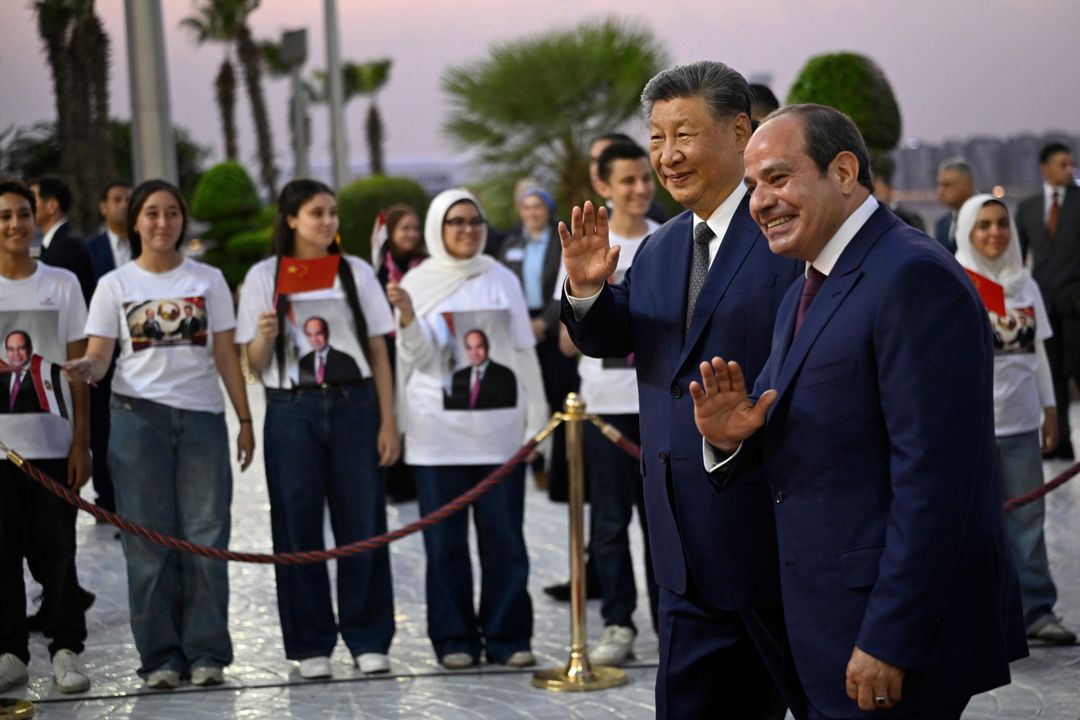
Chinese leader Xi Jinping arrived in Cairo as China and Egypt marked 70 years of diplomatic ties, shortly before a possible meeting with US President Donald Trump in late September.
The visit came amid renewed regional tensions, with US forces attacking IRGC targets and Tehran retaliating by attacking American bases across the Middle East.
Egypt, which has been largely silent on US-Iran tensions, condemned recent Iran attacks on Arab states.
During the visit, Xi and Egyptian President Abdel Fattah el-Sisi called for a “comprehensive agreement” to end the war with Iran and signed more than 20 agreements. They included a deal allowing Beijing to complete the third phase of a joint industrial zone at the Suez Canal, expanding China’s economic presence along one of the world’s most important trade routes.
Cairo and Beijing have a significant economic relationship, with bilateral trade reaching close to $21 billion, as the two countries have linked Egypt’s Vision 2030 with China’s Belt and Road Initiative.
“There is a clear economic interest on both sides, especially given the current circumstances in the region,” Altay Atli, an expert on Chinese politics and a senior scholar at Sabanci University’s Istanbul Policy Center, tells TRT World.
He highlighted both states’ growing concerns that the war in Iran has stalled global trade because of tensions in the Bab el-Mandeb and Hormuz straits.
Egypt, whose economy depends heavily on Suez Canal trade, has been concerned that pro-Iranian Houthi attacks in the Bab el-Mandeb have disrupted shipping across the Red Sea, reducing revenues.
Burdened by deep structural debt, the Egyptian economy has long been vulnerable to regional conflicts like the current Iran-US war.
China, a major consumer of Gulf oil, has also been concerned about the Iran conflict, as blockades across the region’s two key straits have disrupted global energy shipments.
Related
“While the anniversary provided the occasion for the visit, the deeper issue is a shared interest in regional stability,” Atli tells TRT World, referring to possible Egyptian-Chinese cooperation to ensure regional stability across the Middle East.
Why Egypt matters
Despite Houthi attacks in the Red Sea, Iran’s effective closure of the Strait of Hormuz has pushed more oil tanker traffic towards the Suez Canal, making the waterway even more strategically important at a time when China is increasing its investment there, according to Atli.
Egypt could also help China deepen its engagement not only with Arab states but also across Africa, given Cairo’s involvement in several regional conflicts, including those in Palestine, Sudan and Libya.
“In that sense, Egypt offers China geography, markets, and political legitimacy at precisely the moment Beijing wants a larger Middle Eastern role,” Dania Thafer, the executive director of Gulf International Forum, a Washington, DC-based research institute, tells TRT World.
Atli also highlights Egypt, the most populous Arab state with good relations with both China and the US, as “a potential point of convergence” between Washington and Beijing.
“Egypt is continuing to diversify its partnerships, bringing in Chinese investment and cooperation without giving up its relationship with the United States. And China, for its part, seems quite comfortable being one partner, but a very important one, among several, rather than trying to pull Egypt exclusively into its camp,” says Atli.
While Egypt has substantial economic ties with China, it remains the second-largest recipient of US military aid, receiving roughly $1.3 billion annually, while pursuing a foreign policy of “strategic balance.”
“For Xi, engaging such a close US partner allows China to demonstrate that deeper relations with Beijing do not require governments to formally abandon Washington,” says Thafer.
This balancing act between the two great powers may also be one reason for Xi’s visit to Cairo ahead of his possible late September meeting with Trump.
China wants to guide Cairo “to lead from the center” because Beijing supports “an architecture that develops in concentric circles,” says Dan Steinbock, a geopolitical analyst and international economist.
“Egypt could serve as the maritime anchor of this new architecture, preempting interference in regional choke points,” Steinbock tells TRT World.
That potential role also carries a message for Washington.
Credit: Source link