

While SpaceX and Boeing compete for billion-dollar NASA contracts, Turkey has begun constructing a spaceport in Somalia to launch rockets near the equator and transform the Horn of Africa’s coastline into a strategic shortcut to reach space by 2028.
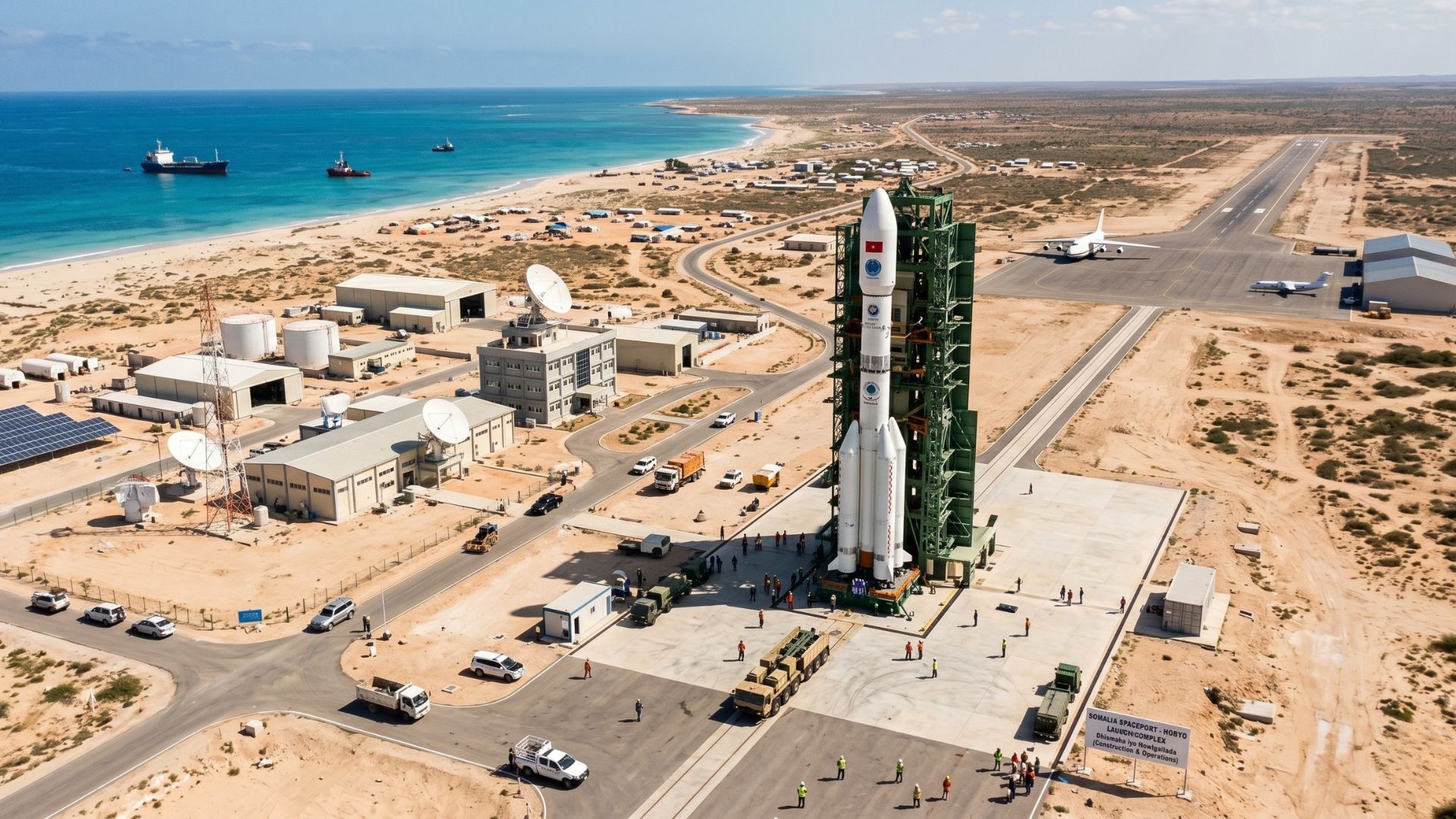
Turkey began construction of a spaceport in Somalia to launch rockets near the equator and reduce the cost of space missions.
The global race for access to space has gained a new unexpected chapter in the Horn of Africa. While companies like SpaceX and Boeing continue to fight for billion-dollar contracts from NASA and the United States government, Turkey has decided to bet on a completely different strategy: building a spaceport in Somalia, practically next to the equator, to reduce launch costs and accelerate its national space program. The information was officially confirmed following statements by Turkish President Recep Tayyip Erdoğan and Turkey’s Minister of Industry and Technology, Mehmet Fatih Kacır, at the end of December 2025.
According to the specialized portal Space in Africa, Turkey completed the feasibility and design studies of the project and started the first phase of construction of the spaceport on Somali territory. The announcement was made during a joint conference between Erdoğan and Somalia’s President, Hassan Sheikh Mohamud, in Istanbul on December 30, 2025.
Turkey chose Somalia because rockets launched near the equator gain a natural physical advantage
The technical logic behind choosing Somalia is relatively simple but extremely powerful for the space industry.
The Earth rotates faster in the equatorial region. This means that rockets launched near the equator receive a sort of “boost” from the planet’s own rotation. As a result, they need to spend less fuel to reach orbit.
This physical advantage is so important that some of the world’s main space bases have been operating near the equator for decades.
The most famous example is the Kourou Space Center, in French Guiana, used by the European Space Agency. The Turkish think tank ORSAM’s own analysis cited Kourou as a direct reference to justify Turkey’s choice of Somalia.
The Somali coast on the Indian Ocean offers another strategic benefit: vast uninhabited ocean areas ahead of the launch trajectory. This reduces risks to civilian populations in case of rocket failures and facilitates testing of long-range space systems.
Spaceport is part of the Turkish national program to achieve space independence
The construction of the spaceport did not come out of nowhere. The project is directly linked to Turkey’s National Space Program, officially announced by Erdoğan in 2021. Among the disclosed objectives were:
- develop own rockets
- ensure independent access to space
- create a national launch base
- send future lunar missions
- expand the Turkish aerospace industry
According to the Turkish government, the Somali spaceport will be used both for launching Turkish rockets and to serve international commercial clients in the future. The idea is to transform the facility into a regional platform for space services and satellite integration.
Turkey already has growing experience in space programs. The country officially created its Turkish Space Agency in 2018 and sent its first astronaut, Alper Gezeravcı, to the International Space Station in January 2024 through the Axiom Mission 3.
Space project also expands Turkish presence in the Horn of Africa
The spaceport is not just a scientific project. International analysts observe that the initiative reinforces Turkey’s geopolitical presence in the Horn of Africa, a region considered strategic because of the Indian Ocean, the Red Sea, and global maritime routes.
Turkey has maintained a strong military and economic presence in Somalia for years. The country has in Mogadishu the TURKSOM military base, one of the largest Turkish military installations outside national territory. Additionally, Ankara has been expanding energy, infrastructure, and defense agreements with the Somali government.

In 2024 and 2025, the two countries also deepened cooperation in offshore energy exploration and maritime security. The construction of the spaceport appears as an extension of this strategic partnership.
According to the portal Al-Monitor, Turkish authorities consider the project an important step to expand technological, military, and industrial cooperation between Ankara and Mogadishu.
Turkey wants to reduce dependence on foreign bases to launch rockets
One of the problems faced by countries without their own spaceports is the dependence on foreign facilities to launch satellites or rockets.
Today, various space programs need to negotiate access to international launch bases, which increases cost, political dependence, and technical limitations. The Turkish government wants to escape this scenario.
The proximity of Somalia to the equator also allows Turkish rockets to be more efficient in equatorial orbit missions, widely used for telecommunications and meteorological satellites.
According to the analysis published by ORSAM in September 2025, the choice of Somalia is considered “rational” because Turkish geography does not offer ideal conditions for frequent large-scale launches.
Somali spaceport could become a new commercial launch platform
Besides the Turkish space program, Ankara also wants to enter the global commercial launch market.
The global space sector continues to grow rapidly. ORSAM cited that the global space economy was already approaching US$ 600 billion in 2024, driven by the expansion of satellites, telecommunications, orbital internet, and private space services.
The idea of Turkey is to use the Somali spaceport not only for national missions but also to offer:
- launch platform rental
- satellite integration
- rocket testing
- commercial orbital services
This would place Turkey in a very small group of countries capable of operating their own space access facilities.
The African coast chosen by Turkey has already begun to attract international attention
The project quickly began to attract international attention. According to the publication Intelligence Online in April 2025, Western and Chinese satellites were already monitoring areas of the Somali coast associated with the future Turkish space base.
The report stated that the facility had become a target of international observation even before the full details of the project were disclosed.
The interest is not surprising. Modern space bases can have enormous strategic importance because they involve:
- satellite launches
- military communications
- orbital monitoring
- rocket development
- aerospace testing
Even so, the Turkish government claims that the main goal is to ensure independent access to space within its national space program.
Somalia could become a new African gateway to space
If the schedule progresses as planned, Somalia could transform into one of the most unusual space platforms on the planet: a country historically associated with internal conflicts attempting to enter the global space economy.
According to TRT Afrika, the Somali government considers the project a historic milestone for the country and sees the partnership with Turkey as an opportunity for infrastructure, technology, and economic development.
The spaceport could also transform part of the Horn of Africa’s coastline into a new global route for space access in an era dominated by reusable rockets, private satellites, and commercial orbital expansion.
And perhaps this is precisely the most surprising aspect of the story: while traditional giants like the United States, Russia, and China have been competing for space supremacy for decades, a new launch hub may emerge on an African coast near the equator that, until a few years ago, almost no one associated with the space race.
Credit: Source link