

What’s driving Colombia’s shift toward Israel?
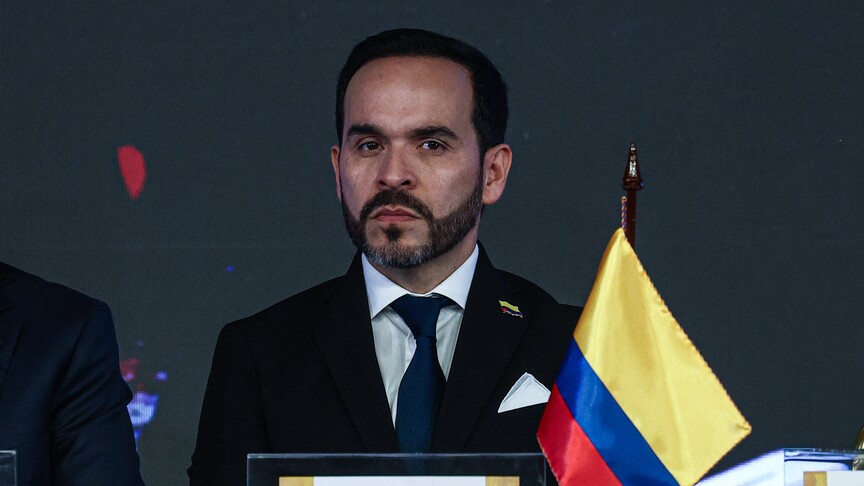
- Analyst says President Abelardo de la Espriella’s recognition of Golan Heights as Israeli territory violates international law
- Experts point to ideological affinity and a security agenda against drug trafficking as key drivers behind Bogota’s shift
Within days of taking office, Colombia’s new president has fast-tracked efforts to restore the South American nation’s ties with Israel, reversing predecessor Gustavo Petro’s strong stance on the genocide in Gaza.
President Abelardo de la Espriella defeated left-wing candidate Ivan Cepeda by less than one percentage point in the runoff vote in June. He took office on Aug. 7.
Petro, on the other hand, was barred from seeking a second term.
From Jerusalem embassy to Golan recognition
Within days, De la Espriella fulfilled a campaign pledge, announcing in a video message that Colombia would reopen its embassy in Jerusalem.
Israel considers Jerusalem its capital, but the city’s status remains disputed, and most countries do not recognize Israeli sovereignty over all of Jerusalem. The US recognized Jerusalem as Israel’s capital in 2017 and moved its embassy there in 2018.
He also froze a separate plan, announced by Petro in October 2023, to open a Colombian Embassy in Palestine, saying the office had never become operational.
Colombia formally recognized Palestine as a free, independent and sovereign state in August 2018, years before a new wave of Western recognition began with Spain, Ireland and Norway in 2024 and continued with France and the UK in 2025.
Under De la Espriella, Colombia formally recognized Israeli sovereignty over the occupied Golan Heights in Syria. This made Colombia the second country after the US to recognize Israeli sovereignty over the occupied rocky plateau in southwestern Syria overlooking northern Israel.
The announcement came the same day a 7.4-magnitude earthquake struck Colombia that killed hundreds and injured thousands more people, a coincidence analysts say pushed domestic attention toward disaster relief rather than foreign policy.
Israeli Prime Minister Benjamin Netanyahu welcomed the move in a video statement, thanking De la Espriella.
Bogota separately appointed Tania Gilinski as its ambassador to Israel, while Israel named Vivian Aisen as its envoy to Colombia.
Furthermore, both nations agreed to implement a mutual visa exemption for their citizens effective Sept. 1.
The two governments also launched the Colombia-Israel Binational Economic Commission. Colombian Vice President Jose Manuel Restrepo announced that a Colombian delegation would visit Israel in October.
Additionally, Bogota moved to resume coal exports to Israel that Petro had halted.
De la Espriella’s government has also begun withdrawing Colombia’s earlier intervention in South Africa’s case in the International Court of Justice linked to Israel’s genocide in Gaza.
Understanding the shift
How do regional experts view this move?
Arlene Beth Tickner, a former Colombian UN representative and ambassador-at-large, said the turnaround has little to do with Israel itself.
“I think the main purpose … is to demonstrate loyalty and proximity to the government of the United States,” she told Anadolu.
Glaeldys Gonzalez, a Colombia expert at the International Crisis Group, told Anadolu that framing the shift as a “U-turn” somewhat overstates the change.
Colombia spent two decades before 2024 as one of Israel’s closest allies in the region, its second-largest partner in Latin America after Brazil and a longtime buyer of Israeli weapons, before Petro severed ties over Gaza and ended defense contracts, she said.
Gonzalez said two considerations drive De la Espriella: an ideological affinity built on a defense of what he calls Judeo-Christian values and a security agenda centered on fighting “narco-terrorism,” with Israel presented, alongside the US, as a partner in his military-led crackdown on drug trafficking and armed groups.
Gonzales predicted military equipment and security technology, including air-defense systems and artificial intelligence, to counter the growing use of drones by armed and criminal groups, would sit at the center of the revived relationship.
She said the Golan recognition also reflects Bogota’s broader alignment with Washington’s foreign policy.
Gonzalez said Israel “is a central diplomatic priority for Colombia’s new government, extending beyond the restoration of bilateral ties.”
Mariano Aguirre Ernst, associate fellow at Chatham House, agreed that the pace of the decision signals alignment with the Trump administration while also sending a message to Colombia’s conservative political establishment, private sector and military.
Ernst, who is also a researcher at the Barcelona Centre on International Affairs, described it as a return to decades-old links among political, business, military and intelligence circles that only grew “very complicated” after Petro turned critical of Netanyahu’s government.
What’s in it for Israel?
For Israel, the experts said, the payoff is as much about legitimacy as economics.
Daniel Wajner, an associate professor at the Hebrew University of Jerusalem, said being recognized by another country carries practical rather than purely symbolic weight.
He said Colombia was again seeking closeness to Washington, much as it did in the 2000s under former President Alvaro Uribe, with Tel Aviv serving as a “bridge” toward that goal.
Israel, he added, has its own domestic interest in such gestures ahead of elections in November, using them to show its public that the government is “managing to have good relations with the world” despite facing criticism, boycotts and sanctions over its genocide.
Tickner offered a similar reading of Israel’s motives, saying these ties are “important for counteracting the reputational damage that’s being caused by its own actions in Gaza and in the occupied territories.”
Wajner framed the shift around two axes shaping global positions on Israel: the left-right political spectrum and a populist axis.
He said Colombia’s shift from Petro, a left-wing populist, to De la Espriella reflects a wider regional trend, citing Brazil’s *** earlier *** shift from Luiz Inacio Lula da Silva to Jair Bolsonaro, as well as the more recent cases of Argentine President Javier Milei and Salvadoran President Nayib Bukele.
Wajner and Ernst separately Israel’s Latin America strategy back decades, pointing to sales of intelligence and cybersecurity technology alongside military cooperation, including support once used to help Colombian forces fight leftist guerrilla groups such as the FARC and the ELN.
Ernst linked the practice to the 1970s, when Israel began arming Colombia after Washington, under then-President Jimmy Carter, imposed an arms embargo over human rights concerns
Looking ahead
Gonzalez said the earthquake absorbed public attention in Colombia, leaving the decision to generate “little public debate.”
Tickner, by contrast, said she was surprised, in a positive way, by how strong Colombian public outrage over the decision had been.
Calling the Golan recognition and the Jerusalem embassy plan an “open disavowal” of international law, UN Security Council resolutions and the UN Charter, she said the move would cause “tremendous damage for Colombia and Colombian interests” rather than the reputational gains De la Espriella may be seeking.
She also warned that expanding security cooperation could draw Colombia into joint operations with Washington in which Israel takes part, risking deeper US-Israeli military involvement across the region.
Ernst placed Colombia’s turn within a broader playbook used by far-right governments in the US and Europe. De la Espriella “wants to demonstrate his tough far-right/MAGA identity,” he said.
Both Ernst and Gonzalez expect ties with Israel to return to their traditional pattern.
Petro’s break with Israel was “an exception” that is unlikely to be repeated unless Colombia shifts sharply back to the left in future elections, said Ernst.