

What Libya’s intel chief death and drone attacks mean for reunification — Naharnet
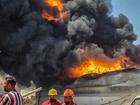
Libya has, within the span of a single day, had a senior intelligence official killed in a car bomb in the east and suffered drone attacks on a major oil refinery near Tripoli in the west.
How does this affect ongoing efforts, notably by the Trump administration, to reunify the country’s divided institutions?
– Who killed intel chief? –
Fawzi al-Mansouri, who presided over intelligence for the Libyan National Army, which controls the east and parts of southern Libya, was killed on Monday night by a car bomb in Benghazi.
Authorities have yet to identify the perpetrators or their motives, but Khaled Haftar — the son of LNA commander Khalifa Haftar — told AFP that “crime indicators point to a despicable terrorist tactic”.
A senior LNA official told AFP that the killing was a “jihadist attack” but said the authorities were “waiting for investigations to be done”.
According to intelligence monitoring group SITE, a member of the Islamic State group hailed the attack and called for “extending” the group’s operations in Libya.
– What’s the impact on the Haftar-backed administration? –
Libya has been divided for more than a decade, after being plunged into war during the overthrow in 2011 of former leader Muammar Gaddafi.
Two administrations are currently vying for power: a U.N.-recogniZed government in Tripoli and its rival in Benghazi, backed by Haftar.
Al-Mansouri’s killing handed the Haftars a significant setback in their efforts to paint a picture of stability in the areas of Libya they control.
Hamish Kinnear, an analyst with UK-based Verisk Maplecroft, said the LNA has long leveraged stability as “a source of popular legitimacy”. But the killing of a senior official in public “calls into question (its) claim to be a guarantor of security”.
Anas El Gomati, head of the Tripoli-based Sadeq Institute think tank, said the bombing “strikes at the image of Benghazi as the one part of Libya where the security order is settled”.
“That does not mean Haftar is suddenly losing control,” he added. “But it does expose a vulnerability inside the system he has built.”
– Will the killing affect reunification efforts? –
Experts say Al-Mansouri’s killing also challenges the US-brokered deal to reunify Libya, and particularly its armed forces.
“Any real reunification of Libya’s military institutions requires the eastern forces to give up some autonomy and some control,” said El Gomati.
“A military establishment that feels under threat is less likely to do that.”
Libya analyst Jalel Harchaoui said the United States had demanded concessions from the eastern authorities, including a shared defense ministry with the Tripoli government.
And Saddam — Haftar’s son and heir apparent — was “willing to grant these concessions” in recent talks, according to Harchaoui. But now “the atmosphere has completely changed”.
“The serenity that existed before August 10 is gone, and the priority is no longer to make concessions with Dbeibah.”
The US-mediated plan “is too slow and things in Libya keep shifting”, Harchaoui added.
– How will refinery attack affect Libya’s oil industry? –
On August 10, a large petrol reservoir in Zawiya caught fire during a drone attack on a major oil facility near Tripoli. Authorities have said it contained about 4.5 million liters of petrol.
The reservoir is part of the second-largest oil refinery in Libya, with a refining capacity of 120,000 barrels per day.
The fires were extinguished on Tuesday, and the incident claimed no victims, according to authorities, but experts said it could have consequences for Libya’s oil economy.
“This is not just an attack on the tank or the refinery, but on the entire Zawiya energy complex,” said Harchaoui.
“It must be remembered that in addition to the gasoline tanks, there are crude oil tanks, an export port terminal, pipelines, a power plant, etc.”
Harchaoui said the attacks were easy to carry out, using cheap quadcopter drones, and could deter energy companies from investing in Libya even as the North African country was striving to attract energy giants.
Gomati said the attacks were “a serious problem” for the sector.
“Investors are not only looking at how much oil Libya can produce. They are looking at whether the infrastructure around that oil can be protected,” he said.
Verisk Maplecroft’s Kinnear said Libya had been showing “tentative signs of recovery in recent months” with a slate of deals with foreign energy companies.
“But the sudden uptick in attacks on energy infrastructure and renewed uncertainty over leadership at one of Libya’s most crucial institutions underlines the fragility of Libya’s political and security situation.”
Credit: Source link