

Week Fifteen in 250 to 250
Last week was the fifteenth week of videos from the 250 to 250 Project that we’re producing to honor the 250th anniversary of the Declaration of Independence.
Our hope was for the videos to emphasize the agency of Americans—mostly everyday Americans—to change the country. Each falls into a category that defines what it means to be an American, including community, democracy, innovation, mobility, civil rights, education, conservation, and creativity.
Every week, I try to say something new about the week’s videos, but in a way, each week’s production has been the same: a wonderful combination of my own favorite historical events and ones new to me, with narrators who fit their topics perfectly and are themselves part of America’s story. The generous participation of so many people in this project has made it significantly bigger than the sum of its parts, and this week is no exception.
You can follow the project at the sites listed below, or under “videos” at my own YouTube page: Heather Cox Richardson. Or just wait until I send out the week’s roundup.
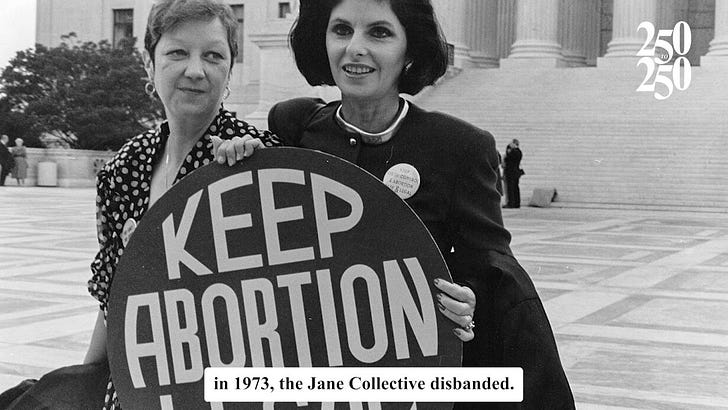
Heather Booth is an organizer and political strategist who has worked in civil rights and the feminist movement. She was a founder of the underground abortion service provider known as the Jane Collective.
Dr. Andrew J. Huebner is a Professor of History at the University of Alabama who focuses on modern U.S. cultural and military history. He is a Distinguished Lecturer for the Organization of American Historians (OAH), author of the acclaimed books Love and Death in the Great War and The Warrior Image, and co-editor of The Cambridge History of War and Society in America. He is currently finishing a new history of the buffalo soldiers, the first Black regular army units in US history, established by Congress in 1866.
Daniel Lurie is San Francisco’s 46th Mayor. He has focused on public safety, building housing, getting people off the streets and on a path to stability, and San Francisco’s long-term economic recovery. He honors the murals in San Francisco’s Coit Tower, which portray the lives and histories of everyday Americans.
Zohran Mamdani is the 112th Mayor of the City of New York. He previously represented the 36th New York State Assembly District and its neighborhoods of Astoria, Ditmars-Steinway, and Astoria Heights. Here, Mamdani recounts the history of the colony that, in 1665, would become New York.
The Brothers Three—Tyler, Ryan, and Clay Hereth—completed a southbound thru-hike of the Appalachian Trail together July 16 to November 22, 2011. Their history of the Appalachian Trail is a reminder of the importance of volunteerism and environmental stewardship.
Award-winning journalist Amna Nawaz is co-anchor and co-managing editor of the PBS News Hour. Her reporting spans politics, foreign affairs, immigration, culture and sports. Nawaz profiles Roberto Clemente, the Puerto Rican baseball legend whose brilliance on the field was matched by the humanitarianism that led to his tragic death.
Tennessee State Representative Justin Pearson is a prominent progressive American activist and politician best known for being the co-founder of Memphis Community Against Pollution and as a member of the “Tennessee Three.” He is currently a candidate for U.S. Congress. Here he tells the story of the historic labor strike in 1968 that would be the Reverend Dr. Martin Luther King Jr.’s final campaign.
Dana Tiger is an award-winning, internationally acclaimed artist known for her watercolors and acrylic paintings depicting the strength and determination of Native American women. Dana’s paintings are exhibited nationwide. She celebrates the legacy of her father, Jerome Tiger, a celebrated and influential Muscogee/Seminole artist.
Kahlil Greene, the “Gen-Z Historian,” is a well known digital educator, Peabody Award winner, and two-time Emmy nominee with an audience of over 50 million views across TikTok, Instagram, and author of History Can’t Hide on Substack. He recounts the history— including the destruction— of Tulsa, Oklahoma’s Greenwood District, a prosperous African American community known as “Black Wall Street.”
Dr. David Erickson, senior vice president at the Federal Reserve Bank of New York, leads a team focused on community development, seeking ways to increase investments in low-income communities. Erickson has a PhD in history from UC Berkeley. Alexander Hamilton’s work laid the foundation for central banking in the United States and, eventually, for the Federal Reserve.
Nicholas Stubblefield, a proud former member of the Heather Cox Richardson posse, is a writer and stand-up comedian based in Boston. He’s won awards, though none that you’ve heard of. Idaho is home. He celebrates landscape architect, author, conservationist and public servant, Frederick Law Olmsted, who designed some of America’s most celebrated landmarks, from New York’s Central Park to the U.S. Capitol Grounds and Chicago’s Jackson Park.
Award-winning Senior writer at Slate, Aymann Ismail is an author, and president of the Arab and Middle Eastern Journalists Association. His work has appeared in the New York Times and GQ, and on CNN and NPR. He tells the story of one of the nation’s first mosques, built outside the tiny town of Ross, North Dakota.
Colin Makoto Craig is a fourth generation veteran who served in the US Air Force. With the G.I. Bill, he graduated from Cornell University and is a JD candidate at St. John’s University. Craig examines how the G.I. Bill reshaped postwar America, sending millions of veterans to college and into the middle class.
Dr. Thavolia Glymph is an author and a professor of history and law at Duke University. Her research, writing, and teaching focus on slavery, emancipation, Reconstruction, labor, and women in the U.S South. Signed by Abraham Lincoln on January 1, 1863, the Emancipation Proclamation declared that all enslaved people living in territory controlled by the Confederate States of America were legally free and allowed Black men to join the U.S. Army.
Lina Khan served as chair of the Federal Trade Commission from June 2021 to January 2025. She teaches and writes about antitrust law, infrastructure industries law, the antimonopoly tradition, and law and political economy. Here, she captures the complicated story of America’s first transcontinental railroad.
Chuck Cooper III is President and CEO of the Chuck Cooper Foundation, which honors and carries forward the legacy of his father, Naismith Basketball Hall of Famer Chuck Cooper, the first African American drafted into the NBA. He celebrates the life of activist and athlete, basketball’s Bill Russell.
Former Secretary of State Hillary Clinton made history as the first First Lady elected to the United States Senate, and in her run for president in 2016. A lawyer, an author, and a staunch advocate for women, children, and families, she is an active force for progress and human rights. She recalls Eleanor Roosevelt’s leadership role in creating The Universal Declaration of Human Rights (UDHR), a milestone document in the history of human rights.
Follow Along | #WeAreAmerica250
Substack | YouTube | Facebook | Instagram | TikTok | Bluesky | Threads