

Uvalde PD hosts officials from Iraq, Morocco, Algeria
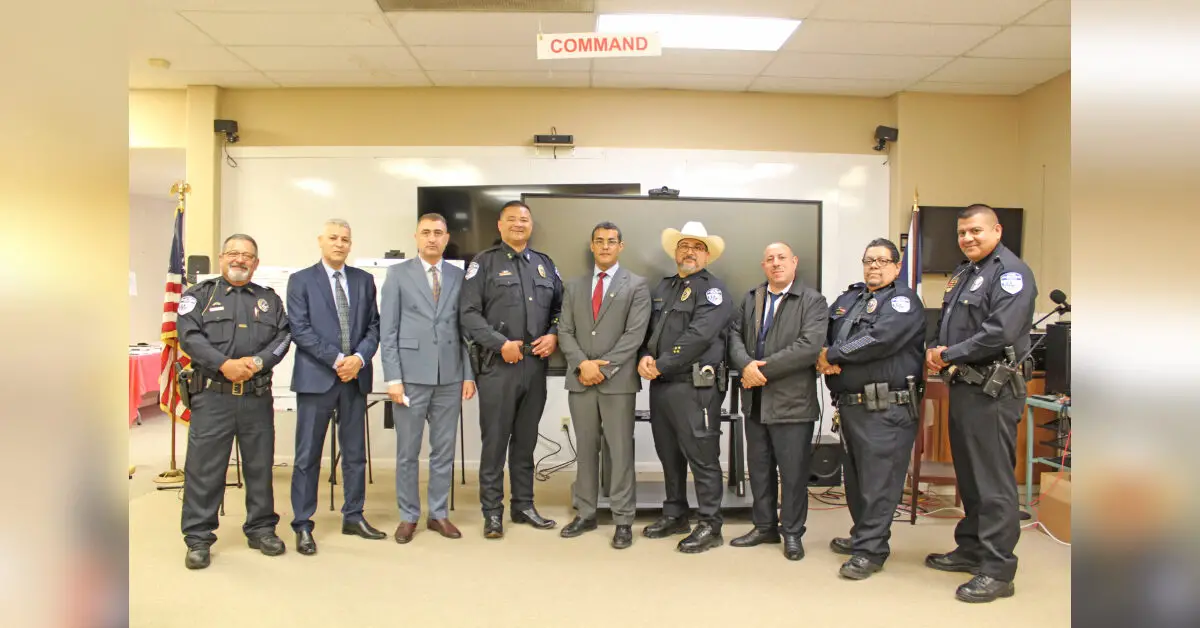
Lt. Javier Martinez, Abdelhadi Soum, Omar Hameed, police chief Homer Delgado, Mohamed Rafi, assistant chief Mike Davis, Amar Mostefaoui, lt. Juan Martinez and lt. Eduardo Canales (from left) meet at the Uvalde Police Department to discuss strategies for preventing terrorism. (Uvalde Police Department)
The U.S. Department of State escorted officials from Iraq, Morocco and Algeria on a trip to Uvalde on April 21. While getting a taste of small-town Texas charm, the leaders learned about combatting youth terrorism, shared advice on resilience after mass tragedies and ate cheeseburgers at vintage air travel-themed diner Hangar 6.
The group included Omar Hameed, the director of the psychosocial department at the joint operations information center in Baghdad, Iraq; Mohamed Rafi, the head of internal affairs of Kenitra in Morocco’s ministry of interior; Amar Mostefaoui, the judge at the directorate of penal affairs and pardons ministry of justice in Rouiba, Algeria; and Abdelhadi Soum, the head of the office for combating incitement acts in Algiers, Algeria.
“We had a lot in common when we talked about how the community feels about public safety, how the community feels about going to work, going to school, that sense of tension,” Uvalde Police Department assistant chief Mike Davis said.
The men spoke little English, and only one had been to the U.S. before. They wanted to learn about the May 24, 2022, mass shooting at Robb Elementary School, but Davis said they were more interested in the healing process than the initial event.
“It wasn’t so much that they were researching the tragedy. They were researching the resilience,” he said.
They came to Texas through the state department’s International Visitor Leadership Program. The men also stopped at various San Antonio-area agencies to learn about active-shooter training, resources for low-income youth and communication during mass casualty events. Davis first met them at the South Texas Fusion Center in San Antonio, where he serves as fusion liaison every Friday.
SWTFC is a regional public safety hub where agencies work together to assess threats across the area, which includes Uvalde. Davis said this collaborative approach inspired the international visitors.
“That concept to them was very new — different jurisdictions working together, sharing information in real time, and saying, ‘Hey, this could affect public safety, and we both have a vested interest in sharing the information.’”
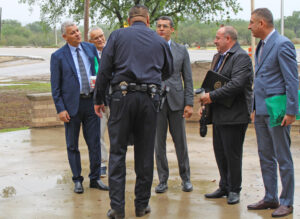
After getting to Uvalde, the men met city officials and toured UPD’s facilities with their interpreters. They learned how officers approach behavioral threat analysis in the wake of the Robb Elementary shooting, during which a troubled 18-year-old killed 19 students and two teachers.
Davis, who was hired in 2024, shared about UPD initiatives like the Crisis Assistance Response and Emergency Support (CARES) program and his training in identifying warning signs. The department now has mental health investigators who work with Hill Country MHDD to take a person of concern from “the pathway to violence” to “the pathway to wellness.”
The assistant chief was particularly moved by his interactions with Hameed, who reintegrates children kidnapped by ISIS into society.
“One of the biggest things that I learned was the importance of sustainability from them,” Davis said. “We think about our Robb kids and how they’re clustered together. [Hameed and his team] were already thinking, ‘Okay, what are we going to do when these kids graduate? How are we going to make them feel safe and comfortable and work in the community?’”
They also discussed the disparate roles of law enforcement in their communities. Davis said in the visitors’ North African and Middle Eastern countries, police officers are some of the highest paid workers. They are also more isolated.
In Uvalde, some residents don’t trust local law enforcement after their slow and disorganized response to the Robb Elementary attack. Davis said he shared the department’s new strategies for healing with the visitors.
“This message kept getting relayed, ‘[UPD] failed in their response during this incident, and we should never trust them,’ and so earning that trust takes perpetual effort,” Davis said. “We know that there’s going to be kinks in the road… We’re still going to be here to serve.”
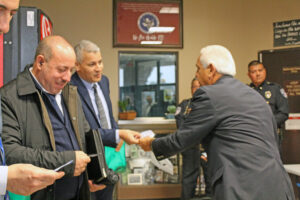
Uvalde Police Department chief Homer Delgado shakes the hand of Mohamed Rafi, the head of internal affairs of Kenitra in Morocco’s ministry of interior (center). Also present were (from left) Abdelhadi Soum from Algeria, an interpreter, Amar Mostefaoui from Algeria and Omar Hameed from Iraq. (Uvalde Police Department)
“We don’t have a time machine. We can’t go back and change the events of the past, but we can be a model for others globally,” he continued.
While the visit kept a formal tone at the department, Davis said everyone loosened up by lunchtime. The visitors asked to end their trip with an American staple — a diner cheeseburger.
“That cheeseburger came, and then all of a sudden everybody was able to relax,” Davis said. “We have so much in common, you know. We have families. We work. We care about our communities.”
Report for America corps member Hali Mecklin, hmecklin@ulnnow.com, 830-278-3335, covers education and crime for the Leader-News. Support local reporting with a tax-deductible donation at tinyurl.com/SupportHali .
Credit: Source link