

US World Cup is over but Pochettino, Infantino intrigue just beginning
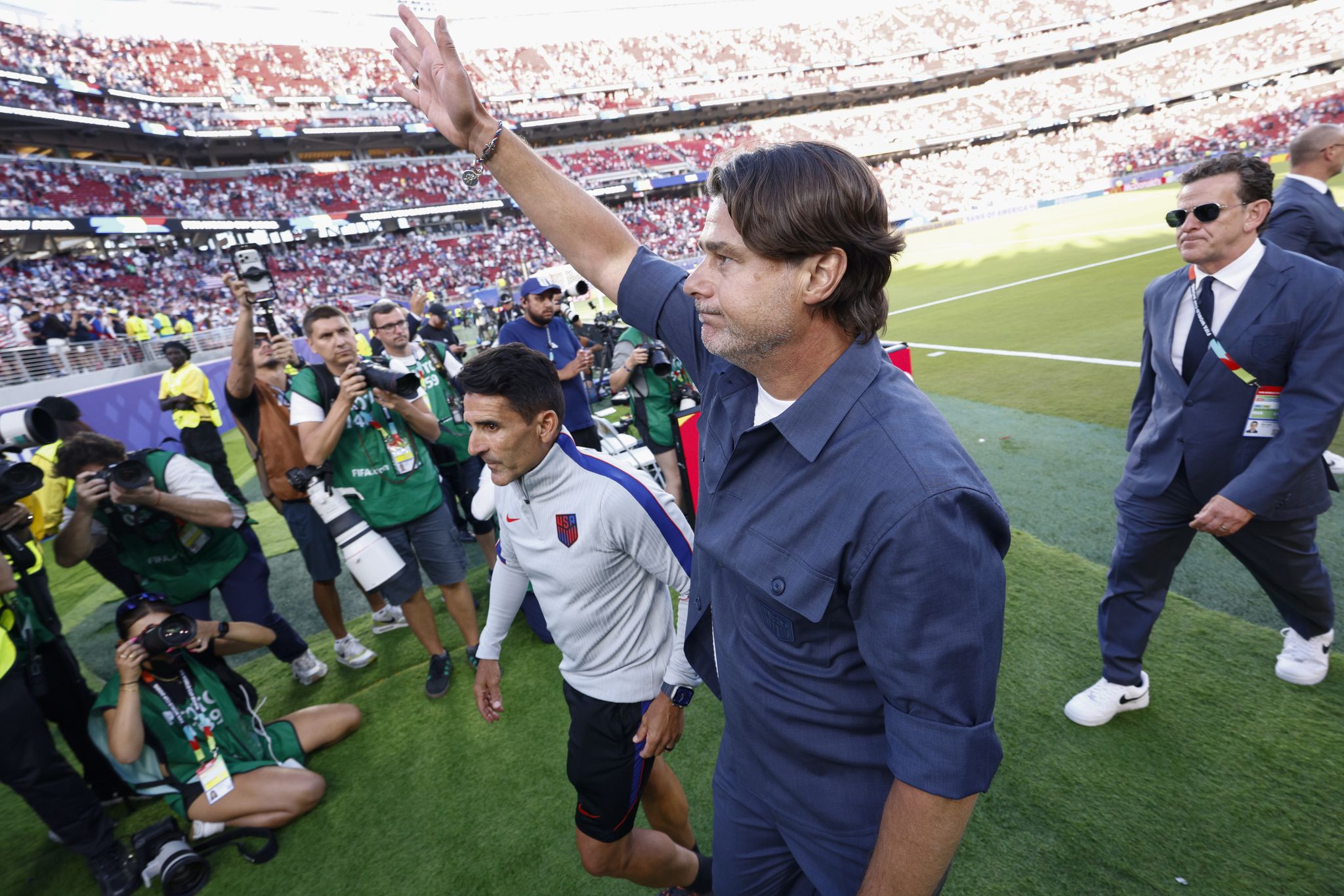

U.S. head coach Mauricio Pochettino acknowledges spectators following the FIFA World Cup Round of 32 match against Bosnia and Herzegovina on July 1 at the Levi’s Stadium. The U.S. won 2-0.
Do you remember the World Cup?
It’s been less than three weeks since the tournament that enthralled the United States has ended, and it seems we’ve all moved on. America loves a big event but we’re also pretty good at turning the page and, hey, NFL season is right around the corner.
Though MLS Commissioner Don Garber claimed the World Cup would be “rocket fuel” for his league — which, frankly, did a horrible job of marketing around soccer’s premiere event — the evidence is yet to materialize. Attendance is averaging about the same as before the World Cup and equivalent to last year. There’s very little buzz about MLS, aside from pockets of popularity.
Article continues below this ad
If you’re a newly minted soccer fan, the real excitement starts in about a week when the curtain goes up on the Premier League and everyone’s favorite Norwegian, Erling Haaland, as well as player of the tournament, Rodri, take the field for Man City against Arsenal. It starts at 7 a.m. on Aug. 16 — set your alarm.


But, even if the Viking rows have halted, “Take Me Home Country Roads,” is once again relegated to elevator music and — criminally — the grass has been torn out of NFL stadiums, the business of soccer goes on. The cycle for the 2030 World Cup has already begun.
For the United States, most notably, manager Mauricio Pochettino has signed on to coach the men’s team for another World Cup cycle. On one hand, you can say this makes sense. Pochettino was hired midway through the last cycle, after U.S. Soccer moved off of Gregg Berhalter and he had just 20 months to prepare. Now he’ll have the full four years with the team.
Article continues below this ad
On the other hand, you can argue whether he deserves the new contract. This will be the fifth time U.S. Soccer has kept the same coach from one cycle to the next, and it hasn’t worked out well in any of the previous World Cups.
Bruce Arena was the only one who made it all the way from one World Cup to the next: his team made a stunning quarterfinal in 2002 but flopped badly in 2006, failing to win a game. Bob Bradley and Berhalter only made it one year past when they signed their contract extensions before being fired. Jurgen Klinsmann, who signed his extension before he even coached in the 2014 World Cup, was such a subsequent disaster that the Americans failed to qualify for 2018; Klinsmann was fired during qualifying and emergency replacement Arena couldn’t change the team’s embarrassing fate.
U.S. Soccer touted that Pochettino “set the USMNT record for most tournament wins by a head coach,” but that achievement comes with an asterisk: He coached an extra round, something none of his predecessors could do. In truth, his record of success is pretty slim. He went 17-12-2 as head of the men’s team. His team didn’t have to qualify, as one of the host countries. He was 1-7 against European teams, the lone victory against Bosnia and Herzegovina at Levi’s Stadium.
Ultimately, his fate was the same as his predecessors: When his team faced a real test, against Belgium, it was manhandled and finished its run in the Round of 16. He wasn’t helped by the meddling of the president of the United States in revoking a red card, which seemed to discombobulate his own team and fire up the Belgians, but the end result was anything but a fluke.
Many believed Pochettino would go back to managing a European club but that ugly loss to Belgium might have dissuaded any bidders. Pochettino, who was making $6 million a year, the third highest paid manager in the World Cup, seemed to like his salary and America, so why not stay?
Article continues below this ad
The U.S. Soccer news release noted that the hire was “being supported in significant part by a philanthropic leadership gift from Kenneth C. Griffin,” with additional support from Socott Goodwin and Adam Freede. Those are the hedge fund billionaires who sought out and bankrolled Pochettino, so they — not results — may be the ones who decide whether he is a success.
In the broader world of international soccer, the fallout from Gianni Infantino’s attempt to sell stakes of the men’s and women’s World Cups to outside investors, and enrich himself in the process, continues. Already facing deep anger from the football world for much of his behavior during the World Cup, including bowing to pressure from President Trump on the red card issue, he now faces an outright mutiny.
In a note that should be of interest to San Francisco Giants fans, Infantino intended to bring in Joshua Kushner’s private equity fund as the lead investor. Kushner, whose brother is Trump son-in-law Jared Kushner, recently bought a minority stake in the Giants. The Times of London reported that Jared was originally part of Infantino’s plan, but Joshua was brought in as a more palatable alternative in the attempt to rally support.
Infantino, who — according to reports — could have stood to make $30 million a year in salary as a “commissioner,” more than quadrupling his current salary, immediately came under fire and the soccer world revolted. UEFA and its members unanimously condemned the plan, as did CONCACAF and the Asian Football Confederation.
Infantino backed off the proposal but now his future as FIFA president is very much in doubt, and he held an emergency meeting in Morocco on Wednesday with top FIFA leadership in a bid to save his job. He reportedly tried to bribe Morocco’s loyalty with an offer that the country — one of joint hosts — be awarded the 2030 championship match.
Article continues below this ad
The next major FIFA tournament is the women’s World Cup, which will be held in Brazil next summer. Infantino apparently didn’t consider the impact his rash plan, or the fallout, which could have included boycotts, would have on the women’s game. The Guardian reported that a sales pitch deck for the proposal, running 25-pages long, mentioned the women’s game exactly once. In a nice twist, the fiercest leaders of the resistance to Infantino’s plan were, according to the Athletic, the only two women on UEFA’s executive committee.
Infantino, long known for his patronizing attitude toward the women’s side of the game, now faces a major crisis. And he might not make it to next summer’s women’s World Cup.
You may have moved on. But the World Cup intrigue continues.
Crédito: Link de origem