

United States: The historical roots of Trump’s anti-Haitian racism
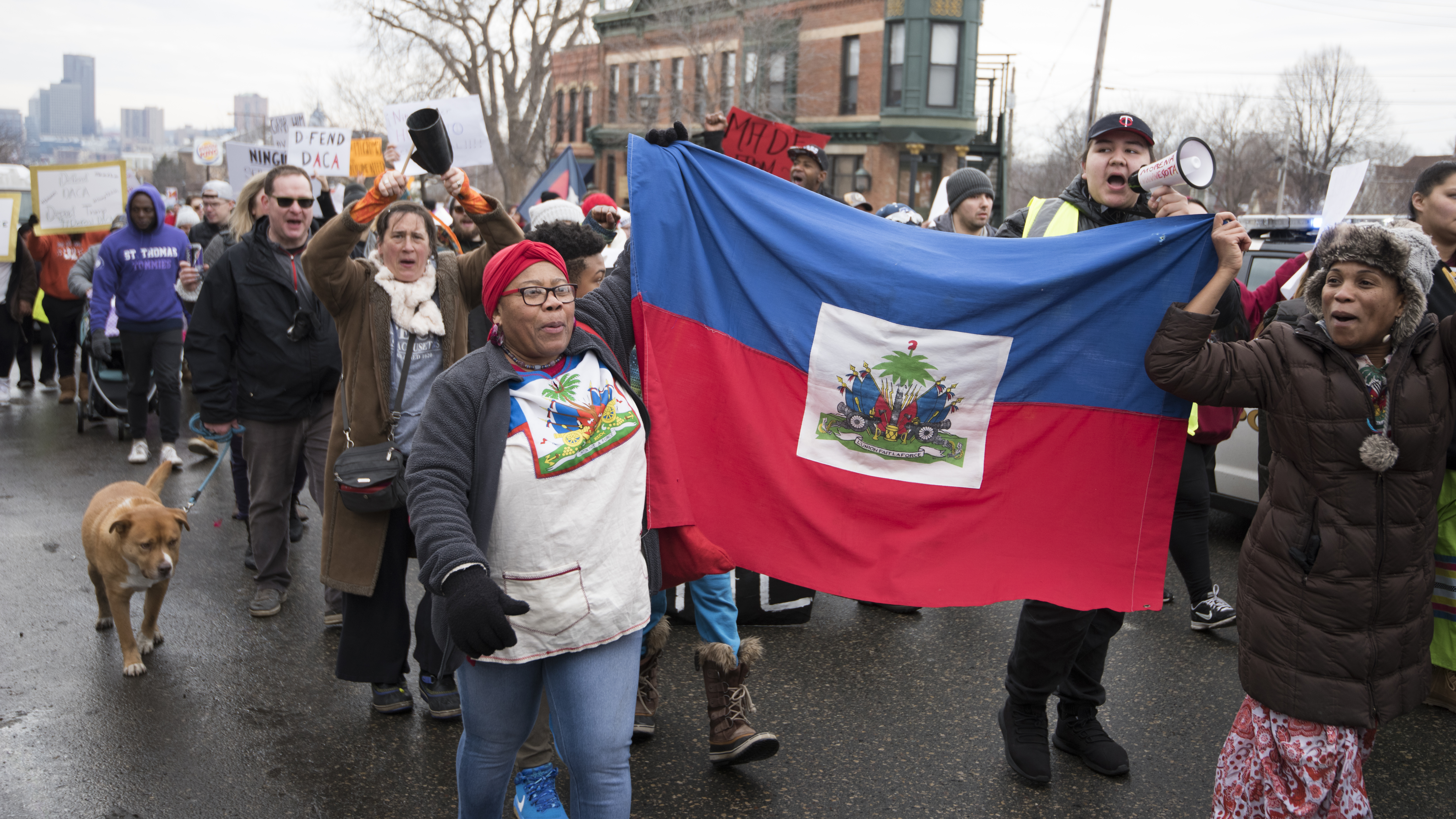
United States President Donald Trump’s government overturned the temporary protected status (TPS) of 350,000 Haitians living in the country this month, following a June 25 Supreme Court decision to greenlight the administration’s actions.
According to the American Civil Liberties Union, the Supreme Court case, Mullin v. Dahlia Doe challenged the Trump administration’s decision to terminate TPS for thousands of Syrian immigrants living and working legally in the US while it is unsafe for them to return home. The case was consolidated with Trump v. Miot, the case concerning Haitian TPS holders.
“TPS has historically allowed people from specific countries to remain in the US and to work here if it is not safe for them to return home due to war, disasters, or other emergencies,” the ACLU said.
Following the court’s decision, the Department of Homeland Security (DHS) moved quickly to end Haitians’ TPS, despite State Department advice saying it is unsafe for anyone to travel to Haiti.
Work permits for all Haitians were terminated on August 6, which will lead to mass layoffs and TPS holders losing their homes.
Thousands of these legal residents are now “illegal” and subject to deportation.
Haitians waiting for hearings on their residency status are being forced to wear ankle monitors — reminiscent of the iron shackles forced on enslaved people.
Trump’s racism
Haitians and their children are seen by the government as “the worst of the worst”.
Trump’s hatred for Black people — whether from Africa or their descendants in other countries — has spilled over into racism against other non-whites, as seen by the forced detention and deportation of Latinx residents and citizens by Immigration and Customs Enforcement and Border Patrol agents.
Trump’s goal is clear: “Make America White Again”.
Many Haitians have been living in the US under protected status since the devastating earthquake that struck Haiti in January 2010. TPS was extended and re-designated several times due to the ongoing humanitarian, political and security crises in Haiti.
Soon after taking office, Trump’s administration rescinded former president Joe Biden’s TPS extension, saying it believed TPS was being used far beyond its intended purpose.
The DHS said it was “returning TPS to its original status: temporary”.
The administration contended that repeated extensions allowed increasing numbers of Haitians to qualify for the program over time and described the system as having been “exploited and abused”.
The DHS also said the move was part of Trump’s broader effort to reverse policies it viewed as “encouraging illegal immigration”.
Critics of the decision, including human rights, civil libertarian and immigrant rights advocates, argue that TPS protections should remain in place, as Haitians continue to face severe political instability, gang violence and humanitarian crises, making it unsafe for them to return.
Significant community
People of Haitian descent living in the US number 1.1–1.5 million, depending on the definition and dataset used.
The 2021–22 census estimated there were about 1.14 million people of full or partial Haitian ancestry in the US.
Of the 852,000 Haitian-born immigrants living in the US in 2024, about 70% (585,000) were naturalised citizens.
The remaining 30% were made up of permanent residents (“green card” holders), TPS holders, parolees, visa holders or undocumented immigrants.
DHS reported that 235,350 Haitians received green cards between 2010 and 2022.
Parts of Central and South Florida, including Miami-Dade County, North Miami, Little Haiti, Fort Lauderdale and surrounding areas have some of the largest Haitian communities in the country.
In New York, Brooklyn’s neighbourhoods of Flatbush and East Flatbush have long-established Haitian populations.
Haitians have also settled in Boston, Brockton, Randolph, and nearby communities in Massachusetts, and there are significant Haitian populations in parts of Connecticut and New Jersey.
There is also a growing Haitian community in Atlanta, Georgia.
Haitians in Ohio, home of Vice President JD Vance, were falsely accused by Vance and Trump of killing and eating cats and dogs. The Republican governor repudiated those attacks, saying Haitians are hard-working members of the community.
Trump’s anti-Haitian racism is not unique. Historically, hostility towards Haitians and Black people has long been a policy of US imperialism. Direct intervention by the US into Haiti dates back to the 1800s, following Haiti’s struggle for independence from French colonial rule, when the Haitian people rose up and overthrew slavery and French colonial rule in a revolutionary struggle that lasted from 1791 to 1804.
Haiti’s struggle for liberation
Led by the revolutionary, Toussaint Louverture (1743–1803), enslaved people in the French colony began a major uprising in August, 1791. Haiti declared its independence from France on January 1, 1804, under the leadership of Jean Jacques Dessalines, Louverture’s lieutenant.
This ended French rule and created the world’s first independent Black republic.
It was the only revolution by slaves to have ever succeeded.
Defeated, France declared that the Haitians owed it an indemnity for the “property” (slaves) French slave holders had lost. Imperialist pressure finally forced Haiti to pay up in 1947.
For more than a century after independence, Haiti faced hostility from France and the US.
By 1862, the US government wanted control over Haitian finances, labour, ports and resources to benefit US capitalism’s banking and business interests.
By 1905, the US replaced France as Haiti’s main trading partner. In 1909, the National City Bank of New York secured a controlling interest in Haiti’s National Bank. In 1910 a US investor acquired Haiti’s national railroad, with rights to establish banana plantations on both sides of the tracks.
Peasants who held this land for generations were evicted. This prompted fierce resistance. For four years peasant armies fought back.
In 1915 President Woodrow Wilson sent the US Marines into Haiti. This act demonstrated the emergence of the US as an imperialist power on a par with European imperialists and based on the rule of powerful financial-industrial monopolies.
The marines seized the customs house, imposed martial law and media censorship, and outlawed dissent. They disbanded the Haitian legislature and eliminated the ban on foreign land ownership in the Haitian constitution.
During the occupation, the marines seized US$500,000 in gold from Haiti’s National Bank and transferred it to the National City Bank of New York.
US atrocities
After World War I, a resurgent Black leadership in the US opposed the US occupation of Haiti.
In 1920, James Johnson, Field Secretary of the National Association for the Advancement of Colored People (NAACP), visited Haiti and reported for The Nation about the brutality and atrocities carried out by US marines against the people of Haiti, including rapes, murders and massacres of resisting Haitian peasant guerrillas, as well as the reimposition of forced labour to build a major highway.
The Haitian hero under the US occupation was Charlemagne Péralte (1885–1919). Like Augusto César Sandino in Nicaragua and Emiliano Zapata and Pancho Villa in Mexico, Péralte led a nationalist peasant army resisting foreign domination.
Péralte had been dismissed from the army when he refused to surrender his weapons and flag to US marines who took over his district.
For this, he was court martialled and sentenced to five years hard labour in 1917 and his brother Saul was sentenced to death and executed by order of the marines.
In September 1918 Péralte escaped and began recruiting a guerrilla movement. Resistance spread over much of the country, and the US responded with brutal repression. The marines’ campaign against the guerrillas became a war of extermination. The US couched its campaign with racist terms about Black Haitians.
Prisoners were routinely executed. Villages suspected of harbouring guerrillas were burned; suspected sympathisers were shot. Villages and livestock were bombed from the air. Ground troops followed the bombings, killing survivors.
The occupation lasted until 1934. One of its chief legacies was the creation of a new army, the Haitian Gendarmes, under US command, to keep Haitians “in line”.
When the occupation ended, the US turned over power to the Haitian Gendarmes. Several dictatorships followed, most notably that of Francois Duvalier, known as “Papa Doc”. Duvalier’s regime killed 30–60,000 Haitians.
Duvalier ruled from 1957–71, and his son, Jean-Claude, or “Bébé Doc”, continued the dynastic regime until 1986, when the military intervened and he was ousted.
Elections were held and Jean-Bertrand Aristide was elected president in 1990. On September 30, 1991, a military coup overthrew him. Mass protests erupted, and the turmoil caused the US to intervene, and allowed Aristide to return to power from 1994–96.
Aristide led a new organisation, Lavalas, based among the nation’s workers, peasants and the poor. He disbanded the military and organised free and fair elections.
He was elected again in 2001. An opposition, representing Haiti’s bourgeoisie, and marked by political intrigues, forced him into exile, with the US again occupying Haiti to enforce his exile in 2004.
Turmoil again rocked the country, which has intensified due to political destabilisation, corruption, rising street violence, natural disasters and the impacts of decades of foreign military and political intervention and resource theft.