

UN biodiversity summit enters crucial final week amid funding disputes and calls for urgent action

UN biodiversity summit enters crucial final week amid funding disputes and calls for urgent action
From L-R: Kirsty Bryant, CBD Secretariat; and Co-Facilitators of a Friends of the Co-Chairs group on DSI Katie Beckett, UK, and Henry Michael Ndengejeho, Namibia.PHOTO/IISD/ENB – Mike Muzurakis.
By PATRICK MAYOYO
newsdesk@africaeconews.co.ke
The United Nations Biodiversity Conference has entered its decisive final week, with governments facing mounting pressure to bridge funding gaps, reform harmful subsidies and strengthen accountability in the global fight against biodiversity loss.
The 17th Conference of the Parties to the Convention on Biological Diversity (COP 17) is expected to conclude on Friday, following a first week that delivered several adopted decisions and fresh financial pledges worth hundreds of millions of dollars.
The second week, which includes a high-level segment, brings together approximately 1,500 participants, including 140 finance and environment ministers and deputy ministers, to address barriers to implementing the Kunming-Montreal Global Biodiversity Framework adopted in 2022.
The summit also encompasses meetings under the Cartagena Protocol on Biosafety and the Nagoya Protocol on Access and Benefit-sharing.
COP 17 President Hambardzum Matevosyan said the conference had mobilised more than US$1.8 billion from governments, philanthropic organisations and investors to support biodiversity action.
“The first week has shown that cooperation can deliver progress. The second week must demonstrate that political commitment can deliver action,” he said.
During the opening week, delegates adopted four COP 17 decisions covering invasive alien species, gender, education and knowledge management. A further eight substantive decisions advanced implementation of the Cartagena Protocol, while two decisions addressed monitoring, reporting and compliance under the Nagoya Protocol.
Attention is now shifting to unresolved negotiations over international biodiversity finance, the reform of environmentally harmful incentives and the responsibilities of businesses benefiting from nature-related resources.
United Nations Environment Programme executive director Inger Andersen said the participation of finance ministers highlighted the need to integrate biodiversity into economic planning and financial decisions.
Melissa Cotterill, Australia. PHOTO/IISD/ENB – Mike Muzurakis.
“Nature is not a luxury we protect when economies can afford it. Nature is what makes economies possible,” she said, warning that biodiversity loss was an economic challenge as well as an environmental one.
Astrid Schomaker, executive secretary of the Convention on Biological Diversity, said governments must prioritise accountability, align financial flows with conservation goals and accelerate implementation of the framework’s 23 targets for 2030.
She warned that financial incentives continued to undermine conservation efforts, with significantly more money supporting activities that damage nature than initiatives aimed at restoring it.
The Armenian presidency has launched the Yerevan Call on incentives positive to biodiversity and the Friends of Target 18 initiative. Both seek to build international support for reducing harmful incentives by at least US$500 billion annually and increasing positive incentives for biodiversity by 2030.
Financial commitments have also gathered pace. Following new pledges from Spain and Uzbekistan, the ninth replenishment of the Global Environment Facility reached US$4.4 billion.
Germany, Iceland, Monaco, the Canadian province of Québec and the city of Berlin announced contributions exceeding US$60 million to the Global Biodiversity Framework Fund, while Armenia confirmed its intention to contribute. Germany also announced a US$300 million public-private finance package for the Legacy Landscapes Fund.
Despite these announcements, major disagreements remain over how international biodiversity funding should be structured, which countries and other actors should contribute, and how much money should be mobilised.
Negotiations on the financial mechanism established under Article 21 of the biodiversity convention failed to reach consensus, forcing delegates to continue discussions in a smaller group. Disputes over the contributor base are also expected to remain a central issue.
Another contentious subject is the multilateral mechanism for sharing benefits arising from the use of digital sequence information (DSI), including the Cali Fund.
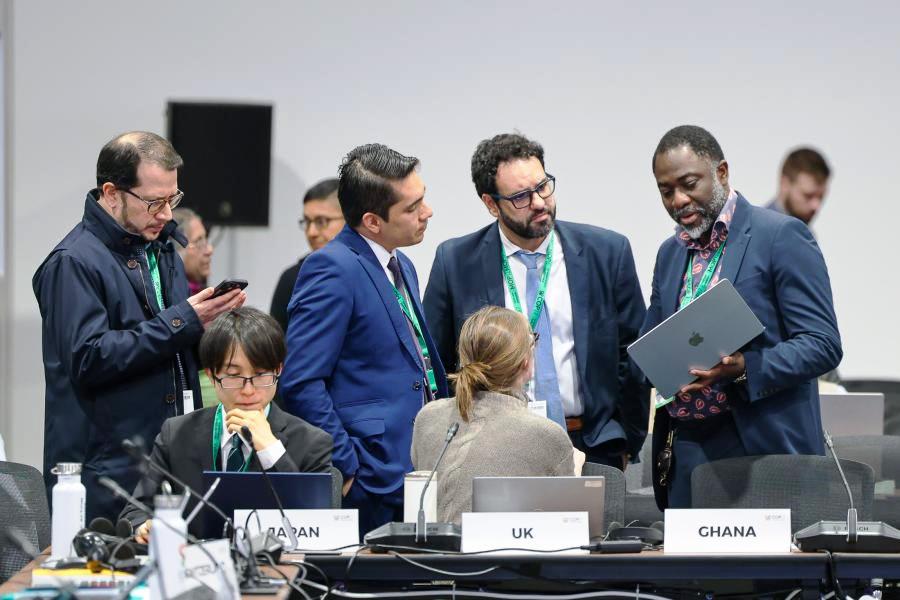
In the negotiation rooms, intensive deliberations continued on resource mobilization and the Multilateral Mechanism on benefit-sharing. PHOTO/IISD/ENB – Mike Muzurakis.
Under indicative rates agreed in 2024, companies using DSI are encouraged to contribute 1 per cent of global profits or 0.1 per cent of revenue to support biodiversity conservation and sustainable use.
However, the fund has received just US$8,990 in deposits so far, highlighting the gap between international commitments and financial delivery.
An analysis by Zero Carbon Analytics of the world’s 15 largest pharmaceutical companies estimated that their contributions would have totalled US$756 million for 2025 if calculated using the indicative rates. The analysis also found that the companies’ profits were 213 times greater than that amount, while shareholder payments exceeded the suggested contribution by more than 175 times.
Delegates remain divided over which businesses should contribute and whether certificates recognising contributions to the Cali Fund should offer flexibility or be restricted to users paying in line with the indicative rates.
Other outstanding issues include establishing a permanent body for Indigenous Peoples and local communities under Article 8(j), and ensuring biodiversity measures are consistent with climate commitments and other international obligations.
The summit’s final days are expected to test whether governments can turn political promises and new funding announcements into concrete measures to halt and reverse biodiversity loss.
With the first global review identifying substantial gaps between national commitments and implementation, negotiators face mounting pressure to agree on practical solutions before the conference closes on Friday.
Crédito: Link de origem