

Ukraine drone attacks might be pushing Russia the wrong way on war
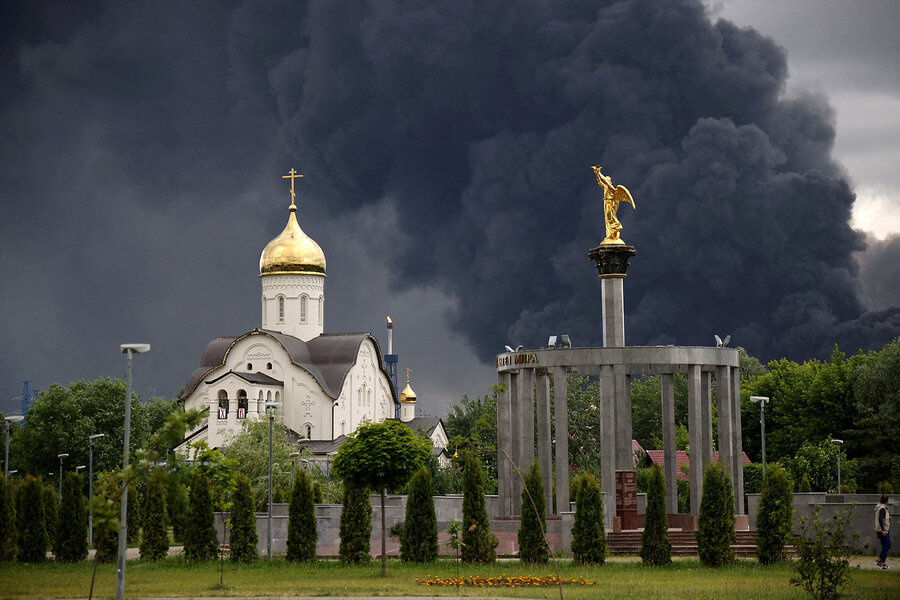
Alexei Mukhin says he was vacationing at a Black Sea resort near Sochi in late June when an incoming Ukrainian drone was shot down by Russian air defenses, with a loud explosion, in full sight of a beach crowded with people.
“The thing is, no one looked particularly surprised. Many people didn’t even seem to notice,” says Mr. Mukhin, head of the Center for Political Information, a Moscow-based independent consultancy. “It’s a near-daily occurrence around there, and people are getting used to it. I felt like the most nervous person on that beach.”
Ukrainian drone strikes deep into Russia’s heartland – including a wave on Monday night – are causing fuel shortages and long lines at gas stations, even in Moscow. The attacks are dampening the mood of average Russians more visibly than at any time since the war in Ukraine began 4 1/2 years ago.
Why We Wrote This
Ukraine has been taking the fight to Russia in recent months with waves of drone attacks on strategic sites across the country – particularly energy production facilities. The Russian public has definitely noticed, but isn’t responding as Kyiv might hope.
For many Russians, particularly in the capital, it’s the first time the war has struck so close to home. People have been irritated by internet and cellphone disruptions that authorities say are war-related, and small businesses have been hit with tax increases due to the rising costs of the war, but spending hours trying to fill the gas tank is a new level of inconvenience.
“The increase in drone attacks is putting pressure on the economy, civil infrastructure, and it’s certainly affecting the public mood,” says Sergei Strokan, an independent political analyst. “Social tension is rising. People are worried. Things are obviously not going on as before.”
But experts such as Mr. Strokan and Mr. Mukhin say the idea that Russians are likely to panic, even as the pressure ramps up, is misguided. Though public exhaustion with the war is growing, and the number of people who favor peace talks is high, experts say the voices calling for tougher prosecution of the war against Ukraine are also becoming louder and more persuasive.
“Public opinion is changing,” says Mr. Strokan, “but not necessarily in the direction that people in the West seem to expect.”
Creating problems, but not critical?
Russian President Vladimir Putin made a rare admission of the difficulties during an interview with state TV journalist Pavel Zarubin on Sunday, conceding that stepped-up Ukrainian attacks against bridges, oil refineries, and fuel trucks are creating “problems … [and] certain shortages.” According to Russian media, those include restrictions on gasoline sales in at least 20 Russian regions, and price hikes and supply disruptions in several more.
The hardest-hit region is the Black Sea peninsula of Crimea, annexed by Russia in 2014, where strikes against bridges and other infrastructure have severely reduced fuel supplies, ruined the summer tourist season, and led authorities to declare a state of emergency.
A mid-June attack badly damaged the Kapotnya oil refinery, which supplies about 40% of the gasoline for the Moscow region, leading to the first serious shortages in the capital in many years. A taxi driver, who declined to be named, said several gas stations near his home in northwestern Moscow were closed Monday, and he waited for almost two hours at another before filling his tank – albeit at the regular price of 74 rubles per liter (about $3.60 per gallon).
During his interview, Mr. Putin insisted the problems were “not critical,” the damage would be quickly repaired, and that Russian air-defense forces were developing new weaponry and tactics to counter the Ukrainian assault.
Viktor Litovkin, a military expert with the official RIA news agency, says Russian air defenses are mostly coping with the surge in Ukrainian attacks, and only a few incoming drones actually get through – especially around big cities such as Moscow and St. Petersburg.
“The attacks are becoming more intensive. The drones fly in swarms, which is technically difficult to deal with,” Mr. Litovkin says. But war always involves a steep learning curve, he adds. “On the whole, our defense forces are well-equipped, well-trained, and are operating effectively. Our air defenses are getting better at it every day, and I’m pretty sure they’ll handle whatever the Ukrainians are going to throw at them.”
Speaking to state TV, Mr. Putin said the Ukrainian tactic of launching strikes deep into Russia, increasingly hitting civilian targets, has largely psychological aims. “Its purpose is to undermine our confidence in ourselves and our capabilities and, ideally, to create divisions within Russian society, force Russia to suspend, even temporarily, the advance of our forces along the line of contact, and create conditions for launching negotiations on terms favorable to our adversary,” he said.
Not the response Ukraine was looking for?
Lev Gudkov, scientific director of Russia’s only independent polling agency, the Levada Center, says anxieties are indeed spiking, with more than half of Russians indicating that they pay close attention to war news. While 74% of Russians say they support their troops in Ukraine, more than 60% favor peace talks. Only about one-third say they want the war to continue, though Mr. Gudkov says that percentage has been rising over the past three months.
“The threat of drone attacks has been coming to the fore in public opinion lately, pushing aside other developments in the war zone,” he says. “The general tendency is for people to mentally separate the attacks on us from what’s going on in Ukraine. The number of people who support talks with Ukraine is decreasing, while there are more and more people who feel that Russia should take decisive actions to destroy Ukraine.”
From the other side, Volodymyr Paniotto, director of the Kyiv International Institute of Sociology, reached via Facebook, says Ukrainians are generally pleased with their forces’ improved ability to strike deeper and harder into Russia’s heartland.
“Ukrainians perceive such actions not as escalation, but as part of defense and as a way to make the aggressor feel the price of war,” he says. “In addition, at a time when Russia is systematically attacking Ukrainian cities and energy, most Ukrainians consider it unfair that Russian society can live as if the war does not concern it.”
But some Russian analysts warn that hard-liners who advocate strikes against European targets involved in producing and supplying weapons to Ukraine, perhaps even staging a nuclear explosion to demonstrate Russia’s resolve, are growing in influence. The idea of a nuclear strike to warn Europeans to stop helping Ukraine was first put forward by senior Russian foreign policy veteran Sergey Karaganov, who voiced it directly to Mr. Putin at a conference three years ago. Mr. Putin firmly rejected it at the time.
The idea is gaining fresh currency amid Ukraine’s stepped-up drone assault, says Igor Korotchenko, editor of the Moscow-based National Defense magazine.
“The Russian expert community is actively considering a scenario involving possible tactical nuclear weapon strikes against key points on Ukrainian territory, along the borders with Romania and Poland, to interdict the supplies of weaponry to Ukraine,” he says. “This is needed to definitively choke NATO arms supplies to Ukraine, and it might compel the Zelenskyy regime to sit down and negotiate on Russia’s terms.”