

Trump wants to reduce joint military exercises with South Korea. What are they for?
Trump wants to reduce joint military exercises with South Korea. What are they for?
President Donald Trump said he’s instructed Defense Secretary Pete Hegseth to “substantially reduce” U.S.-South Korea joint military exercises. He said this was “based on my very good relationship” with North Korea’s leader Kim Jong Un.
In an Aug. 16 Truth Social post, Trump said, “These exercises are not only costly, with much of these costs paid for by the United States of America (as usual!), but send a signal that is totally inappropriate and hostile, to a Country that, as long as Donald J. Trump has been President, has been unthreatening and respectful.”
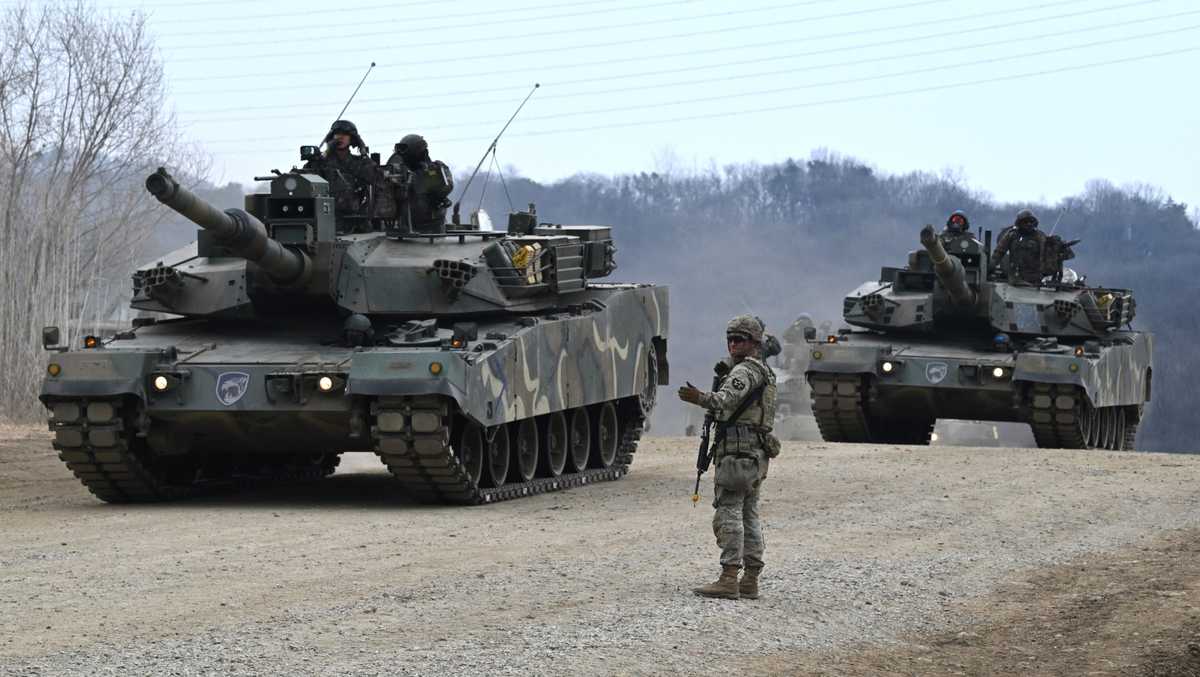
The U.S. and South Korea military exercises prepare the nations for possible attacks from North Korea, which is armed with artillery and missile forces. Trump’s statement of an “unthreatening and respectful” North Korea omits that the country fired missiles days before the military exercise was set to begin, and has done so regularly, too.
The annual exercise, Ulchi Freedom Shield, is underway and scheduled to continue until Aug. 27, and it’s unclear whether Trump’s announcement has affected the drills so far. About 18,000 South Korean servicemembers were expected to participate, according to news reports. It’s unclear how many U.S. servicemembers will participate.
It’s hard to verify Trump’s statement that the U.S. pays more for the exercises because specific figures are not available. Funding involves multiple military service budgets and Pentagon officials typically don’t disclose the costs. One canceled U.S. military exercise with South Korea in 2018, then called the Ulchi Freedom Guardian before it was rebranded as Ulchi Freedom Shield, would have cost $14 million, the Pentagon said at that time.
Reuters reported Aug. 10 that this year’s military drills involve exercises “to counter drones, GPS disruption and cyberattacks.”
What we know is that overall, it costs U.S. taxpayers around $14,500 to $58,000 more per person annually to station servicemembers abroad compared with having them in the U.S., according to the Center for International Policy. But South Korea also makes a substantial contribution and is expected to pay about $1.2 billion in 2026 to have U.S. servicemembers in the country.
The U.S. and South Korea have long had a military alliance under the Mutual Defense Treaty ratified in 1954, in which the two countries agreed “to defend themselves against external armed attack so that no potential aggressor could be under the illusion that either of them stands alone in the Pacific area.”
The Korean War ended in 1953 after an armistice agreement, but a formal peace treaty wasn’t signed, so North Korea and South Korea are still at war.
South Korea has about 570,000 active-duty servicemembers and 3.1 million reservists, according to a March 2026 Congressional Research Service report.
The number of U.S. soldiers in South Korea has decreased since the 1950s, as different administrations shifted policies. In 1955, there were about 75,000 U.S. soldiers in South Korea. Now, there are about 28,500 U.S. servicemembers stationed in the country.
Since 1991, South Korea has paid the U.S. for having its military in the country. This includes salaries for South Koreans working on U.S. bases, logistics and construction by Korean firms.