

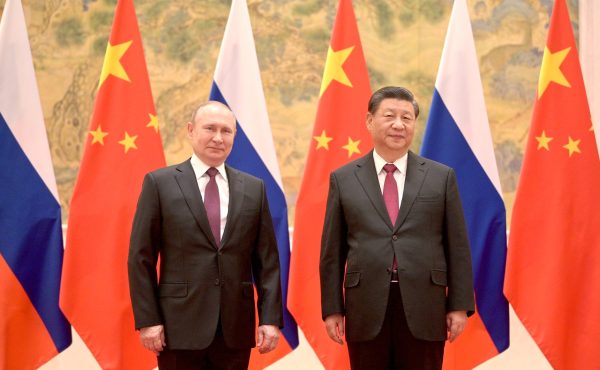
Since not long after Russia’s full-scale invasion of Ukraine in 2022, the democratic world has largely watched passively as China has been the main enabler of Moscow’s war effort. Despite knowing about Russia’s reliance on China, the world’s inaction boils down to the collective dependence on China’s control and dominance of global trade and technology supply chains. With democracies having little appetite to take on any economic risk, China’s support for Russia continues, and so too does the war.
Initial hopes that China might be able to convince its junior authoritarian partner to scale back the war quickly faded as it became clear there really were no limits to the Beijing-Moscow friendship. The use of nuclear weapons may be an exception, but even that assumption should be questioned.
Now, a May 19 Reuters report citing three European intelligence agencies has revealed that China’s military “secretly trained about 200 Russian military personnel in China late last year.” While seemingly a revelation, no one should be surprised, given that the training, which allegedly took place in Beijing and Nanjing, was based on an agreement signed in July 2025.
And yet there is still no single world leader or government willing to publicly condemn such training. Indeed, world leaders such as German Chancellor Friedrich Merz continue to answer questions by repeating the same hope from 2022 that President Xi Jinping might “urge President [Vladimir] Putin to end this war in Ukraine.” This hope should have faded from rhetoric long ago.
If these reports of training are true, the activity represents an egregious contradiction of Chinese leaders’ declarations of neutrality in the Ukraine conflict. At the Munich Security Conference in February 2024, Chinese Foreign Minister Wang Yi said Beijing was not a party to the Ukraine war and “all efforts conducive to a peaceful settlement of the crisis should be supported.” In a July 2025 press briefing along with German Foreign Minister Johann David Wadephul, Wang reiterated China’s position on the Ukraine conflict, which he said “includes promoting peace talks, not providing lethal weapons to parties in the conflict, and strictly controlling the export of dual-use articles, including drones.”
While we have not yet seen evidence of direct Chinese government involvement in the war (whereas North Korea has sent soldiers to the front), nations that support Ukraine have effectively set a precedent in allowing China to give Russia anything it needs for the war short of direct military involvement.
We have created a rod for Ukraine’s back. China’s supply of electronic components, machine tools, drones and other dual-use items has been instrumental in Russia’s ability to sustain the war. Within the first few months of the invasion, China reportedly stepped up its export to Russia of microchips, other electronic components and raw materials, some of which have military uses. The Wall Street Journal reported in July 2022 that these exports had “more than doubled to about $50 million” in the first five months after the war started. The report added that shipment of aluminum oxide, an important precursor in weapons production and aerospace, had increased by 400 times.
A March 2026 report by The Insider identified Chinese companies as the largest group among the 6,000 exporting restricted dual-use goods to Russian companies and defense industry contractors. This included small turbojet engines that generate 800 newtons (80 kg-force) of thrust, potentially for large military drones.
Russia is also reported to have received chemical precursors, such as ammonium perchlorate, that can be used in high-performance solid rocket propellants in space launches and missiles.
A policy dashboard produced by the Mercator Institute for China Studies provides details of China’s export of dual-use technologies with military applications.
Source: Hugo von Essen/Mercator Institute for China Studies.
As part of its Russia-China policy dashboard, the European Union Institute of Security Studies (EUISS) identified the specific Russian dependencies that have been increasing in recent years (top), which have potential military applications. Another graphic from EUISS (bottom) provides further detail on China’s exports of dual-use goods to Russia.

Source: EUISS.

Source: EUISS.
A March 2026 ASPI report detailed growing defense cooperation by China and Russia. It identified that military exercises were increasing in numbers and complexity, including a spike after the 2022 invasion of Ukraine.

China has not slowly emerged as the decisive enabler of Russia’s war on Ukraine. Its no-limits partnership was signed immediately before the war, and the two authoritarian regimes have been in lockstep from day one. China’s training of Russian troops may be a new activity, but it is merely another part of their deep strategic partnership.
This article was originally published in ASPI’s The Strategist.