

The victory that wasn’t: Netanyahu and the Iran war
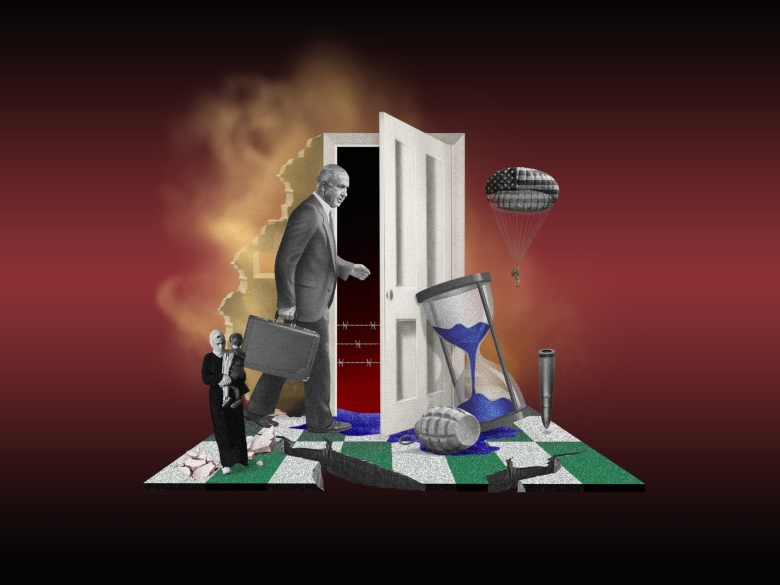
This is an important electoral card because it effectively trumps all counterarguments. The logic goes as follows: Do you dislike Netanyahu’s brand of toxic politics? Sure, but should you vote to replace him, the country will not survive in a region that has little care for the weak. Are you shaken by Netanyahu’s attempts to undermine the Supreme Court, by his corruption trial, by the proximity of some of his associates with countries deemed to be adversaries? Yes, but there would be no Israeli democracy, no Israel at all, without Netanyahu. The corollary is that his opponents would be dangerous for Israel. They are infantilised as mere children (including being literally depicted as kids in dire need of a babysitter, in an electoral ad nearly a decade ago).
October 7 shook that image. But real successes have paved the way to a triumphant comeback for Mr Security. These successes shouldn’t be brushed aside. Israel has severely weakened Hezbollah, which was by far Israel’s most dangerous adversary due to its proximity to the country’s border and immense rocket arsenal. Hamas is no longer able to fire rockets at Israel, no act as a de facto conventional military. Iran has been caught in a cycle of escalation that led to two major Israeli/Israeli-US operations, with Israeli planes flying daily missions above Iran during those wars. The problem is, of course, that while Israel certainly weakened its adversary, the adversary is not defeated. Netanyahu didn’t promise a temporary respite or half victory after October 7—he pledged that Israel would secure “Total Victory”.
A culminating moment
In that context, the Iran war wasn’t just another round of violence; it was the culmination of all other efforts. It was the time to move from weakening to actually winning. Whether explicit or not, regime change was in the cards. Iran 2026 was going to put October 7 2023, where Netanyahu wants it to be—in a corner and as a fluke pinned on others than the Israeli PM.
A close Netanyahu aide, Natan Eshel, stated bluntly that “the removal of the Iranian threat is a hundred times more significant than the October disaster,” framing the war as the narrative trump card that would erase October 7 from the public consciousness by election time. The calculus was simple: win Iran, win the October 7 narrative, win the election.
The problem with this calculus is that it collided with a stubborn empirical reality. Israeli public opinion, when it comes to elections, was remarkably resistant to movement. In the weeks after Operation Roaring Lion began, support for the war itself was overwhelming. A March 2-3 Israel Democracy Institute survey found 93% of Jewish Israelis supporting the campaign, with 74% trusting Netanyahu to manage it well. Overall support across the full Israeli population stood at 82%. These numbers resembled, in structure if not in cause, the 2006 pattern: near-total Jewish consensus in the face of a perceived existential threat.
But the electoral map did not move. Political scientist Gideon Rahat of the Hebrew University put it precisely: polls consistently showed around 40% of voters sticking with Netanyahu’s coalition of nationalist and religious parties, 40% backing opposition parties, and a swing vote so far not moving to Netanyahu. That basic picture held across weeks and pollsters. An April 2026 Jerusalem Post-Lazar Research poll gave Likud 25 seats, with the coalition at 49 and the opposition holding a stable 61-seat majority for a third consecutive week. By late April, a Channel 12 poll showed the new Bennett-Lapid “Together” list winning 26 seats, edging ahead of Likud. Netanyahu’s coalition could muster only 50 seats, compared with the Zionist opposition’s 60.
By March and April 2026, a clearer picture had emerged. The Iran war achieved major tactical successes, including the killing of Khamenei and the degradation of roughly two-thirds of Iran’s missile and drone production, but it had not achieved its stated strategic objective. The Iranian regime had not collapsed. Hezbollah, battered but not broken, was still firing from Lebanon. Hamas continued to exist.
Mission not accomplished
An INSS poll published in mid-April captured the resulting public mood with precision: 61% of Israelis opposed the ceasefire announced with Iran; 73% expected fighting with Iran to resume within a year; 69% supported continued military operations in Lebanon despite ongoing ceasefire negotiations. A subsequent IDI survey in late April found that 64% of Jewish Israelis said ending the war under current conditions was only slightly or not at all aligned with Israel’s security interests. Support for the war itself had fallen from 93% to 78% among Jewish Israelis within roughly a month. The drop was not catastrophic, but the direction was recognisable.
Then came the possibility that, for Netanyahu, represents a nightmare scenario of an entirely different order. The US-Iran ceasefire declared in early April 2026 brought fighting to a fragile halt, but the deeper negotiations that followed opened the question of a formal framework agreement. By late May, Trump was reporting that a deal had been “largely negotiated” and that the two sides were working toward a Memorandum of Understanding that would include a 60-day ceasefire extension, a plan to reopen the Strait of Hormuz, and the deferral of the most contentious nuclear questions to later negotiations. Iran’s Foreign Minister Araghchi described the two sides as simultaneously “very close and very far” from a final deal.
From Israel’s perspective, this trajectory is alarming for reasons both strategic and deeply political. Strategically, Israeli officials warned publicly that the emerging deal was “a bad deal,” one that failed to address Iran’s ballistic missile program, left the proxy network intact, and potentially curbed Israel’s freedom of action in Lebanon. An unnamed Israeli official told the Jerusalem Post: “This is an agreement that could affect whether and how we are able to operate.” Some experts assessed on Israeli radio that the best achievable result was an agreement resembling Obama’s 2015 JCPOA, the very deal Netanyahu had spent a decade calling a “stunning historic mistake” and “a danger to humanity.”