

The U.S. Is Quietly Building a New Energy Foothold in Iraq
There have been perhaps a handful of events since the end of the Second World War that have fundamentally reshaped the world’s oil markets and consequently its geopolitics while remaining largely unnoticed at the time. The quiet agreement between U.S. President Franklin D. Roosevelt and Saudi King Abdulaziz bin Abdul Rahman Al Saud struck on 14 February 1945 that would define the energy, economic, political and military relationship between the two countries until the rise of American shale in the early 2010s is one, as analysed in my latest book on the new global oil market order. The series of meetings between U.S. President Richard Nixon and his Secretary of State and National Security Advisor, Henry Kissinger, in October and November 1973 to neutralise the newfound power of the Arab states in light of the 1973 Oil Crisis through the strategy of ‘constructive ambiguity’ was another, as also detailed in that book. And the humiliation of Donald Trump by President Barack Obama during the White House Correspondents’ Dinner in 2011 that, according to one of his most senior advisors spoken to exclusively by OilPrice.com at the time, decisively triggered his desire to run for president in the future was another. An announcement last week may well fit into this mould, concerning a seemingly obscure new project in Iraq being quietly undertaken by the U.S. with almost no publicity.
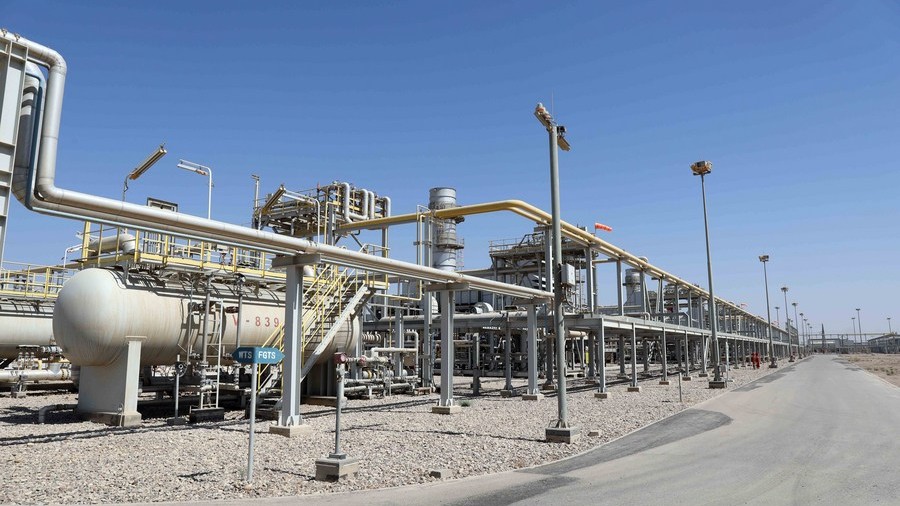
The mere details alone would not be enough to excite the world’s media either: operations will commence in the second quarter of 2027 from a liquefied natural gas (LNG) import terminal being built in Iraq. However, the more detail that is uncovered, the more extraordinary the vision becomes. For a start, this is the first-ever LNG import terminal to be constructed in Iraq, and it is being developed, financed, and will be operated by the U.S.-based Excelerate Energy — the firm that made the low-key announcement last week about the start date. Unbeknownst to many, the company is the global leader in LNG floating storage and regasification units (FRSUs), and all related downstream LNG infrastructure, and a while back signed the fully integrated agreement with Iraq’s Ministry of Electricity, with an initial budget of US$450m. That said, according to a very senior figure who works closely with Iraq’s Oil Ministry, spoken to exclusively by OilPrice.com last week, this is very much just a starting figure. Excelerate will be the sole commercial developer of this floating LNG infrastructure project at the Port of Khor Al Zubair, managing all engineering, procurement, dredging, and site clearance activities at the port. It will be responsible for installing topside equipment, upgrading berth facilities, and reinforcing the terminal’s jetty infrastructure to support FSRU operations, and will also act as the primary LNG cargo supplier, combining infrastructure and fuel delivery into a single contract. The facility has been designed in the first instance to handle a guaranteed regasification capacity of 500 million standard cubic feet per day (MMscf/d), with Iraq committing to a minimum daily take of 250 MMscf/d. It is highly apposite to note at this point that under international law foreign oil and gas firms are allowed to deploy whatever security personnel and related infrastructure developments they see as being necessary to safeguard their investments on the ground, provided that these meet with the approval of the indigenous government. Related: Distillate Stocks Sink Further as U.S. Crude Inventories Barely Budge
It is also apposite to note that although Iraq’s neighbour, Iran, has dominated the news cycles since at least the onset of ‘Operation Epic Fury’ on 28 February, it has always been Iraq in which Washington has maintained the closest interest, as underlined by its overt and covert activities there since the toppling of Saddam Hussein in 2003. In this context, it is true that the U.S. has seen Iraq as being in several key respects a client state of Iran since that country’s Islamic Revolution in 1979 through Tehran’s economic, political, military and religious proxies. By extension, Washington has also come to regard Iraq — at least the southern part — as being in thrall to China, just as Iran is. In Iran’s case, this dominance by Beijing was established through the broad and deep ‘Iran-China 25-Year Comprehensive Cooperation Agreement’ first revealed anywhere in the world in my 3 September 2019 article and analysed in full in my latest book on the new global oil market order. This gave huge discounts to China for oil and gas it bought from Iran, allowed it the first right to choose the oil and gas fields it wanted to explore and develop (Russia had second choice), and afforded it the right to build out extensive infrastructure projects (including those heavily geared towards military expansion on the ground). The same sorts of all-encompassing deals were then made by Beijing with Iraq, beginning with the ‘Oil for Reconstruction and Investment’ agreement signed in 2019 and expanded into the ‘Iraq-China Framework Agreement’ of 2021. Crucially for Iraq, Iran, the Middle East, and all the relevant bigger international powers, this tight relationship between Iraq and Iran was critical in enabling Tehran’s economic survival — and, therefore, the Islamic regime’s survival — despite huge international sanctions since 1979. This was done in large part by disguising sanctioned Iranian oil as non-sanctioned Iraqi oil — a process made all the easier by the fact that several of the two countries’ major oil fields are part of shared reservoirs, as also fully detailed in my latest book. Moreover, for China, these two sets of deals — with Iran and Iraq — has provided it with a major influence over the Middle East’s to key oil and LNG transit routes: the Iran-controlled Strait of Hormuz (through which up to 30% of the world’s oil historically travels, and up 20% of its LNG), and the Iran-Houthi-controlled Bab el-Mandeb Strait (which historically sees up to 12% of the globe’s total seaborne oil trade and around 8% of its LNG shipments.
Having said all of this, it is also true that Washington has long seen the possibility of reverse-engineering this relationship between Iraq and Iraq; that is, weakening the links between Baghdad and Tehran, before replacing Iran and China as Baghdad’s key superpower relationship, and then — having so undermined the Islamic regime in Iran — replacing it with a more Western-leaning democracy of one sort or another over time. As over 90% of Iraq’s government revenues still come from oil and gas, and as LNG has become the world’s key emergency energy supply since Russia invaded Ukraine on 24 February 2022, Washington sees establishing one of the world’s major LNG hubs in Iraq as a great way in which to loosen Iran’s and China’s grip on Iraq. In tandem with this, it also sees placing Iraq at the centre of a new push by the U.S. to roll out more of the relationship normalisation deals (‘Abraham Accords’) between Arab states and Israel, brokered by Washington, as an effective way to halt China’s strategy to extend its influence across the Middle East through its ‘Belt and Road Initiative’. The U.S. is in a prime position to push this LNG-led strategy, especially in light of infrastructure damage done by Iran on key LNG suppliers in the region, having established itself by the end of 2022 as the world’s leading LNG exporter. Officials in Qatar — historically one of the top global LNG exporters now estimate that fully repairing the damage to its vast North Dome gas facilities in Ras Laffan Industrial City will take three to five years, with significant implications for the emirate’s LNG export capacity in the meantime. Conversely, the U.S. today remains by far the largest exporter, processing around 18 Bcf/d of natural gas into LNG, with the Energy Information Administration projecting that export capacity will double by 2031 compared with 2024 levels. “There’s an old phrase: ‘If you’ve got them by the balls, their hearts and minds will follow,’ and Trump knows that controlling energy is the way to do this,” a very senior energy security source at the European Commission exclusively told OilPrice.com recently. “You saw it when he [President Trump] told the Europeans — when the Strait of Hormuz was closed — that they should just get their energy from the U.S. That’s what this is,” he underlined.
By Simon Watkins for Oilprice.com