

The Sahel region is less secure than ever: foreign forces just add to the cycle of violence
Several of Mali’s major cities experienced coordinated attacks in April by a new coalition of jihadists and separatist groups.
As the coalition took over the town of Kidal in the north of Mali, images of Russian troops being escorted out of the town after negotiations were cabled out across global media.
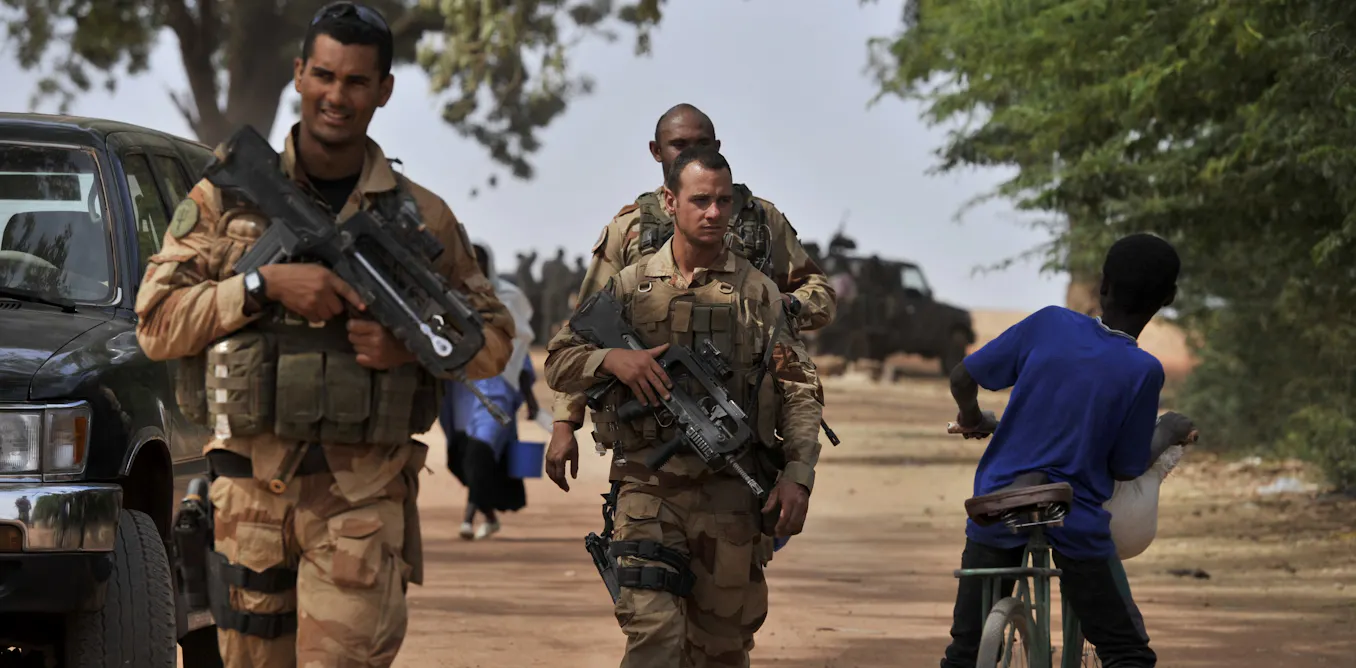
Russia, now in the shape of Africa Corps and previously the Wagner Group, has been the Malian military’s external security partner since the beginning of 2022. It replaced French and European troops from the counter-terrorism operation Barkhane and Taskforce Takuba. France had deployed a force of 5,000 troops from 2014 to 2022. European special forces numbered 1,000 between 2020 and 2022. Both missions were forced to leave as relations between France and the Malian junta grew tense.
The strategic realignment, from western and multilateral forces to Russian troops, expanded in the region. In Burkina Faso, which experienced two coups in 2022, the French troops were expelled at the start of 2023, as 200 Russian troops moved in.
In the summer of 2023, the Malian authorities also kicked out the decade-old 13,000-strong UN peacekeeping mission. Niger’s junta, which took power the same year, followed suit and expelled the EU’s operations in the country six months later, before accepting a few hundred Russian troops.
During the past decade I have researched external security interventions in the Sahel and analysed their justifications, development on the ground, and consequences for political and security environments.
I conclude from my research that the external interventions have not stabilised the region. More than a decade after the first major interventions, the Sahel is more fragmented, militarised and violent than before.
Yet the persistence of insecurity also serves political purposes.
For military juntas, the jihadist threat justifies continued rule and repression. For Russia, the region has become a showcase for anti-western influence and security partnerships in Africa. For western actors, jihadist expansion, migration concerns and fears of regional instability are used as reasons for security engagement despite repeated failures.
The complex interactions between these actors have resulted in a continuous, strategic circle of violence, where civilians are the first victims.
On the ground
On the ground, interventions have often evolved in unpredictable ways through ad hoc decisions and informal interactions between local and external actors.
For example, they have shared logistical and medical assistance and intelligence.
More broadly, the external interventions strengthened militaries as political actors, reinforcing an already biased civil-military balance across the region.
“Security in the Sahel” became the moniker that framed the western and multilateral interventions in the region from 2013 onwards. Improving the capacities, capabilities and professionalism of the national security forces became the official objectives of these interventions, closely linked to the broader aim of defeating the jihadist insurgencies.
Framing the intersecting crises in the Sahel as a security issue also meant that security actors had the task of resolving it. The importance, status and budgets of the national militaries thus increased as the security situation deteriorated. A heavily tilted civil-military imbalance was the result.
As military officers took over power through coups in Mali, Burkina Faso and Niger, a strategic realignment towards Russia began, to maintain military rule.
The Russian Wagner group allowed the newly installed juntas to entrench their power, while “deprofessionalising” the forces through harassment, attacks and massacres of civilians.
Research shows for example that civilian targeting accounted for 71% of the Wagner Group’s involvement in political violence in Mali between December 2021 and July 2022. This strategy of attacking civilians has made recruitment easier for jihadist groups. They could increase their ranks by exploiting grievances.
The latest attacks in Mali in April 2026 demonstrate the military junta’s failure, together with its Russian security partners, to contain the jihadist groups’ expansion.
They also reveal that Russia is in the country mainly to keep the military junta in power. Assimi Goïta, Mali’s military leader, reconfirmed the partnership with Russia after the attacks in spite of their failure on the battlefield.
The military leader needs regime maintenance more than ever, and the Russians need to be in the country for continued geopolitical influence on the African continent.
Conclusion
The result is that while all external actors claim to fight instability, the current regional order depends on continuing insecurity.
Stabilisation risks becoming less about resolving conflict than about managing insecurity in ways that sustain regimes, partnerships and geopolitical influence.
Foreign interventions, in combination with national actors’ ambitions, have helped to transform the region into a space of militarised regime survival, jihadist expansion and geopolitical competition between Russia and western democracies.
As military approaches have repeatedly proven insufficient to solve the intersecting crises in the Sahel, pressured military juntas may now be forced to negotiate with jihadist groups. That is likely to result in new, hybrid spaces of power and governance.
Credit: Source link