

THE RALLY OF THREE – Jamaica Observer
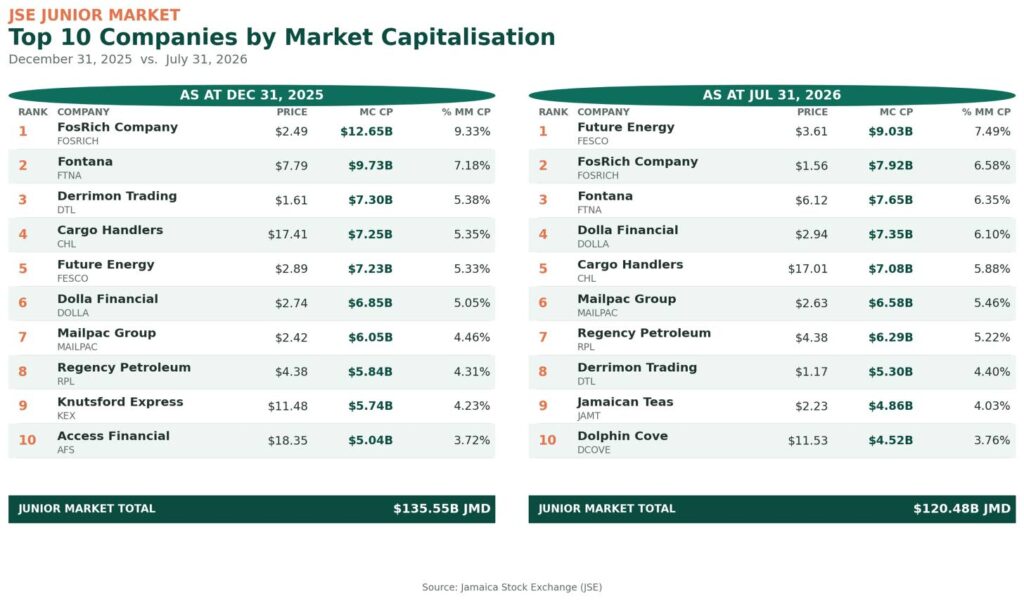
The top 10 Junior Market companies by market capitalisation.
THREE companies accounted for $97.74 billion — or 85 cents of every dollar — of the Jamaica Stock Exchange Main Market’s increase in value during July, exposing how narrowly the market’s 2026 recovery has been distributed.
Carreras Limited, NCB Financial Group Limited and TransJamaican Highway Limited supplied 85.2 per cent of the $114.70 billion added during the month. The rest of the Main Market accounted for a combined net increase of just $16.96 billion.
Yet only 20 of the Main Market’s 53 stocks ended July above their 2025 closing prices. The Junior Market was weaker still, with just seven of 47 stocks advancing. Across both markets, 73 of 100 stocks remained down for the year.
That apparent contradiction is possible because the JSE Index is weighted by market capitalisation: movements in the largest companies exert more influence than equivalent movements in smaller stocks. The index’s 17.62 per cent return, therefore, measures the movement in market value, not the experience of the typical listed company.
The Main Market’s capitalisation rose from approximately $1.90 trillion to $2.02 trillion in July, crossing $2 trillion for the first time.
Carreras, a distributor of cigarettes and vaping products, added $36.12 billion in market value to become the third-largest company on the exchange, valued at $170 billion.
NCB Financial Group added $33.37 billion to regain the top position with a market capitalisation of $191.80 billion. NCBFG last held that position in 2022 before a falling share price allowed Sagicor Group Jamaica Limited (SJ) to overtake it. Scotia Group Jamaica Limited (SGJ) began 2026 as the largest company by market capitalisation.
TransJamaican Highway added $28.25 billion in value to rise to sixth place with a market capitalisation of $128.14 billion. TJH began the year as the 13th-largest company, valued at $57.63 billion.
The sharp gains in the three stocks occurred against the backdrop of Scotiabank Caribbean Holdings Limited’s proposed $54-billion (US$340-million) acquisition of the SGJ shares it does not already own.
SGJ ended July at $57.54, about 6.4 per cent below the $61.50 offer price, giving the financial conglomerate a market capitalisation of $179.04 billion.
Several brokers and fund managers have raised the prospect that investors would need to find new positions for some of the money released if the transaction is completed. That possibility provides context for the wider market movement, but trading data do not establish that the proposed SGJ privatisation caused the gains in Carreras, NCBFG, or TJH.
The three companies also present investors with different income profiles. SGJ’s aggregate annual dividend payments declined from $6.35 billion in 2019 to $5.60 billion in 2025, while NCBFG’s fell from $8.89 billion to $3.88 billion over the same period. Carreras’ annual distribution rose from $3.25 billion to $7.23 billion, making it the largest aggregate dividend payer on the JSE.
West Indies Petroleum Terminal Limited (WIPT) was the Main Market’s best-performing stock at the end of July, rising 587 per cent from its 2026 opening price of $1.31 to $9 on July 31. The company had listed by introduction at $0.50 in December 2025. Its July closing price gave it a market capitalisation of $100.62 billion.
Excluding WIPT, TJH, Carreras, and NCBFG were the three largest year-to-date gainers, with each rising by at least 90 per cent. The next six best-performing stocks returned between 11.30 per cent and 44.03 per cent.
The Main Market had 20 stocks increasing in value compared to the 33 which were down year to date (YTD), meaning that three-fifths of the listed stocks were trending lower. Palace Amusement (1921) Company Limited was the worst-performing stock in 2026 as it saw its price cut by 63 per cent to $0.36. Most of the top-10 stocks that were down at the end of July were financial stocks, with Portland JSX Limited suspended for late financials.
The JSE’s top-10 composition has shifted considerably since December, with there now being at least seven stocks valued at more than $100 billion. Carreras and TJH became the 10th and 11th companies to surpass the $100-billion market cap threshold in JSE history. The JSE Main Market began 2026 with a $1.71 trillion market cap.
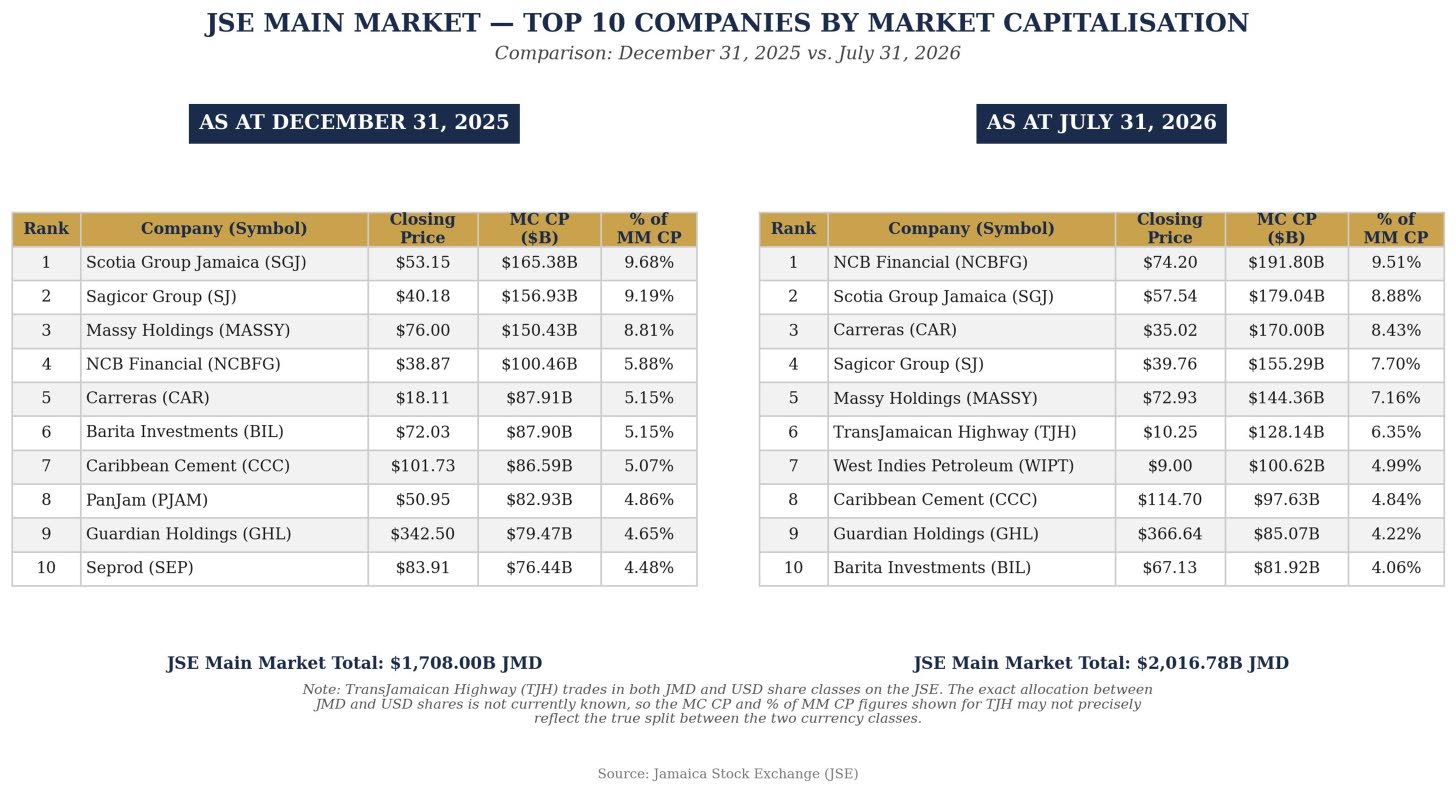
The JSE’s ten largest companies by market capitalisation.
The JSE Index rose 17.62 per cent, from 317,986.88 points at the start of the year to 374,012.30 at the end of July. According to Countryeconomy.com’s July 31 comparison of international stock market indices, that placed the JSE 20th among the indices tracked.
Jamaica’s return was above Japan’s TOPIX, which gained 16.95 per cent, but below Türkiye’s XU100, which rose 19.16 per cent. Venezuela’s IBC Caracas led the comparison with a 230.23 per cent increase.
Junior Market in deep red
While the Main Market saw positive double-digit returns, the Junior Market Index was down 12.49 per cent and reached 2,976.70 points, the first time since February 2021 that it fell below 3,000 points.
The Junior Market only had seven stocks out of 47 stocks increasing in value since the start of the year. Jetcon Corporation Limited was the best-performing stock on this market as it grew 119.33 per cent in value. Following Jetcon, Future Energy Source Corporation Limited (FESCO) was the second best-performing stock with a 24.91 per cent return, with Dolla Financial Services Limited up 7.30 per cent as the seventh best-performing stock.
Kintyre Holdings (Ja) Limited was the worst-performing stock at the end of July as it declined 77.63 per cent to $0.17. The company’s shares were suspended from trading on July 1 due to the overdue submission of its audited financial statements. IronRock Insurance Company Limited (ROC), Main Event Entertainment Group Limited (MEEG), and Caribbean Flavours & Fragrances Limited (CFF) were all down more than 40 per cent at the end of July.
FESCO became the largest Junior Market company by market capitalisation as it was worth $9.03 billion. It overtook FosRich whose stock has declined 37.35 per cent to a $7.92 billion market cap. The JSE Junior Market Index lost $4.53 billion in market capitalisation during the month and was worth $120.48 billion at the end of July. The Junior Market was worth $135.55 billion at the start of 2026.
The JSE Combined Market capitalisation was worth $2.14 trillion at the end of July with the JSE Combined Index at 378,973.79 points. The JSE Combined Index peaked at the end of 2019 with a $2.08 trillion market cap with 505,253.97 points. Thus, even though the index has achieved a new peak in terms of market cap, it is still trending below the 2019 index values when most company stock prices peaked.