

The power of sports showcased at One Young World Summit 2026
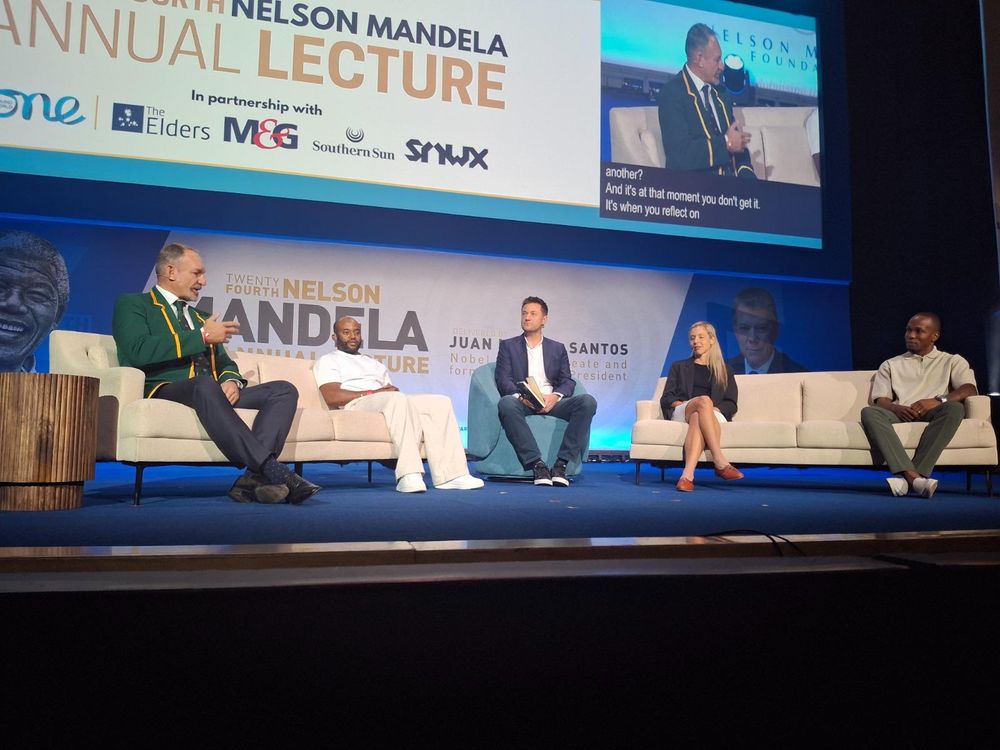
On the final day of the One Young World Summit, held in Cape Town from November 3 to 6, the presentation “Healing a Nation Through Sport: The Role of Sport in South Africa’s Ongoing Story of Reconciliation” brought together former Springbok captain Francois Pienaar, Proteas captain Temba Bavuma, sprinter Akani Simbine and Comrades Marathon champion Gerda Steyn to discuss sport’s role in shaping unity and identity.
Pienaar reflects on 1995 Rugby World Cup
Pienaar reflected on the 1995 Rugby World Cup and Nelson Mandela’s decision to embrace the Springboks during the tournament.
He described Mandela as a “genuine, real, authentic” leader and recalled the team taking the field before a crowd of about 65,000 people as a “life-changing” experience.
Pienaar praised Mandela’s “magnanimousness”, describing him as “one of the most incredible human beings the world has ever seen”.
He said the tournament remained “a special day” for South Africa and linked its legacy to Mandela’s vision of a united country.
Bavuma on leadership and inclusion
Bavuma described sporting leadership as a “selfless job” focused on providing “some level of positivity to our country”.
He pointed to South Africa’s victory over Australia in the 2025 World Test Championship final at Lord’s as a recent example of sport bringing the country together.
South Africa won the final by five wickets on June 14, 2025.
Reflecting on South Africa’s victory over Australia in the 2025 World Test Championship final at Lord’s, Proteas captain Temba Bavuma said the result gave the country a moment to celebrate together.
“Despite the challenges that we face as a country, we found a moment to come together and embrace what we were doing,” Bavuma said. “We were very proud as South Africans.”
He also discussed the practical value of diversity within a team.
Bavuma said an inclusive environment, where players could “truly express themselves” and “be authentic”, led to better collective decision-making.
“When you have different people from different backgrounds, different experiences, different cultures, different opinions, the decisions become a lot more informed,” he said.
Steyn on the Comrades Marathon
Steyn reflected on the challenges of the Comrades Marathon, an ultramarathon whose distance varies according to its route.
She said that, during the most difficult stages of the race, an athlete’s personal motivation could become connected to a broader shared purpose.
“It’s in that moment where you have to really know what you are doing and the purpose of what you are doing,” Steyn said.
She added that the drive to finish extended beyond personal ambition.
“It’s for those who support you,” she said. “It’s for the nation who’s behind you, and for the little ones standing along the way and watching.”
Simbine on pressure and teamwork
Simbine spoke about the pressure of competing as an individual athlete, where every fraction of a second and every technical error can be scrutinised.
The sprinter, who has reached two Olympic 100m finals, said his career had required consistency, discipline and the ability to manage expectations from both the public and the international sporting community.
He described the challenge as “consistently showing up and making sure I’m the same person”.
Simbine said competing in the relay had helped ease the burden of individual competition.
He was part of the South African men’s 4x100m relay team that won silver at the Paris 2024 Olympic Games.
“Working together as a team” gave the athletes a collective goal, he said. Trust and accountability among teammates also strengthened their performance.
Sport as a global language
The discussion highlighted sport’s ability to create shared experiences, bring people from different backgrounds together and provide a common source of national pride.
For Pienaar, the 1995 Rugby World Cup showed how sporting achievement and symbolic leadership could contribute to a changing national identity.
Bavuma said inclusion strengthened teams by ensuring that different perspectives were heard.
Steyn spoke about the collective support surrounding the Comrades Marathon, while Simbine highlighted the shared responsibility involved in relay competition.
Together, the panellists suggested that sport can provide a language through which South Africans connect across their differences.
Closing the presentation, Pienaar linked sport to Mandela’s vision of a united “Rainbow Nation”.
Quoting the late president, he said: “Sport has the power to change the world. Think about that … Sport has the power to unite people like nothing else does. Sport generates hope where there was previously only despair.”
Crédito: Link de origem