

The Houthis ramp up activity in Yemen and Saudi Arabia, but avoid reigniting the civil war so far
Houthis target Saudi energy infrastructure while Saudi Arabia targets military sites
Reignited tensions between the Houthis and Saudi Arabia escalated into open conflict last month. After Saudi Arabia launched strikes on Yemen’s Sanaa International Airport on 13 July, the Houthis immediately launched retaliatory attacks. Between 13 July and 14 August, they carried out 16 attacks against Saudi Arabian assets, including seven oil facilities and six oil tankers (see map below).
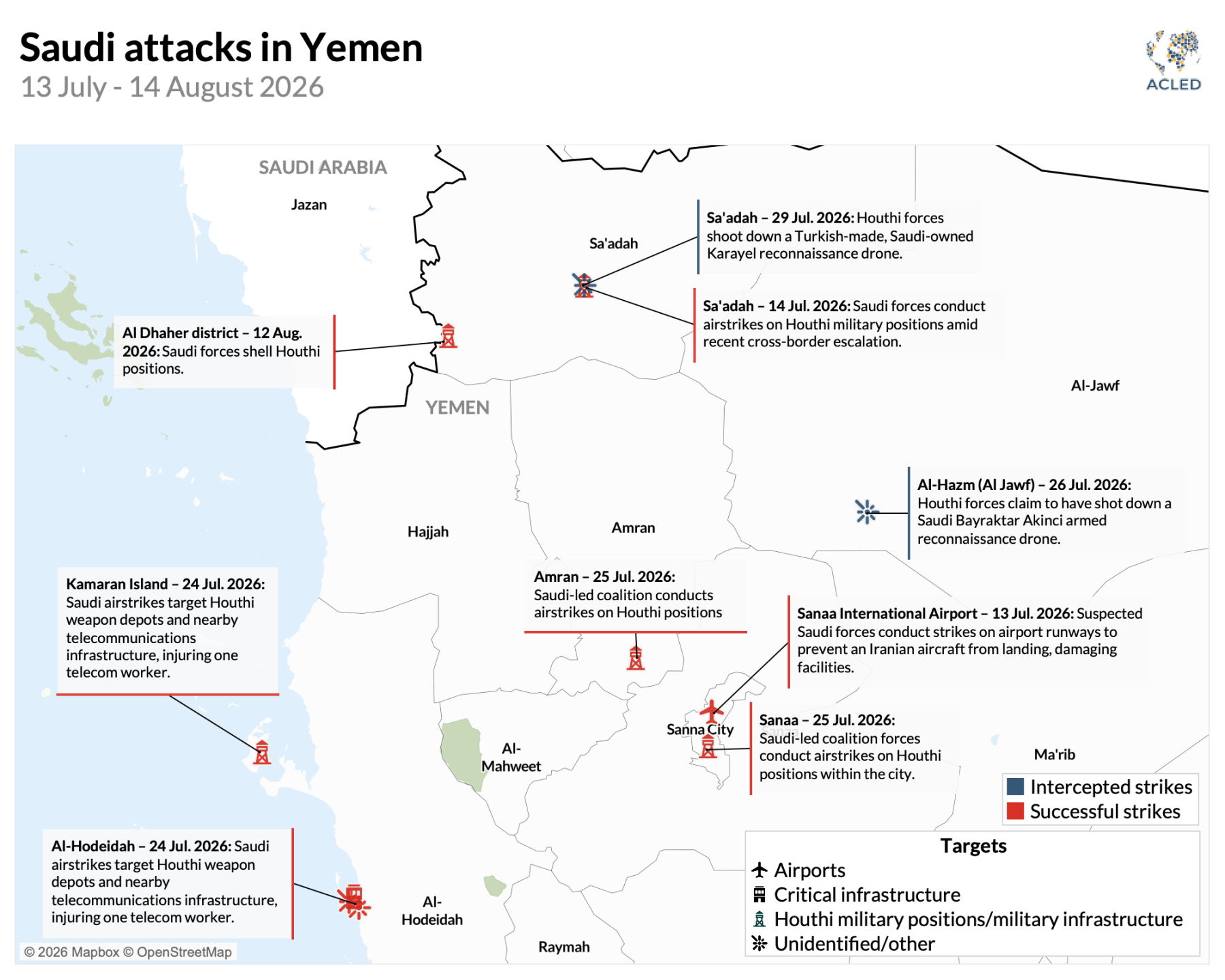
Saudi forces have responded directly to these Houthi attacks, most significantly on 24 July. They conducted a series of strikes on military sites in al-Hodeidah port area and Kamaran Island, targeting weapon depots and telecommunication infrastructure (see map below).
The Houthis have carefully calibrated attacks on oil infrastructure to inflict economic damage and extract concessions from Saudi Arabia — primarily lifting the blockade on Houthi-controlled Yemen. The extent of damage to Saudi oil facilities remains unclear, but the strikes have forced the Saudis to adjust oil exports. Since late July, Saudi Arabia has adopted a policy of “dark” transit, whereby it turns off tracking signals on oil-carrying vessels in the Red Sea to evade Houthi targeting while simultaneously diverting more ships to the northern route out of the Red Sea through Egypt.
Houthi and IRG forces engage in their fiercest clashes in years
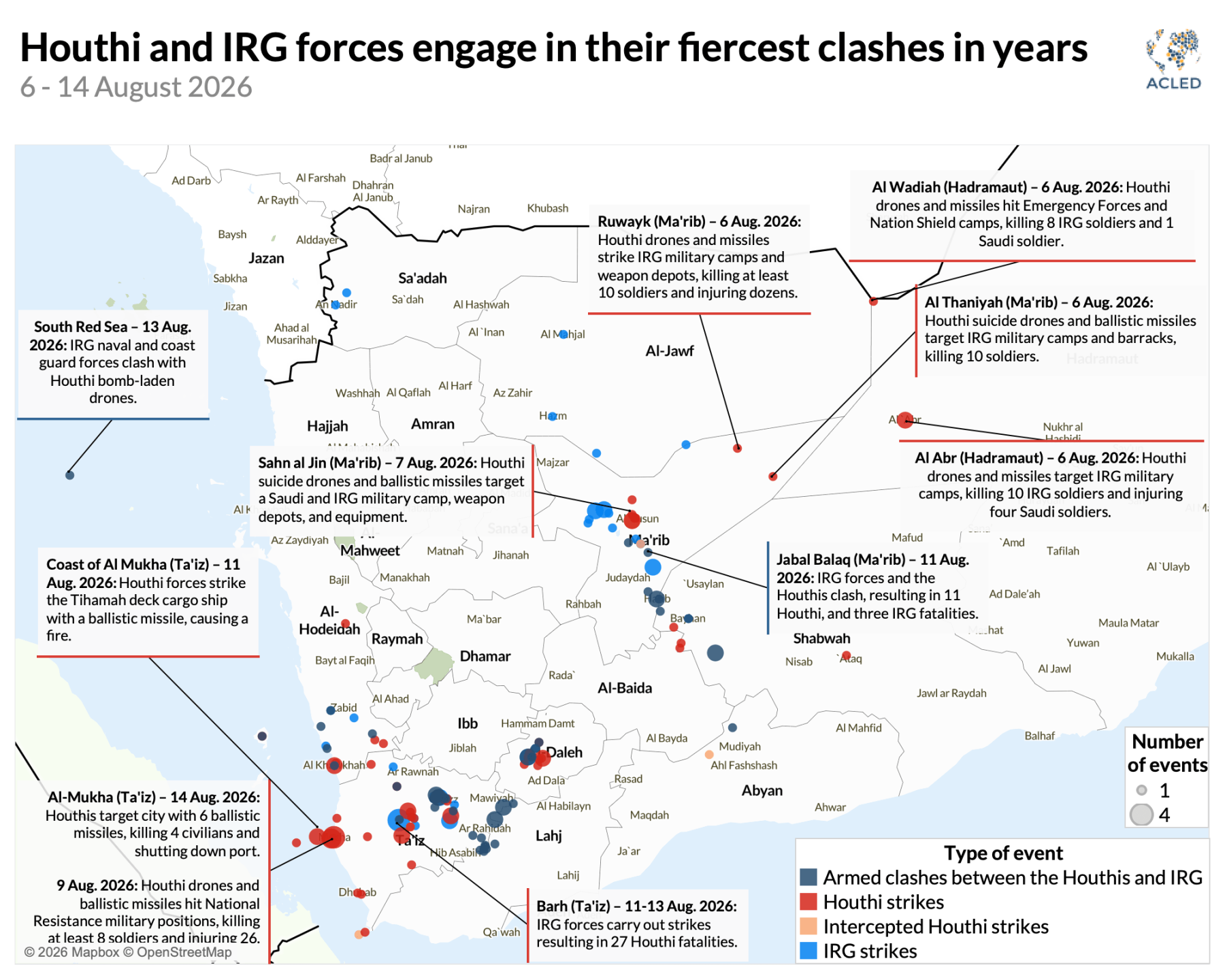
The Houthis escalated their campaign by launching large-scale attacks targeting the Saudi-backed IRG forces inside Yemen in the most serious escalation in violence between the two sides since 2022. On 6 August, the Houthis conducted simultaneous attacks on IRG camps in Hadramawt and Marib, killing at least 30 soldiers (see map below). Since then, heavy clashes between the IRG and the Houthis have occurred on a near-daily basis on internal frontlines, primarily in Marib, Taizz, and al-Hodeidah. A multi-pronged attack on 9 August targeting Mocha, a port city controlled by the IRG, marked a further escalation. The attack involved dozens of drones, WBIEDs, and missiles. While the Houthis claimed they targeted Saudi forces operating in the area, the attack caused at least 11 fatalities — including three civilians — and caused considerable damage to the city’s port and other civilian and military infrastructure.
The clashes with IRG forces are a continuation of the Houthis’ efforts to assert themselves as the dominant power in Yemen and as an effective regional actor. The complexity and severity of the Mocha attack are meant to project strength in the face of an increasingly centralized IRG. However, such an aggressive posture poses a greater risk to the Houthis than in previous years. Since early this year, the IRG’s military has been slowly unifying under a more centralized command with Saudi support. It is more capable of retaliating to Houthi provocations than it was on the eve of the 2022 ceasefire. In the recent clashes, IRG forces intercepted Houthi drone attacks, inflicted heavy casualties on the group, and captured fighters. The IRG’s president, Rashad al-Alimi, even announced on Monday that “the era of costless Houthi attacks is over.”
Outlook: The escalation is unlikely to subside without significant strategic change
It is unclear how long the Houthis plan to continue this current round of escalation. While armed clashes have increased on internal front lines, neither the Houthis nor the IRG has attempted a serious push to claim territory so far, which would seriously risk actively reigniting the Yemen civil war. If both sides continue to escalate in the coming weeks and months, chances for renewed full-scale war increase exponentially, since with each new attack, both the Houthis and the IRG risk losing control of the escalation.
In the meantime, the Houthis have kept an exit strategy available. The group has framed its attacks as a response to Saudi violations only, and they have claimed to have “always been open to negotiations and dialogue.” Without a diplomatic breakthrough, the group is likely to continue targeting Saudi energy infrastructure and ships in a way that compounds the damage Saudi Arabia already suffers due to the current closure of the Strait of Hormuz. As previous American and Saudi air campaigns have proven, airstrikes alone won’t deter the Houthis from carrying out cross-border attacks. Saudi Arabia is faced with two difficult options: negotiate and concede to at least some Houthi demands, or commit to a joint campaign with the IRG against the group that will force it to contend with increased direct Houthi attacks in the short-term. If Saudi Arabia opts for the latter option, a likely goal would be to seize the entirety of the coastal al-Hodeidah governorate from the Houthis to reduce their capacity to attack maritime shipping.
Risk factors that can influence how the conflict develops
Iran War and the Strait of Hormuz crisis: The stand-off between the United States and Iran over the Strait of Hormuz currently shows no signs of a resolution. A sudden breakthrough is possible, as talks through Pakistani and other mediators continue. Any such breakthrough would reduce the economic pressure on Saudi Arabia by reopening an alternate route for oil exports. But the longer the Iran war remains unresolved, the more incentive Saudi Arabia has to deal with the Houthis more resolutely, whether through diplomacy or military.
The southern question in Yemen: In January 2026, the IRG, with Saudi backing, seized the entirety of southern Yemen from the secessionist Southern Transitional Council (STC). However, the STC still retains considerable support and military power on the ground in southern Yemen. So far, the STC has not engaged in extended clashes with IRG forces. If they choose to use the crisis with the Houthis as an opportunity to reassert themselves militarily, this would risk opening a new front line in Yemen, which would change the IRG and Saudi Arabia’s approach to their dealings with the Houthis.
Visuals produced by Ana Marco.