

The Horn’s Crisis Clock: When Regional Disorder Outruns Diplomacy
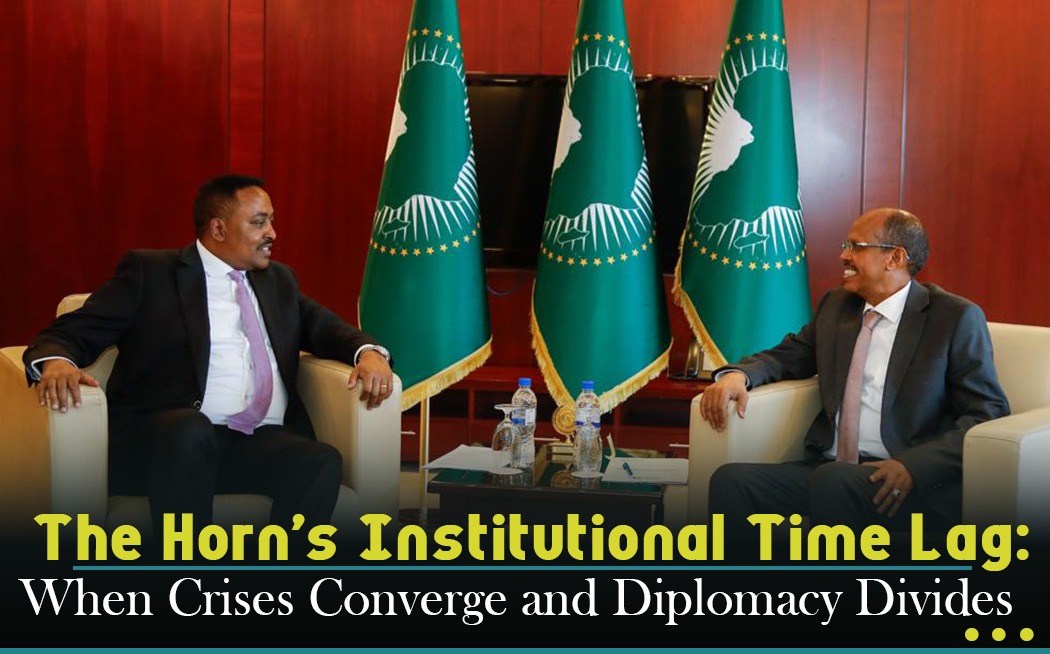
The Horn of Africa’s defining diplomatic problem is not the absence of institutions but the misalignment between institutional design and regional reality. Sudan’s war, Red Sea insecurity, Ethiopia’s maritime predicament, South Sudan’s delayed transition, and the unfinished Ethiopian peace settlement now interact as one crisis geometry, while the African Union, IGAD, and external partners continue to manage them as separate files.
This is institutional time lag: the interval between the moment a regional system begins to behave as an integrated whole and the moment its diplomatic architecture is reorganized to govern it as one. It is not simply weakness. Weak institutions fail at tasks they were built to perform. Lagging institutions may still convene meetings, issue communiqués, and appoint envoys, yet remain structurally behind because the environment they were designed to manage has changed shape beneath them.
The Horn’s New Crisis Geometry
Sudan is the clearest expression of the new pattern. Since April 2023, the war between the Sudanese Armed Forces and the Rapid Support Forces has generated the world’s largest displacement and protection crisis, with UNHCR describing millions displaced inside Sudan and across neighbouring states. The war is not contained by Sudan’s borders. It pressures Ethiopia’s western frontier, exposes South Sudan’s oil and transition vulnerabilities, disrupts Red Sea logistics, and pulls Gulf, Egyptian, Turkish, and Iranian interests into the same theatre.
The Red Sea supplies the second chain. Houthi attacks, drone warfare, port vulnerability, piracy risk, and military competition have turned maritime security into a landward security problem for the Horn. Port Sudan’s exposure to drone strikes showed that the Red Sea is not adjacent to Sudan’s war; it is part of the war’s geography. For Ethiopia, whose economic trajectory depends on reliable maritime corridors, this makes sea access not a symbolic question but a structural vulnerability.
South Sudan adds a third layer. Its transition has been extended toward elections planned for December 2026, while the political and security milestones required for credible elections remain incomplete. Instability there would not remain a domestic matter. It would travel through refugee flows, oil infrastructure, the Nile frontier, and Ethiopia’s western security environment.
Why the Architecture Is Behind the Crisis
The African Union has begun to recognize the scale-shift. Its March 2026 appointment of former Tanzanian president Jakaya Kikwete as High Representative for the Horn of Africa and the Red Sea was significant precisely because it treated the inland Horn and the maritime corridor as one strategic space. Yet a single envoy cannot by itself overcome the deeper institutional problem: Sudan, Somalia, South Sudan, the Red Sea, and Ethiopia-related peace processes still move through different tracks, reporting lines, and political assumptions.
IGAD has a Red Sea and Gulf of Aden mechanism, and its own description gives that mechanism a mandate to promote dialogue, develop common positions, and formulate a regional plan of action. That is useful but insufficient. Dialogue platforms are not crisis-synchronization instruments. The present environment requires shared threat mapping, cross-file scenario planning, synchronized mediation calendars, and a standing capacity to ask how a shift in one theatre alters incentives in another.
The Quintet on Sudan—comprising the AU, IGAD, the League of Arab States, the European Union, and the United Nations—has moved in the right direction by supporting a civilian call for de-escalation and a Sudanese-owned political process. The gap is that no comparable connective mechanism links that Sudan track to Red Sea security, South Sudan’s transition, Somalia-Somaliland tensions, or Ethiopia’s maritime-security concerns. The result is procedural activity without architectural integration.
Ethiopia’s Exposure and Diplomatic Leverage
Ethiopia is more exposed to this lag than any other regional actor. It is an upper Nile riparian, a landlocked state seeking reliable maritime corridors, a neighbour of Sudan and South Sudan, host to the AU, and a central IGAD member. Fragmented diplomacy therefore produces direct costs: unmanaged refugee pressure, contested borderlands, maritime uncertainty, and the risk that external actors set the tempo of regional order.
Yet exposure also creates leverage. Ethiopia’s strategic advantage lies not in treating each file defensively, but in making the case that the files are no longer separable. Its diplomatic posture should therefore move from case-by-case response to architecture-building: a Horn–Red Sea coordination layer that connects Sudan mediation, maritime security, South Sudan’s transition, Somalia-related diplomacy, and Ethiopia’s own corridor-security agenda.
This is not a call for a new bureaucracy. It is a call for a connective layer over existing institutions. The AU should establish a Horn–Red Sea Cross-File Cell under the High Representative’s office. IGAD should convert its Red Sea mechanism from a dialogue platform into a crisis-synchronization instrument. Ethiopia should lead the proposal, not as unilateral agenda-setting, but as regional burden-sharing grounded in the reality that a system-level crisis requires system-level governance.
Closing the Lag
The counter-argument is that integrated mechanisms may over-centralize sensitive files and provoke resistance from states that prefer narrow mandates. That concern is real. But the present alternative is not sovereignty-preserving clarity; it is fragmented diplomacy that allows external actors, armed groups, and wartime economies to connect the region faster than its institutions can.
If the AU and IGAD close the lag, the Horn can begin to manage the relationships among its crises rather than merely react to each crisis after it has reshaped the next. If they do not, Sudan’s war, Red Sea militarization, South Sudan’s transition, Somalia’s fragmentation, and Ethiopia’s maritime predicament will continue to be processed as separate files while behaving as one regional system. The actors that close that gap will shape the next architecture of the Horn.
Notes
1. United Nations High Commissioner for Refugees, “Sudan Emergency,” 2026; UNHCR Operational Data Portal, “Sudan Situation,” June 2026. (UNHCR)
2. Reuters, “UN Warns Drone Attacks Drive Surge in Civilian Deaths in Sudan,” May 11, 2026; Associated Press, “Drone Strikes Kill over 1,000 Civilians in Sudan in the First 5 Months of 2026,” June 2026. (Reuters)
3. Reconstituted Joint Monitoring and Evaluation Commission, press release on South Sudan’s extended transition and December 2026 election timeline. (JMECS South Sudan)
4. African Union, “AUC Chairperson Appoints President Jakaya Kikwete as AU High Representative for the Horn of Africa and the Red Sea,” March 25, 2026. (African Union)
5. IGAD, “Red Sea, Gulf of Aden and Somalia,” 2026; IGAD, “Common IGAD Position and Regional Plan of Action on the Red Sea and Gulf of Aden,” October 8, 2023. (IGAD)
6. African Union Peace and Security Council, “Quintet Statement on the Sudan Conference Civilian Call for an End to the War and Advancement of Peace,” April 16, 2026; German Federal Foreign Office, “Berlin Principles for Sudan,” April 30, 2026. (peaceau.org)
By Amen Biniyam, IFA
Disclaimer:
The content disseminated by the Institute of Foreign Affairs (IFA) – including, but not limited to, publications, public statements, events, media appearances, and digital communications – reflects the views of individual contributors and does not necessarily represent the official positions or policies of the Institute, its partners, or any affiliated governmental or non-governmental entities.
While the IFA endeavors to ensure the accuracy, integrity, and timeliness of the information presented, it makes no representations or warranties, express or implied, regarding the completeness, reliability, or suitability of such content for any purpose. The Institute expressly disclaims any liability for errors or omissions, as well as for any actions taken or decisions made based on the information provided.
The inclusion of external links, references, or third-party resources does not constitute an endorsement by the Institute. Additionally, engagement on social media platforms – including, but not limited to, likes, shares, retweets (RTs), or reposts – shall not be interpreted as an endorsement or validation of the views expressed therein.
Readers and audiences are encouraged to exercise critical judgment and seek independent verification when interpreting or relying upon any information disseminated through publications and posts on the Institute’s platforms or representative