

The hidden tradeoffs of using Trump’s tariffs as leverage with China
This piece references a forthcoming Brookings interactive. A link will be added here once it is published.
Trump’s tariffs are broad in reach but complex in structure. Beneath the headline rates sits a stack of measures imposed under different legal authorities on top of existing U.S. tariffs, with different product coverage and exemptions. Some of these tariffs date to Trump’s first term and were maintained by the Biden administration, while the second Trump administration has expanded their reach dramatically across countries and industries (see our earlier analysis for the full chronology and our trade data interactive for the major actions in context). The administration sees this growing stock of tariffs as leverage. But using it strategically means balancing multiple—and sometimes competing—objectives embedded in the tariff regime itself.
Most of the additional tariffs apply to the same products regardless of where they come from.1 But different countries sell different mixes of products to the United States, so their exposure to the tariffs varies. A forthcoming Brookings interactive will show how imports from the 60 economies subject to the new forced-labor Section 301 action—which functionally replaces the “Liberation Day” tariffs struck down by the Supreme Court—are treated under the different tariff actions now in place. More tariff actions are likely, including a pending Section 301 investigation on overcapacity, and we will update the interactive as they take effect.
The interactive applies the tariff regime currently in place to the composition of U.S. import value in 2025. We divide import value into three groups: covered by Section 232 tariffs, covered by the forced-labor Section 301, and exempt from additional duties. The global shares shown in Figure 1 are estimates because some exemptions depend on information we cannot observe directly in trade data. In calculating them, we count imports from Canada and Mexico as exempt from the forced-labor Section 301, effectively assuming they all meet the United States-Mexico-Canada Agreement (USMCA) requirements. We do not attempt to capture other conditional exemptions or product-level carve-outs, which therefore remain in the relevant tariff category.
Figure 1
The striking feature at the global level is our estimate that nearly half of U.S. import value is exempt from these additional tariffs. The interactive will allow users to see these shares by trading partner. China, to which we turn next, looks very different from the global aggregate, with less than 20% of 2025 import value exempt from additional duties.
China faces an additional tariff layer
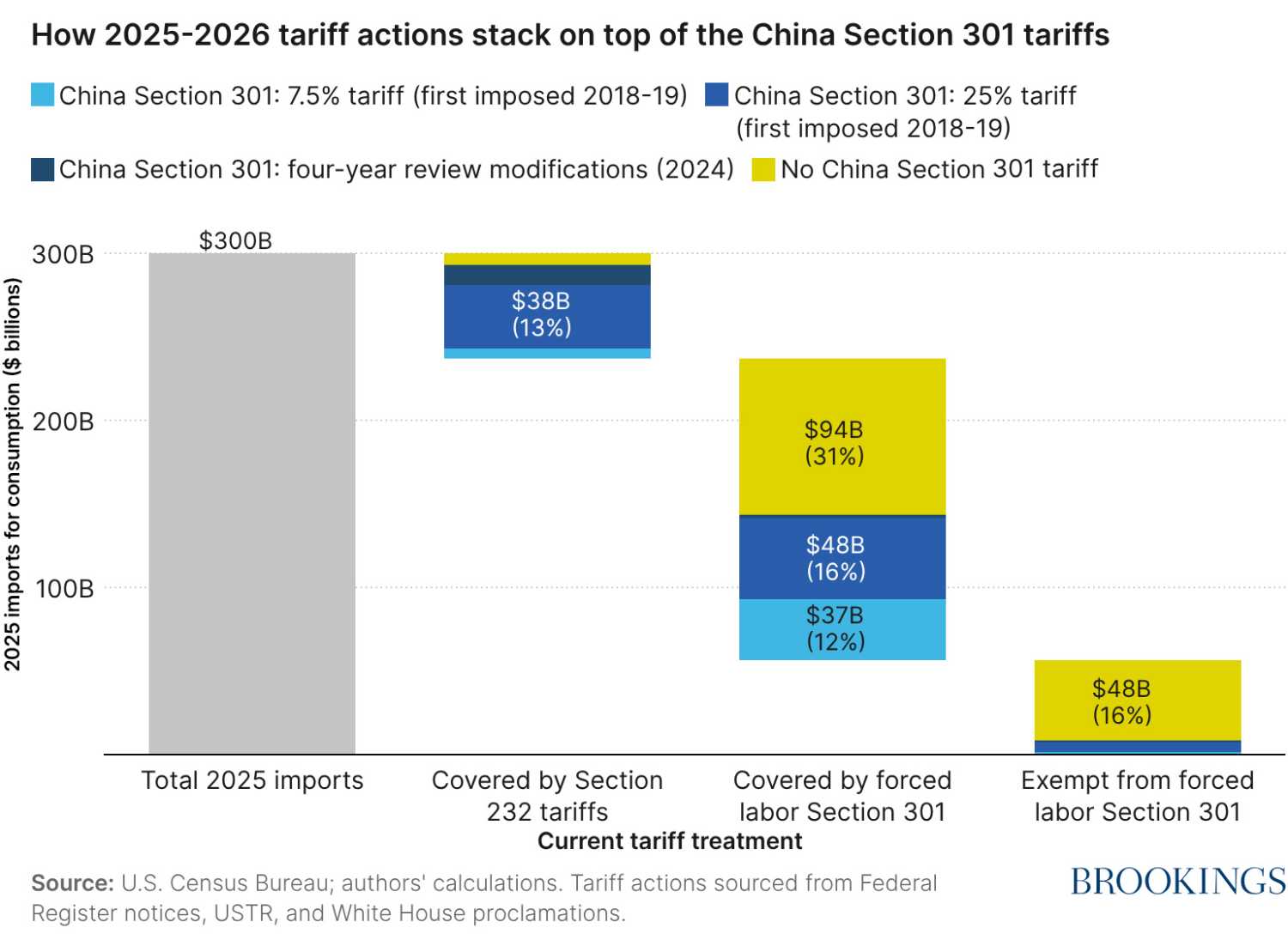
Many goods imported from China already faced additional tariffs carried over Trump’s first term. These tariffs were imposed following a Section 301 investigation into China’s practices related to technology transfer, intellectual property, and innovation, and have been maintained, with modifications, since then. We refer to these as the China Section 301 tariffs. The 2025–2026 tariffs stack on top of them. Figure 2 shows both layers: the columns show treatment under the 2025–2026 tariff actions, while the colors show the China Section 301 tariffs underneath. Only 16% of 2025 imports from China are free of both the newer duties and the China Section 301 tariffs.
Figure 2
What to watch as the U.S.-China Board of Trade takes shape
At their May summit, President Trump and Chinese President Xi Jinping announced a new U.S.-China Board of Trade, described by the White House as a mechanism to “manage bilateral trade” in “non-sensitive” goods. But what has actually been described so far is much more modest. Through the board, the United States and China plan to negotiate lower tariffs on a set of “non-sensitive” products accounting for up to $30 billion in import value. But $30 billion tells us little about how economically meaningful that tariff relief will be.
Three questions will matter:
What goods will qualify?
The administration has not concretely defined “non-sensitive,” but Treasury Secretary Scott Bessent has described it as “non-critical, non-strategic” goods that the United States is “never going to reshore,” pointing to fireworks and low-end consumer products as examples. That would seem to rule out products subject to Section 232 tariffs, which are justified on national security grounds. Past tariff choices provide another place to look. Products that escaped the China Section 301 tariffs or received the lower 7.5% rate were already treated more favorably than products facing the 25% rate. That makes them plausible places to look for products the administration might consider “non-sensitive” today.
What would meaningful tariff relief for China require?
The answer depends not simply on how much tariff relief China receives, but on where that leaves imports from China relative to competing suppliers. Figure 2 shows the difference. About $37 billion of 2025 imports from China currently face both the 7.5% China Section 301 tariff and the forced-labor tariff. Removing the 7.5% tariff would provide relief while leaving the forced-labor tariff in place. The $94 billion gold block is different: those goods escaped the China Section 301 tariffs, so relief from the forced-labor tariff could leave imports from China facing lower additional duties than competing suppliers. Meaningful relief for China, then, may also mean improving its position relative to another economy.
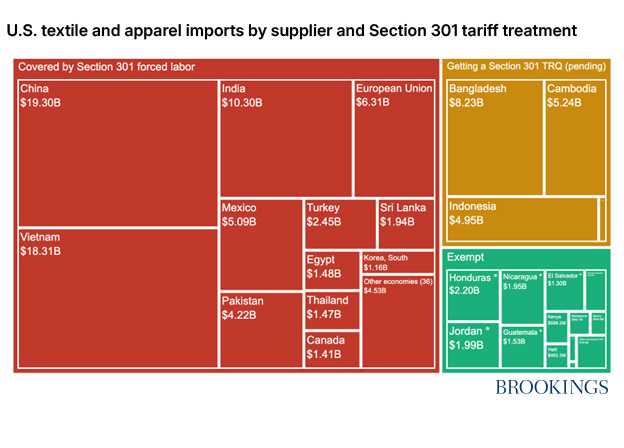
But much of the $37 billion is textiles and apparel, showing why even apparently “non-sensitive” goods may not be straightforward candidates for relief. The forced-labor Section 301 action suggests the administration is also using tariffs in this sector to favor some foreign suppliers over others. It exempts qualifying imports from free trade agreement partners in Central America and Jordan—widening existing preferences whose market-share benefits had been limited in part by competition from Asian exporters. Bangladesh, Cambodia, and Indonesia are slated for tariff-rate quotas designed to encourage greater use of U.S. inputs. Providing China relief in this sector could narrow some of those newly widened preferences.
Figure 3
Source: U.S. Census Bureau, USTR, authors’ calculations
*Jordan, El Salvador, and Guatemala receive specific exemptions for textiles/apparel in Annex II (Part O).
Textiles/apparel trade from Honduras, Nicaragua, Guatemala, El Salvador, Costa Rica, and the Dominican Republic is exempt if CAFTA-DR compliant.
That leaves a narrow path: identify enough products to deliver the promised tariff relief without giving China more meaningful market access than the administration is willing to concede. The administration may want to avoid appearing to undercut domestic production, exposing sensitive sectors to greater competition, or eroding preferences for other trading partners. The purpose underlying each tariff action may also matter for which tariffs the administration chooses to reduce. For example, USTR explicitly justifies exemptions from the forced-labor Section 301 tariffs in terms of advancing the purpose of that investigation. The relatively small scale of the initiative may help. At $30 billion—about one-tenth of U.S. goods imports from China in 2025—the administration needs to find only a limited set of products to deliver the promised tariff relief.
What will the United States get in return?
The potential bargain has an appealing logic: the United States could provide tariff relief on relatively less sensitive imports from China in exchange for better access for U.S. exports. Administration officials have pointed to energy, agriculture, aircraft, and medical devices as areas where they hope to expand U.S. sales.
As on the U.S. side, the value of Chinese tariff relief will depend partly on how U.S. exporters are treated relative to their competitors. When China retaliated against the original U.S. Section 301 tariffs, it raised tariffs on U.S. goods while lowering tariffs on imports from other countries—widening the tariff gap between U.S. exporters and their foreign competitors. And tariffs were not its only lever. Research by Felipe Benguria and Felipe Saffie finds that Chinese state-owned enterprises—which accounted for about 22% of Chinese imports from the United States—reduced purchases of U.S. goods beyond what could be explained by China’s retaliatory tariffs alone, particularly in agriculture and industrial supplies.
Managing tariffs rather than trade
The Board of Trade is only one move in a broader U.S.-China economic contest, in which both sides continue to wield other forms of leverage—from U.S. restrictions on advanced semiconductors and related technologies to Chinese restrictions on exports of rare earths and other critical minerals. A deal that produces relatively little new market access could still matter by facilitating de-escalation when that is an objective, and modest aggregate effects could matter substantially for particular U.S. consumers, exporters, and importers. Those are important outcomes, but they are distinct from the economic value of the bargain itself.
For now, the board of Trade looks less like a mechanism for managing bilateral trade than a framework for negotiating a relatively small amount of tariff relief. On the U.S. side, providing that relief without undermining other objectives embedded in the tariff regime leaves a relatively narrow set of options. On China’s side, equivalent tariff reductions may not translate into equivalent gains for U.S. exporters if relative tariff treatment, other barriers, or state purchasing decisions continue to constrain sales. The result could be an exchange of tariff relief that satisfies the terms of the board without material changes in the trade it is ostensibly intended to manage.
The Brookings Institution is committed to quality, independence, and impact.
We are supported by a diverse array of funders. In line with our values and policies, each Brookings publication represents the sole views of its author(s).