

The Federal Reserve Building Tax Dispute, 1939-1944
A dispute over property taxes threatened to upend the Board’s status as a federal agency
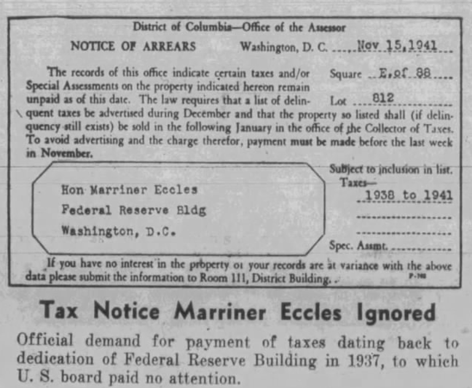
In late 1941, Time magazine printed a brief story stating “The most improbable building in the U.S. to go on the auction block was last week advertised for sale. It was Washington’s magnificent $3,500,000 Federal Reserve (Board) Building, and the District of Columbia was claiming it for non-payment of $315,000” in unpaid taxes and penalties (December 29, 1941, p. 54).
Just four years earlier in 1937, President Roosevelt had spoken at the dedication of the new building on Constitution Avenue in Washington, D.C. Roosevelt paid tribute to the building’s dignity and beauty, “worthy to rank among the foremost of the Capital’s architectural achievements.” Roosevelt went on to say that, beyond architecture, “we are conscious of a larger meaning in this brief ceremony, of the role that the Federal Reserve plays in the broad purpose which this Government must serve” (Roosevelt, 1937).
This embodiment of the Board’s role in the American government became the center of an unexpected legal puzzle: Was the Federal Reserve Board’s headquarters the property of the federal government? The answer was, and continues to be, yes. But it took five years for the Board to satisfactorily convince the District of Columbia government.
Roots in the Fed’s hybrid structure
The dispute that unfolded had roots in the Federal Reserve System’s design, which is rooted in compromise. Congress created the Federal Reserve System as a hybrid institution—neither fully governmental nor fully private—to provide a layer of insulation for monetary policy from direct political control. The Board of Governors is part of the federal government, while the twelve Reserve Banks are privately owned and supervised by the Board. The Board, in turn, is also independent within the federal government. This design has had bipartisan support through the Fed’s history but has also been the subject of confusion and criticism.
The building controversy first surfaced publicly during Congressional hearings in May 1939. Representative Henry Steagall, an influential Alabama Democrat who chaired the House Banking Committee, and Wright Patman, a Texas Democrat, raised questions about the tax status of the Fed Board’s building during testimony on unrelated banking legislation. They noted that the Board’s building had been paid for by assessments on the twelve Federal Reserve Banks. They also noted that the Federal Reserve Act provides that funds derived from such assessments “may not be construed to be Government funds or appropriated money.” This provision provided the Board with budgetary independence from the rest of the federal government. But, in this case, the provision was being interpreted in way that had unexpected implications. Steagall and Patman suggested that these facts together meant the Board’s building was owned by the Reserve Banks and therefore subject to property taxes.1 (In contrast, property owned by the federal government is not subject to property taxes.)
The motivation of Steagall and Patman for raising this question is lost to history, but Patman in particular would earn a reputation as an outspoken critic of the Federal Reserve during his long career in Congress (U.S. House of Representatives, 1939, p. 173).
Following these Congressional discussions, the District of Columbia tax assessor requested a legal opinion on whether he could levy taxes on the Board’s building. The main motivation was reportedly that the District could “gain a sizable bit of revenue if the tax can be imposed, since the assessed value would be high” (Washington Evening Star, May 21, 1939, “Officials Study Federal Reserve Building Tax,” p. B1).
The inquiry uncovered a second legal issue: The 1935 deed that had transferred the property to the Board of Governors from the United States government stated that “the United States of America…does hereby grant, release and forever quitclaim unto the Federal Reserve Board, its successors and assigns, all the right, title and interest of the United States of America” in the land. The deed therefore appeared to indicate that the federal government no longer owned the property. This language, which was most likely a drafting error, would become a thorn in the Board’s side over the next five years.
Howard Hackley, the Board’s General Counsel in 1972, studied the history and admitted that this clause created “some logical basis” for the District government’s position (Hackley, 1972 p. 10-11).
After a lengthy review, the District of Columbia determined in the summer of 1940 that the Board’s property was taxable. The tax assessor’s office sent the Board a bill for fiscal years 1938, 1939, and 1940. The Board refused to pay. In July 1940, Fed Chairman Marriner S. Eccles stated the Board’s position simply: “The Board of Governors is a strictly Governmental organization” and therefore its property is not subject to taxation (Board Minutes, July 24, 1940, p. 1063).
The principle of the matter had important implications that went beyond the expense itself. Paying the taxes would essentially falsely admit that the Board is not a part of the federal government, potentially undermining the Board’s authority to execute its regulatory and supervisory functions. In practice, the Board’s counsel also informed the Board’s members that they had no authority to use Board funds to pay property taxes and could be held personally liable if they did (Board Minutes, January 6, 1944, p. 35).
The Board’s refusal to pay set up a standoff. Over the following year and a half, the Board’s legal staff, including General Counsel Walter Wyatt, met repeatedly with D.C. officials to negotiate a resolution. The Board might have asked for legislation to clarify the matter, but the Board was concerned that an unsuccessful attempt to obtain legislation might cast doubt on its status. It also preferred to avoid litigation if it could. By late 1941, however, negotiations had not found a solution and District of Columbia officials had grown impatient.
On December 3, 1941, the city significantly escalated the dispute by listing the Board’s property for sale at a tax auction to be held on January 6 of the next year. The Federal Reserve property was listed among dozens of other properties in that day’s edition of the Washington Times-Herald (page T-1). The bill included $269,245 in unpaid taxes since 1938 plus $45,773 in penalties. The Washington Evening Star reported that “District officials have at last thrown down the gauntlet” (December 4, 1941, p. 8). Deputy Tax Assessor Byers Bachman stated “The Federal Reserve is in exactly the same position as you and I. We can’t violate the law in this office. When taxes aren’t paid the property must be sold at auction” (Washington Times-Herald, December 4, 1941, p. 3). Time took a light jab at the Fed’s expense: “The Federal Reserve has often proclaimed its independence from the U.S. Government, but in this case it claimed to be an arm of the Government (hence tax-free)” (December 29, 1941, p. 54).
The forced sale of the Board of Governors’ building seems like an inconceivable event: Who could have bought the massive office building that occupied an entire block? Nevertheless, the Board could not ignore the tax sale notice. Chairman Eccles wrote urgently to the U.S. Attorney General, Francis Biddle. The letter asked the Attorney General to bring a lawsuit against the District of Columbia. Eccles emphasized the stakes: “In view of the governmental functions which the Board performs and the nature and importance of the responsibilities with which it is charged under the law, the Board feels that it is important that no doubt should be permitted to arise as to its status as a part or establishment of the Government” (Board Minutes, December 3, 1941, p. 1695-1696).
Four days after the notice of tax sale was published, the attack on Pearl Harbor thrust the United States into World War II and the war effort consumed the attention of the Justice Department. The Attorney General’s office informed the Board of their informal agreement with the Board’s position but regretted they could not devote resources at that time to a lawsuit. Instead, the Attorney General requested that D.C. withdraw the property from the tax sale. The Board repeated that request, “with the understanding that steps will be taken with all reasonable dispatch to bring about a final disposition of this matter by litigation or legislation” (Board Minutes, December 17, 1941, p. 1805-1806).
Resolution, however, proved elusive. While D.C. removed the property from the auction list before the January 1942 tax sale, the city listed it again in December 1942. Once again, the city withdrew the property before the sale date. The Board again conferred with the U.S. Attorney General, asking that the Attorney General issue an opinion that the building was not taxable, in lieu of a lawsuit. However, again, the Attorney General declined, in part because of the stated position of D.C. officials that they would not accept the Attorney General’s opinion as binding on them (Board Minutes, January 6, 1944, p. 35).
In late 1943, Board legal staff suggested a creative solution. The key insight came from re-examining the original source of the controversy, which was the idea that the Reserve Banks had some ownership interest in the Board’s property. Indeed, the D.C. government had suggested that “Should the Federal Reserve Board cease to function the property in question would revert to the various Federal Reserve Banks in the different States, thus indicating that entire control of the building under all circumstances is not in the United States or its agency, the Federal Reserve Board” (Board Minutes, January 6, 1944, p. 35).
This reasoning suggested a solution. If the twelve Federal Reserve Banks were to formally disclaim any interest in the Board’s building, the rationale for taxation would disappear. The Board’s General Counsel proposed this approach to the D.C. government, which responded favorably, paving a path for finally ending the dispute. In January 1944, the Board wrote to all twelve Reserve Banks requesting their cooperation to execute a formal “quitclaim” deed. The Board explained that this deed would be “merely a statement of existing facts” (Board Minutes, January 6, 1944, p. 36).
The Board drafted the deed and circulated it among the Reserve Banks, starting at the Boston Fed on April 24, 1944, and ending at the San Francisco Fed on June 3. Each Bank’s President added his signature in the presence of a notary. The document formally disclaimed “any right, title or interest in or to said pieces or parcels or land and in or to all improvements thereon and do hereby acknowledge all right, title, and interest in and to same to be in the United States of America in the name and under the control of the Board of Governors of the Federal Reserve System.”
After the deed had been filed in the D.C. land records registry, the city withdrew the tax assessment in October 1944, ending the five-year dispute. This remarkable document is available on FRASER. It is an unusual historic artifact: a wartime deed signed by a dozen central bankers that captures in miniature the complexity of the Federal Reserve’s design.
The episode offers a case study in how the Federal Reserve’s institutional status depends on more than statutory language alone. The Federal Reserve Act clearly designates the Board of Governors as a federal agency, yet this designation did not automatically settle the question of its building’s tax liability. D.C. officials interpreted the relevant statutes differently. The resulting uncertainty threatened more than the Board’s physical headquarters; it threatened to undermine more broadly the Board’s status as a federal agency and therefore its legal authority to regulate banks, set reserve requirements, and perform its other statutory functions. Chairman Eccles understood that the Board’s legal status had to be actively defended, not just assumed, which is why he fought for five years rather than simply pay the tax bill.
The resolution required the Fed to not just point to statute but to persuade, negotiate, and creatively solve the problem. In this way, the tax dispute illustrates a broader theme about the Federal Reserve’s independence: It rests not only on law but also on how that law is interpreted, applied, and understood by others. Congress had created the Fed’s hybrid structure to insulate monetary policy from direct political control. Congress also authorized a new building in the 1930s to give the Board physical separation from the Treasury Department, where the Board had convened up to that point. The quitclaim deed from the twelve Reserve Banks ultimately reinforced both the Fed’s physical independence, symbolized by its Constitution Avenue headquarters, and the Board’s status as a federal agency.
References
Board of Governors of the Federal Reserve System. Minutes, 1939-1944. Available on FRASER.
Hackley, Howard H. (1972) “The Status of the Federal Reserve System in the Federal Government.” Available on FRASER.
Roosevelt, Franklin Delano. (1937) “Address at the Opening of the New Federal Reserve Building.” Available on FRASER.
Time. (1941) “Real Estate.” December 29, 1941, p. 54. Available online.
U.S. House of Representatives. (1939) Amendments of 1939 to Federal Home Loan Bank Act : Hearings Before the Committee on Banking and Currency. Available on FRASER.
Washington Times-Herald. Wednesday, December 3, 1941. Available online.
Washington Times-Herald. Thursday, December 4, 1941. Available online.
Washington Evening Star. May 21, 1939. Available online.
Washington Evening Star. December 4, 1941. Available online.
Published July 6, 2026. Jonathan Rose contributed to this article. Please cite this essay as: Federal Reserve History. “The Federal Reserve Building Tax Dispute, 1939-1944.” July 6, 2026. See disclaimer and update policy.