The Evolution Of Asymmetrical Warfare: Proliferation And Operational Impacts Of Drone Tactics In Middle Eastern And African Conflicts – Analysis
Key Takeaways
- The Independence of Aerial Power: The rise of commercial-off-the-shelf drones has greatly undermined the monopoly that the state once had over aerial power. This will give non-state armed groups the ability to carry out precision strikes, complex intelligence, surveillance, and reconnaissance missions, and inundate sovereign militaries.
- The Economic Inversion of Warfare: Non-state actors are successfully inflicting extreme asymmetric costs on sovereign States. The military often has no choice but to shoot down commercial or homemade drones with multimillion-dollar interceptors that cost just hundreds or thousands of dollars.
- Severe Disruption of Global Trade: A significant impact of the Houthis’ use of maritime chokepoints, especially in the Red Sea and Gulf of Aden, has been on global trade. These strategies have caused commercial shipping to be rerouted through the Cape of Good Hope, in turn, depriving Egypt of billions of dollars in income from the Suez Canal and adding significantly to the operational expense of commercial shipping.
- A Paradigm Shift in Counter-Drone Architectures: The sovereign nations are quickly moving from the era of legacy air defense systems to a multi-layered software-defined defense ecosystem. To alleviate the economic unsustainability of missile interceptors, the regional powers are investing heavily in directed-energy weapons, such as high-energy lasers and high-power microwaves, and developing joint procurement projects.
Introduction
The world’s security structure is facing a period of great turbulence, marked by the gradual erosion of the state’s monopoly over aerial power. In the past, the ability to project force from the sky was a prerogative of sovereign countries capable of bearing the enormous industrial, logistical, and financial costs of traditional air forces. However, unmanned aerial systems have made the aerial domain a democratic space, enabling non-state armed groups to compete with the dominance of conventional armed forces in the airspace despite limited financial resources.
The Middle East and Africa are areas where the adoption of commercial drone technology is most evident, as a wide variety of violent groups, including the Houthis in Yemen, al-Qaida, and Islamic State group affiliates in the Sahel and Horn of Africa, have taken a significant part in integrating such technology into their operational doctrines. This convergence has given rise to a new paradigm in warfare, one in which the integration of these systems is transforming how tactical engagements are carried out on the battlefield and reshaping the broader regional geopolitical landscape. These actors have turned agricultural, racing, and photography drones into lethal tools, wreaking havoc on global trade corridors and forcing both regional and international players to develop entirely new drone defense architectures suited to the global technology system.
Analysis
A review of existing military literature indicates that the incorporation of commercial drone technology by non-state actors is a paradigm shift in how war is fought today, and has been described by defense analysts as the Red Queen effect. In a constantly changing tactical landscape, combatants have no choice but to continually innovate and operate at full speed to remain alive, according to Erik A. Davis. State armed forces are increasingly using advanced radio-frequency jamming and geofencing equipment, while non-state armed groups are rapidly learning to incorporate new technologies to retain their lethal advantage. In a 2026 white paper, the Center for Internet Security and DroneSec reported that entire categories of radio-frequency detection and jamming defenses become useless due to the rise of fiber-optic-controlled drones that use a physical wire spool to transmit command and video signals. The speed of asymmetric innovation is a testament to the fact that conventional state armed forces are losing their technological edge to very mobile insurgents.
Many other factors drive this evolution; as a result, the more efficient the technology becomes, and its cost decreases, the more people consume it. The radical drop in the price and complexity of aerospace engineering, the size and cost of sensors such as GPS chips, has made it possible for non-state actors to acquire, modify, and launch precision-guided munitions on an unprecedented scale. In fact, a study published in the 2025 issue of the Combating Terrorism Center CTC Sentinel reported that the transmission distance of popular commercial drones increased from just 0.62 miles in 2013 to more than 12.43 miles in 2023. The same way, groups like Jama’at Nusrat al-Islam wal-Muslimin JNIM in the Sahel can use it to conduct complex intelligence operations, strike operations, and carry them out through open-source, offline AI tools—without having to rely on advanced state-sponsored support or traditional military-industrial complexes.
These low-cost systems are so numerous and easily available that they make classical military theory of force concentration obsolete. Historically, Lanchester’s Rules strategies meant crowding troops and armored columns into a concentration area, and then winning a breakthrough victory. However, the saturation of the airspace with cheap, persistent, kamikaze drones has now turned that logic on its head. On a drone-filled battlefield, infantry and mechanized forces are very susceptible when they operate in the open, a lesson of the modern military that “mass gets you killed.”
Rather, the nature of combat is shaped by Hughes’s Salvo Equations: The killers win if they are widely dispersed, and the survivor wins if they fire first. Insurgents can find and target concentrated forces in a matter of seconds using drones, and the way ground operations are conducted will be shaped by major changes in how sovereign states deploy their military forces.
This technological shift creates a devastating economic imbalance for sovereign states, making them more vulnerable to its operational consequences. The inability of modern air defense to sustain the cost-to-benefit ratio between interceptor aircraft, which cost millions of dollars, and commercial or improvised drones, which cost hundreds or thousands of dollars.
To date, the U.S. Navy and allied forces in the Red Sea have fired interceptors costing up to $15 million apiece to shoot down Houthis’ drones, which cost a few hundred dollars to build. It pads military budgets and consumes scarce military supplies, leaving the defending country with depleted ammunition stocks and a shrinking budget. Thus, the cost of defense itself has become a means to a strategic end, as technologically advanced opponents may realize they can be worn down by the economic strains it imposes.
Lastly, there are porous global supply chains and weak international governance. The non-state armed groups also regularly use transnational smuggling networks to obtain dual-use commercial items, including microprocessors and servo actuators, which are readily available for smuggling and often fall outside existing arms embargoes. A 2024 report from the International Institute for Strategic Studies (ISS) revealed the Houthis’ impressive growth in their arsenal, which they have acquired through the import of sophisticated Iranian-made parts using traditional wooden dhows. This method circumvents the United Nations sanctions. Enforcement of export controls is a unique challenge, as commercial drones and subcomponents are naturally, and by definition, used for dual purposes. The battleground verticals will be a key and disruptive feature of 21st-century warfare until strong international regulations for commercial drone technologies are established and maritime and terrestrial supply chains are controlled.
The Weaponization of the Littoral: Houthi Tactics and Trade Disruption
The Houthis, or Ansar Allah as they officially call themselves, have offered the most advanced blueprint for how a non-state group can deploy asymmetric air power to shape global strategic outcomes. The Houthis launched a very disruptive sea campaign in the Red Sea, Bab el-Mandeb Strait, and the Gulf of Aden since the start of the Gaza conflict in October 2023. The situation looks like a historic achievement in asymmetric warfare, and the first time that a non-state actor has used anti-ship ballistic missiles and one-way attack drones to intercept international commerce.
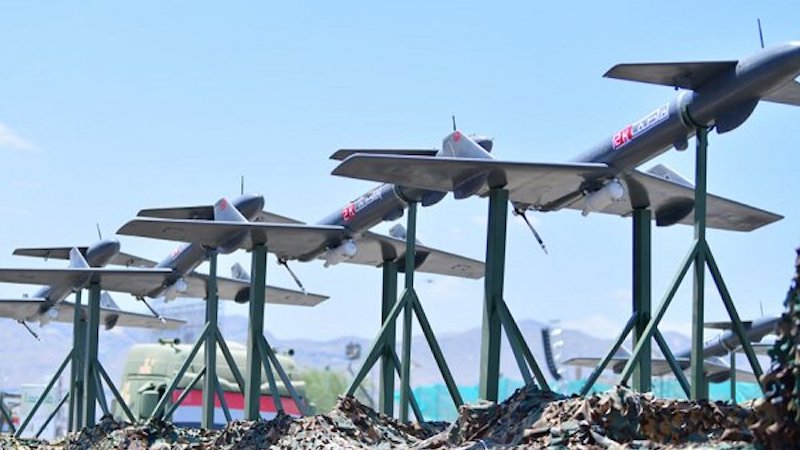
The Houthis’ tactic is heavily based on swarm tactics and using the Iranian-made SAMMAD family of drones. The Houthis have developed a vast and robust arsenal using traditional wooden dhows that have been used to smuggle advanced components, including engines, sensors, and guidance systems, and assembling them with locally produced airframes and commercial components, despite a United Nations arms embargo since 2015. Their main long-range effector, the SAMMAD-3, has a range of more than 1,000 km and an explosive capability of about 18 kg.
The group uses these drones in several modes of operation, including a loitering munition mode, in which operators use real-time electro-optical sensors to fly them toward a ship’s weak points. To boost this, the Houthis have been pressing more and more to use their long-range ballistic missiles, such as the Iranian-made Hatem 2, and their sea-based explosive drones for enhanced lethal ranges.
The chaos in the region’s trade routes has been devastating. At the end of 2023, almost all big container shipping companies rerouted their vessels around the Cape of Good Hope due to the Houthis’ maritime interdiction campaign. By August 2024, Suez Canal sales in Egypt had fallen by nearly half, costing the country some $3.5 billion, according to Associated Press. Economic impacts are immediate in port-dependent countries that rely heavily on the Red Sea. For instance, the port of King Abdullah in Saudi Arabia suffered an incredible 70% decline in liner shipping.
The Sahelian Crucible and the Horn of Africa: Democratizing Aerial Terror
The Houthis in the Middle East offer a blueprint for maritime disruption. At the same time, the African continent, particularly the Sahel and the Horn of Africa, is a test ground for the tactical integration of drones into localized insurgencies. In the Central Sahel – the region of Mali, Burkina Faso, and Niger – non-state actors have rapidly progressed from drone surveillance and propaganda to the launch of coordinated, complex, kinetic operations.
An al-Qaida affiliate, Jama’at Nusrat al-Islam wal-Muslimin (JNIM), is a leader in drone warfare in Africa. In 2025, according to a report from the Policy Center for the New South, JNIM has quickly shifted from a phase of experimentation to one of operational doctrine, enabling the group to operate drones in Mali, Burkina Faso, and Togo. The tactic of dropping improvised explosive devices (IEDs) using modified commercial drones is a tactic that is often used in JNIM’s tactical playbook. In 2024, they became much more powerful when they acquired drone experts from a small group of former rebels who used their offline artificial intelligence capabilities to bypass geofencing and make the most of the payload they carried.
The impact of this “sense and strike” capability is enormous psychologically and strategically. On the contemporary battlefield, the use of drone surveillance makes the use of traditional troop concentrations extremely vulnerable. In early 2026, the Islamic State Sahel Province executed a drone attack on the international airport and military airbase in the capital of Niger, Niamey, an event that ACLED analysts labeled a “gloomy illustration of how inexpensive commercial technology can have mass effects once again reserved for state air power.”
Similarly, al-Qaida affiliate al-Shabaab is in the process of making a strategic shift in East Africa. Al-Shabaab used to depend on guerrilla missions and suicide bombers but has been keen to build up its technological warfare armamentarium. UN watchdogs and the Africa Center for Security Studies have reported that Yemen is a land where al-Shabaab ships arms and drones across the leaky Somali coast and has also been involved in a transactional relationship with the Houthis. Drones are deployed mainly for intelligence, surveillance, and reconnaissance to plan ground operations, but interceptions of al-Shabaab drones suggest a growing trend towards ground offensive operations.
Sovereign Responses and the Evolution of Counter-Drone Strategies
Asymmetric drone attacks have grown rapidly in numbers in recent years, compelling the sovereign air forces of the Middle East and Africa to reevaluate their air defense policies urgently. Current naval and ground air defense designs are Cold War-era, optimized for fighting high-cost, high-technology, state-sponsored weapon systems. The traditional defense takes a severe economic hit when it faces swarms of low-cost commercial drones.
Middle Eastern and African forces have often found themselves firing Standard Missile-3 interceptors, which cost several million dollars apiece, against non—state groups, while a few thousand-dollar drones operate in the Red Sea, the Sahel, and the Horn of Africa. This is not a sustainable cost-exchange ratio, and it leaves a strategic dilemma: if what we do to defend critical infrastructure consumes the limited, costly ammunition stockpiles, then if we do not defend our country, we suffer catastrophic economic and human losses.
To mitigate the threat, regional powers and international military alliances are building up indigenous multi-level systems to counter drones. Saudi Arabia is spearheading this effort in the Middle East. The Saudi Arabian Military Industries (SAMI) has created a separate autonomous systems division to develop a national defense supply chain to address threats in the modern era, according to Breaking Defense. The U.S. Army recently participated in an international drone and counter-drone marketplace at the 2026 Eurosatory defense exhibition in Paris to accelerate the procurement of vetted defense technologies on a global scale, in partnership with allied countries.
In Africa, countries are also pressing for indigenous defense solutions to reduce their reliance on foreign suppliers. Nigeria has begun targeted training for Air Force personnel on advanced anti-drone radar systems that can detect, track, and neutralize drones. The Egyptian Ministry of Military Production and the Arab Organization for Industrialization have also announced the development of indigenous attack drones and jamming technology, indicating a local push to build a domestic military-industrial complex capable of engaging in asymmetric warfare.
Sovereign militaries are shifting towards directed-energy weapons as a definitive solution to the economic paradox of drone warfare. Systems using high-energy lasers and high-power microwaves have essentially unlimited magazines and incredibly low cost per kill.
Conclusion
Asymmetrical warfare has become a reality and has changed the relative strength between nations in the Middle East and Africa, and will continue to do so at an unprecedented pace as new commercial and improvised drone technologies emerge. Non-state actors, including the Houthis, JNIM, the Islamic State of Sahel Province, and al-Shabaab, have proven to be capable of turning simple, commercially available systems into powerful tools capable of evading high-tech air defenses, causing mass casualties, and asphyxiating world trade routes. The economic perversion of warfare, with states spending millions of dollars to beat threats that cost only thousands, has identified fundamental weaknesses in conventional military thinking.
Sovereign militaries, in turn, are scrambling to adjust and build local defense sectors and are spending heavily on software-defined, AI-driven architectures and directed-energy weapons. As long as world trade continues to flow and the technological hurdles to participation in the conflict remain low, the fight to control the vertical spectrum will remain a central feature of 21st-century warfare. In this new age of conflict, though, the winner may not be the player with the most expensive conventional technologies, but the player with the most agile, sustainable, and economical operating model.