

The Copyright Trap: How fake claims are silencing independent media and journalists in Somalia
MOGADISHU, Somalia 30 August 2026 – Independent media houses and journalists in Somalia are facing an escalating wave of online attacks and censorship, including coordinated fake copyright claims, content takedowns and demands for payment, often from individuals apparently operating inside and outside Somalia, according to an investigation by the Somali Journalists Syndicate (SJS).
Journalists, editors and media managers told SJS that the attacks intensified early this year amid opposition protests in Mogadishu and escalating tensions between the Federal Government and Southwest State, as well as the continuing political rift with Puntland.
The attacks are contributing to a shrinking space for independent reporting across the country. With Facebook serving as the primary news and communication platform for most Somali journalists and the general public, the copyright strikes, removals and account restrictions have significantly limited journalists’ ability to report and reach audiences.
Sahal Cable TV
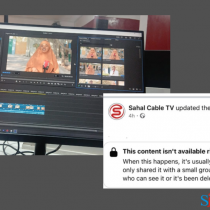
On 28 February 2026, Sahal Cable TV, a Puntland-based local television station, was covering a local event involving a school graduation and food distribution. Shortly after the station posted videos of the event on its Facebook page, Facebook removed the content following a copyright claim that the station said was false.
Then a video clip featuring a speech by Puntland President Said Abdullahi Deni, was subsequently removed following another copyright claim.
A Bangladeshi WhatsApp number then began messaging the station’s manager, claiming responsibility for the takedowns.
“Two videos were removed from the page you manage Sahal Cable TV,” the person wrote and shared a link with a third video clip with the message: “Now this one remove.” In less than a minute he then wrote “Done removed.”
The messages continued with a demand for payment: “1,500$. I need this price,” the person demanded.
When the Sahal Cable TV manager Jabir Isse who was. receiving the texts responded, “Do you think it is right to block or report our Facebook pages while you are fully aware of Facebook’s rules and policies?” the person replied: “I don’t give shit.”
The person demanding payment also shared a local Somalia number and instructed the station to send the money via mobile money transfer.

Sahal Cable TV manager Jabir Isse told SJS that the station declined to pay and reported the matter to Facebook.
SBC Somali TV
Similarly, another Puntland-based broadcaster, Somali Somali TV, faced a series of copyright claims beginning on 9 January 2026, after Facebook removed a vox-pop interview about Somaliland published on the SBC Somali TV Facebook page.
An initial notification from Facebook to SBC Somali TV stated that the content constituted “incitement.” However, SJS reviewed an appeal submitted by SBC TV to Facebook on 9 January, stating that the content was simply “journalistic reporting consisting of vox-pop interviews” with citizens on the streets of Bosaso. The content was never restored.
On 15 July 2026, after SBC Somali TV published a press conference by Puntland President Said Abdullahi Deni in which he denounced the federal government interference in Puntland, the station received another copyright-related restriction.

“Your reel is blocked worldwide. People can’t view, comment or like your reel because it includes content claimed by Lucifer Andras,” the Facebook notification stated.
The SBC Somali TV team explained, with evidence, that the video was an official press conference released publicly by the Puntland State House under public domain use. Facebook nevertheless did not restore the content, and the television page received a warning strike. Similarly, Puntland State TV which is the state-owned outlet had received a removal of the president’s speech.
Himilo Media
Himilo Media, one of Somalia’s major independent media outlets and a station whose journalists have been targeted and threatened for years, is now facing a new wave of cyberattacks.
Three years ago, Himilo Media’s Facebook page was hacked, forcing the outlet to launch a new page to continue its reporting. The station also relocated its staff in Mogadishu earlier this year following threats of violence against its journalists. However, the physical relocation and the launch of the new Facebook page did not stop the cyberattacks.
On 28 June, a Facebook copyright claim resulted in several of the station’s videos being taken down. Almost all of the claims were made by two entities using “Cric TV” and “Quiz.com” on Facebook even though a profile search on Facebook did not show a credible media platform to claim such copyright ownership of a content that is produced in Somalia.

In just one week, from late June to early July 2026, Himilo Media received 13 copyright claims from “Quiz.com” involving content about a clan elders’ meeting in Mogadishu, an election dispute in Galmudug State, a security operation in Puntland, and a report about prostate cancer.
In all cases, Himilo Media submitted disputes against the claims, but Facebook had not acted on them at the time of SJS’s investigation. A search by SJS found various profiles purporting to be based in Asia, with no apparent journalistic content on them.
An editor with Himilo Media told SJS that, prior to these attacks, the outlet received a call from someone at the Somali Ministry of Information advising them to take action on their Facebook page. The attacks eventually led to the station’s Facebook page being removed from Meta Business Suite.
Journalists at Himilo Media told SJS that they are becoming increasingly frustrated with Facebook as a platform for independent reporting because, in their view, the platform has failed to adequately prevent cyberattacks targeting independent journalism.
Gaylan Media
In late June, Gaylan Media, an online media platform with over 1 million followers known for its critical analysis, began receiving a series of copyright claims.
The first claim purported to assert ownership of Gaylan Media’s news content about Somali President Hassan Sheikh Mohamud’s visit to Djibouti on 29 June. This was followed by another claim against a report titled “Villa Somalia’s war on Puntland, the previous failure and the new attempt” published on 30 June.

Each of the claims included a purported claim over segments or full ownership of the audio used in the journalist’s reporting.
Almost all of the claims were made through a Facebook Rights Manager account under the name “Devid A. Donald Alkomer,” and “Eitan Yosef Cohen”.
When SJS searched for profiles or pages belonging to Devid A. Donald Alkomer and Eitan Yosef Cohen it found no publicly available matching profile or page.
On 6 March 2026, journalist Farah Abdukadir Mohamed, founder of Gaylan Media, told SJS that he received a message from a Bangladeshi WhatsApp number demanding payment in exchange for stopping the Facebook attacks. Farah shared screenshots of the messages with SJS and said that he had blocked the number. However, the Facebook copyright attacks escalated afterwards.
From late June to early August, Gaylan Media received about 22 fake copyright claims, with Facebook displaying the message: “This content isn’t available at the moment.”

Facebook never explained the claims. When Gaylan Media disputed them, Facebook did not proceed with the disputes. Farah told SJS that he is considering leaving Facebook because his reporting work is being continuously attacked.

Xogbile Media
Xogbile media founder and journalist Mascuud Warsame said his media outlet also faced a series of online attacks on its Facebook page during protests in Mogadishu in May and June, following an opposition call for public protests in the capital.
After several copyright strikes, the Xogbile Facebook page was hit with restrictions that reduced its reach.
Mascuud said Mogadishu police chief Mahdi Omar Mumin, also known as Moalin Mahdi — a former Al-Shabaab militant — warned Xogbile against publishing content related to the protests. On 30 June, Mascuud was kidnapped by members of NISA shortly after leaving his workplace on Maka Al-Mukarama Avenue in Mogadishu that night. He spent 39 days in a NISA detention cell where his health had deteriorated, and he had no access to his family or legal representation, before he was freed without charge, as SJS documented at the time.

Mascuud told SJS that he is now avoiding anything critical of the government and has become demoralized about his work because of threats against him and his media outlet, both offline and online.
Shabelle TV
Shabelle TV faced a series of fake copyright claims that resulted in more than a dozen of its reports being taken down by Facebook, often with only a notification and, in some cases, without any opportunity to appeal or challenge the claims.
Most of the content taken down involved reports about speeches by a presidential candidate. The takedowns were often followed by WhatsApp messages from a number claiming to have carried out the attacks and demanding a payment of $1,500 to stop further action. Messages shared with SJS show these demands.

Zakariye Timacadde
On 22 February 2026, diaspora-based journalist Zakariye Timacadde posted a video on his 1 Million followers on Facebook discussing an incident in which a member of Somalia’s National Intelligence and Security Agency (NISA) allegedly attacked a civilian in Mogadishu. Hours after the video was published, Facebook removed it on the grounds that it “goes against Facebook community standards.”
The attacks did not stop there.
A Facebook account “Rajiv Kumar,” seemingly based in India, subsequently made copyright claims against several of Zakariye Timacadde’s new pieces of content including another report about Somali police in Mogadishu conducting forced evictions. Then on 9 April when Zakariye Timacadde publiahed his report telling the forced eviction in the Tarabuunka area affecting vulnerable families, he soon received another copyright claim under the name “مجلة الوصفة المفيدة“.

Zakariye Timacadde’s dispute did not go through, and the report was eventually removed. An SJS search on Facebook did not identify any profile or Facebook page matching the full name under which the copyright claim was filed.
Zakariye told SJS that, prior to these incidents, his Facebook Rights Manager access had been revoked and he alleges that personnel at the Somali Ministry of Information reported his Facebook page because of its critical content about the government.
Several journalists affected by these attacks repeatedly mentioned two Somali national intelligence agents working at the Ministry of Information: Abdishakur Ali Ahmed and Mohamed Kafi Sheikh Abukar. Both had previously implicated in attacks on journalists including women reporters and trainees.
Hafid Nor
In June 2026, during protests in Mogadishu, independent Mogadishu-based journalist Hafid Nor was covering demonstrations called by the opposition.
Hafid told SJS that several of his videos and his profile photo were hit with copyright claims, affecting the growth and reach of his page for a period of three weeks. He also told SJS that he faced hacking attempts, although they were unsuccessful.
Similar fake copyright claims were reported by several media outlets, including Mogadishu-based Kaab TV, Danan TV, Shabelle Media Network, and Cosob TV, and Puntland-based Radio Daljir, between January and June 2026. All the fake copyright claims against these institutions targeted content deemed critical of the Somali federal government or the state security agencies.
The online crackdown is also unfolding alongside growing restrictions on social media content inside Somalia. On 28 June 2026, the Somali Police announced the arrest of ten young social media influencers, accusing them of promoting “indecent behaviour” and content allegedly supporting “homosexuality.”
During a press conference at the Criminal Investigation Department (CID) headquarters in Mogadishu, police spokesperson Abdifatah Aden Hassan said security agencies were pursuing additional individuals. In a separate press briefing, he also claimed that the police had “contacted Facebook to take down content and close pages,” although he did not specify how many pages had been targeted or whom they belonged to.
Journalist Cumar Buule
Journalist Cumar Buule was informed that he could no longer use his name on Facebook because he says the “name had been banned”. It began in early June this year after Cumar Buule’s Facebook page was reported for alleged “impersonation”—a claim that his account “was pretending to be another person, organisation or public figure, or using someone else’s identity in a misleading way”. Cumar Buule said he had never impersonated anyone and had been active on Facebook for more than a decade.
“Whenever I attempt to register with my name, I receive a message that I cannot use this name on Facebook due to impersonation,” he told SJS.

Omar Buule told SJS that sometime in May 2026, during protests in Mogadishu, a police source informed him that his name had been placed on a list sent to the Ministry of Information. He believes personnel at the Ministry of Information who are in contact with Facebook reported his page for “deactivation”.
Since then, Omar has turned to TikTok and YouTube for his reporting.
Journalist Ali Ibrahim Mohamed
Journalist Ali Ibrahim Mohamed was covering political and security developments in February this year when a dispute over regional elections erupted in Southwest State. On 18 February, he began receiving fake copyright claims against his own content. He told SJS that he was frustrated to see his own content, including his voiceover for news reports, falsely claimed by others.
“Even though I disputed via Facebook platform, the platform is not going through. No reply, which is annoying,” he told SJS.
Ali is now using the platform intermittently.
Like many other journalists, he said the attacks have contributed to an overall shrinking of reporting in the country because the majority of Somali journalists use Facebook as their primary news and communication platform compared with other social media platforms.
Allegations against Ministry of Information, NCA and NISA
A former employee of the Ministry of Information told SJS, on condition of anonymity, that Somali police and members of the National Intelligence and Security Agency (NISA) forwarded the names of journalists and critical content to the Ministry of Information and the National Communications Authority (NCA). The former employee said the ministry’s Director of Social Media and NCA officials had a communication with Facebook requesting content takedowns, usually on the grounds that the material was “against Facebook Community Standards.”
We wrote to the NCA regarding allegations that its officials were involved in some of these attacks as part of a Somali government campaign to censor critical content. The NCA Director, Mustafa Yasin, did not respond to our email queries.
Abdishakur Ali Ahmed, who told SJS that he was appointed Director of the Social Media Department for the Ministry of Information at the Somalia Federal Government in December 2021, confirmed to SJS that, “Following the development of the National Communication Strategy 2023–2024 in January, it was transformed into the Department of Communication Strategy, with a broader media and communication mandate.” The department’s mandate included “engagement with Meta”, Facebook’s parent company, Abdishakur said.
In an email statement, Abdishakur told SJS that his department’s “mandate included managing the Ministry’s and state media’s social-media accounts, assisting government institutions, journalists and media outlets with platform-related matters, and maintaining official engagement with international social-media companies.”
“The Ministry’s engagement with Meta has contributed to a more conducive digital environment for journalists, influencers and media outlets. Most cases involving mistakenly restricted accounts or legitimate content were resolved after we accurately worked together with Meta,” Abdishakur added in his written statement.
However, Abdishakur declined to provide communications or describe the extent of his department’s engagement with Meta concerning journalists’ accounts, even though he denied requesting the censorship or removal of media content.
SJS also wrote to Mohamedkafi Sheikh Abukar, an officer at Somalia’s Ministry of Information who has been alleged to have connections to the National Intelligence and Security Agency (NISA). Mr. Abukar denied any involvement in targeting journalists’ Facebook accounts.
When SJS contacted Meta’s East Africa team regarding fake copyright takedowns and impersonation under its Community Standards, we received no response.
Read The Original Statement here
Credit: Source link