

The Canton–Hong Kong Strike Changed China’s History
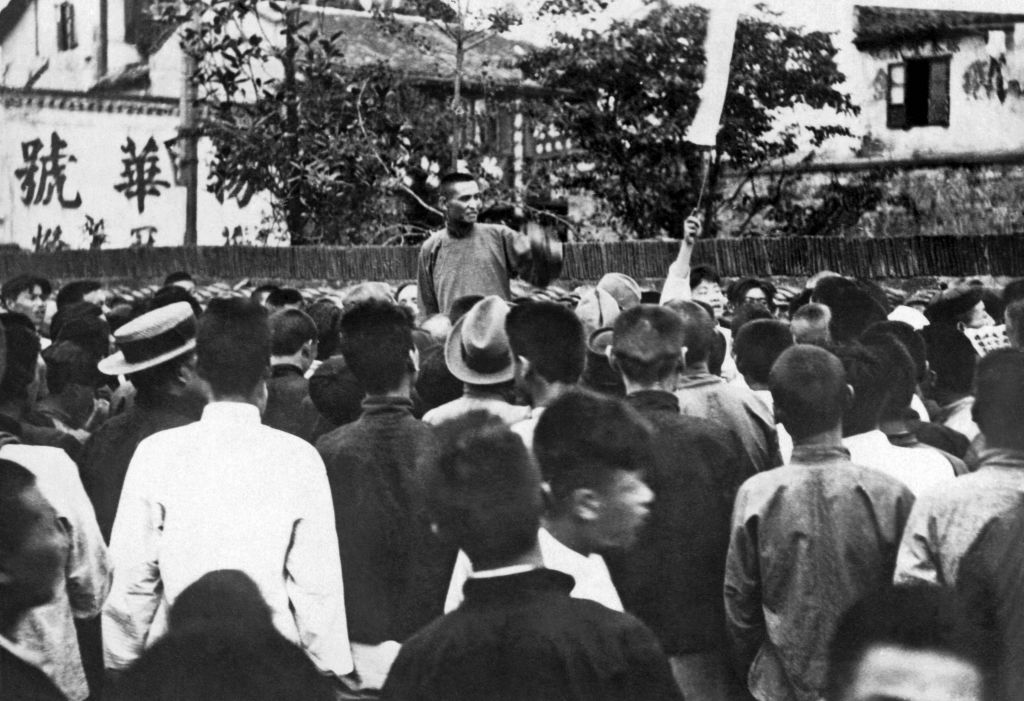
When the CPC sent its best labor organizer, Deng Zhong-xia, to Hong Kong to organize a general strike in solidarity with Shanghai’s anti-imperialist movement, he thus had few expectations of success. Deng came from a different region and spoke a different dialect: he relied on a Hong Kong Communist worker, Su Zhao-zheng, who had led a seamen’s strike in 1922, to build trust with Cantonese workers.
Still, Deng was not completely unknown among the Cantonese workers. As the early CPC’s main labor leader, Deng had just organized China’s second national labor congress. This congress proved pivotal for the party in clarifying a labor strategy that it put into practice in the Canton–Hong Kong strike.
Held just before the May 30 massacre, this gathering called on workers to form their own organizations independent from the bourgeoisie. It also established that workers’ economic and political struggles were inseparable. In other words, Communists had to extend the scope of workers’ struggles for better working conditions to fight the alliance of the capitalist class with warlords and imperialists.
Some of Canton and Hong Kong’s most powerful unions, such as the employer-friendly mechanics’ union, boycotted the congress and protested its militant tone. Deng knew he would face the difficult task of dealing with these unions as he arrived in Hong Kong. But when Deng and Su held a cross-union meeting to call for a strike, a majority, including these yellow unions, voted to authorize it.
In a later reflection, Deng suggested that even corrupt union leaders believed they could benefit from a strike at that moment. They were keen to siphon money from the strike fund and increase their prestige and power in the labor movement. The CPC leaders also helped persuade the yellow union leaders by inviting them to participate in the strike committee.
But there was another crucial element to the strike vote. The massacre in Shanghai was a turning point for Cantonese workers’ hatred of British imperialism. Sensing this opportunity, Deng, Su, and the CPC’s Hong Kong branch — then only a handful of dockworkers and students — went directly into the factories to agitate the workers. Though the seamen’s union was taken over by corrupt leaders after the 1922 strike, seamen and dockworkers still revered Su, who easily rallied them for the general strike.
As historian Daniel Kwan has documented, another CPC cadre, Yang Yin, passionately appealed to a sense of patriotism in seeking to persuade even triad and secret society labor leaders that they had a role to play in a time of national crisis. Thus, as Deng explained, the CPC had a two-pronged strategy: persuading union leaders directly while also agitating among workers to push their own leaders to act.
Despite their support, many conservative labor leaders dragged their feet, resulting in the CPC-friendly unions — led by tram workers, seamen, typesetters, and foreign-firm workers — striking first on June 19. But the feelings of anger and restlessness among the union’s rank and file were too strong for Hong Kong’s conservative union bureaucracy to contain.
Rank-and-file mechanics struck on their own without official approval from their union leadership. The seamen even physically threatened their union leader to issue an order to strike. If he refused, the workers declared, they would “greet him with their fists.”
The Canton–Hong Kong strike uplifted the anti-imperialist demands coming from the movement in Shanghai to abolish China’s unequal treaties with imperialist powers. But its horizon did not stop there. The strike demands were as follows:
-
absolute freedom of the Chinese to gather, organize, speak, publish, and strike;
-
equal treatment of all Hong Kongers, whether Chinese or Western, under the law, and the immediate abolition of all laws and actions targeting Chinese residents for deportation and cruel punishment;
-
every Chinese worker must be granted the right to vote, to satisfy the basic principle of universal suffrage;
-
the introduction of labor laws, including an eight-hour day and a minimum wage, the abolition of contract labor, improvements to the livelihoods of women and child workers, and the implementation of workers’ insurance, with representatives from labor unions included when drafting these laws;
-
the cancellation of proposed rent increases on July 1, with a 40 percent cut to rents instead;
-
freedom of residence to the Chinese in Hong Kong.
The strike combined economic and political demands that identified the roots of the workers’ exploitative conditions in colonial rule. Most significantly, it was the earliest moment at which Hong Kongers demanded universal suffrage in a mass movement. This echoed the early CPC’s demand for a wider struggle for democracy across China. The strike showed that the working class was the vanguard of Hong Kong’s fight for decolonization and democracy.
A massacre by British troops transformed the strike into a mass movement. On June 23, one hundred thousand people from Canton held a march to Hong Kong in solidarity with the strike. When they passed by Shaji Road, British soldiers in the occupied district of Shamian across the river opened fire and killed dozens of protesters.
The massacre drastically broadened the scale of the strike. Workers demanded that London compensate and apologize for the killings. Tens of thousands of workers in Hong Kong then joined the strike and left for Canton.