

Test, Measure, Then Legislate: A Swiss Voice Reads Morocco’s Cannabis Reckoning
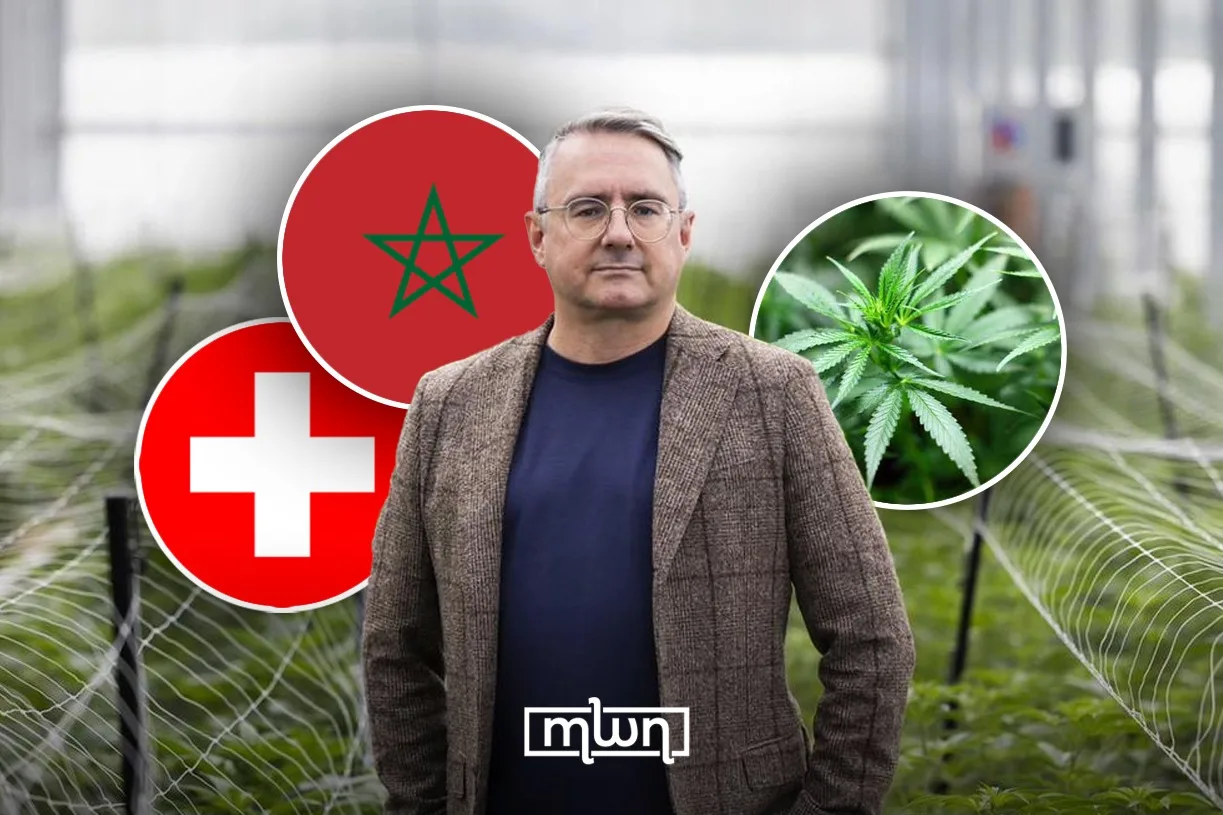
Morocco and Switzerland have reached the same threshold from opposite directions, and from opposite ends of the argument. One country carries a cultivation tradition older than most European states; the other arrives armed with laboratories, cohorts, and a federal mandate to experiment. What unites them is a single, stubbornly modern question: once prohibition has demonstrably failed to make cannabis vanish, what does responsible regulation of its recreational use actually look like?
Paul-Lukas Good has spent years chasing the empirical answer. A Zurich attorney who now helms Swiss Cannabis Research, Good directs the largest study of its kind in Switzerland: a pilot cleared for up to 7,500 participants in the Canton of Zurich, with a second trial of roughly 5,000 already running in St. Gallen, both conducted alongside the University of Zurich and the ETH. This spring he traveled to Morocco. In an exclusive conversation with Morocco World News (MWN), he laid out what he observed, and what two unlikely interlocutors might trade.
His read on Morocco’s trajectory was admiring, and pointed. “It looks like a country moving thoughtfully and in the right order,” Good remarked. “Legalizing cultivation and industry first was a wise foundation – it brought farmers into a regulated economy and gave the whole sector a legitimate base to build on.”
That foundation is Law 13-21, the 2021 statute that lifted cannabis out of pure criminality and into a regulated regime confined to medical, pharmaceutical, cosmetic, and industrial uses. It birthed a dedicated regulator, ANRAC, and routed the Rif’s growers into licensed cooperatives, converting a centuries-old crop into traceable, taxable income. Three years on, the agency reports 5,765 operational authorizations – 5,492 of them for cultivation, benefiting 5,318 farmers – after issuing 4,147 fresh permits in 2025 alone.
For Good, though, the reform’s moral fulcrum lay elsewhere: the 2024 royal pardon. King Mohammed VI extended clemency to 4,831 cultivators convicted, prosecuted, or hunted for a crop their families had grown for generations. “The royal pardon was, to me, the part that showed real statesmanship,” he reflected. “It treated the farmers not as offenders but as citizens whose livelihood had simply been on the wrong side of an old law.”
He grasps why Morocco fascinates him more than the Swiss case ever could. “In Switzerland the discussion is fairly recent,” he observed. “In Morocco, cannabis is woven into the history of a whole region, the Rif, and into the livelihoods of farming communities going back generations. That makes it more complex, but also, in a way, more honest: the plant is already part of the social fabric, and so is its consumption.”
The question both countries now face
Here Good’s argument sharpens into a thesis. Legalizing the field, he contends, settles only half the equation. “Once you accept that prohibition has not made cannabis disappear,” he posed, “what is the responsible way to regulate – not just the growing of it, but the recreational use of it?”
His own answer is unequivocal, and carefully bounded. “The logical next step in the debate is a regulated market for recreational use – not a free market, but a regulated one,” he ventured. “If you leave consumption unregulated and illegal, you hand that part of the sector to organized crime, even after you’ve legalized the farming.”
This is the precise gap Morocco’s own reform leaves open. The legal channel, by every credible estimate, absorbs a sliver of what the mountains actually yield. In a statement to MWN this week, Chakib El Khayari, coordinator of the National Collective for Cannabis Legalization, revealed alarming figures. Against at least 60,000 families living off the plant, he detailed, the 5,318 integrated growers amount to under 10% of potential cultivators. This leaves more than 90% tethered to the illicit market “not because all these farmers are traffickers,” El Khayari clarified, “but because the illegal economy remains, for a great many of them, the only available outlet.”
It is on the method of closing that gap, rather than the politics of it, that Good is most insistent. The Swiss trials, he argues, exist to substitute evidence for instinct. “The value of the trials is that they let you build legislation on research findings rather than on a gut feeling,” he noted. Switzerland, in his telling, has codified a sequence – “a step-by-step, monitored process that produces evidence.”
Could Morocco, with ANRAC and a few years of regulatory muscle memory, attempt something comparable? Good declined to prescribe. “I’d be cautious about prescribing anything for Morocco – I don’t work on Moroccan law, and the legal context here is not mine to navigate,” he demurred. Yet he allowed that the scaffolding already exists. “A regulator that already licenses farmers and tracks legal supply is, in principle, the kind of body that could oversee a time-limited, scientifically monitored trial.” The principle, he reasoned, travels: “Test, measure, then legislate isn’t Swiss. It’s just sound policy.”
Dismantling the gateway
On the objection that shadows every legalization debate – that cannabis ushers users toward harder narcotics – Good was witheringly direct. “For me that belongs in the world of myths,” he countered. “The gateway, where it exists, is usually not the cannabis – it’s the dealer.”
The logic is mercantile, he explained: a dealer rarely traffics in cannabis alone, and has every incentive to nudge clients toward higher-margin product. “A regulated market breaks that link, because the point of sale is no longer a criminal one.”
He extended the same reasoning to public health, refusing the charge that studies like his minimize the risks. “We take the health risks seriously, and I don’t think the supportive case is served by pretending they aren’t real,” he conceded. His trial furnishes low-threshold access to addiction-medicine specialists, controlled-THC product, and tobacco-free options. The contrast he draws is structural, almost forensic: “The black market operates with no health concept whatsoever – no age verification, no quality control, no dosage information, no referral to treatment. A well-regulated market reduces the illegal trade and, crucially, replaces a system with zero health protection with one that has it built in.”
That harm-reduction grammar maps almost exactly onto the position El Khayari has been pressing at home. “The approach to adopt must not be one of encouraging consumption,” he affirmed. “It must be an approach of risk reduction” – one that polices product quality, bars minors, informs users, steers the vulnerable toward care, and bleeds economic power from criminal networks.
His framing of the political ask is deliberately narrow: “It is not a question of calling for a disorderly or commercial liberalization of cannabis. It is a question of opening a serious national debate on a strictly regulated recreational legalization, grounded in public health, risk reduction, protection of minors, the reduction of the illicit market, and the economic integration of farmers.”
Where Morocco’s parties stand
That debate is no longer hypothetical inside Morocco’s political class, where it cuts cleanly across the majority-opposition divide. The Authenticity and Modernity Party (PAM) has signalled the most appetite. Ahmed Touizi, who chairs its group in the House of Representatives, declared in November 2024 that his bench was “very open” to examining recreational regulation, and prepared to table or back a bill – conditional on studies proving the absence of health harm and a measurable dent in trafficking. Regulated, licensed points of sale, he argued, beat forcing consumers toward an unmonitored product in the black market.
Mustapha Benali, secretary-general of the Democratic Forces Front, has gone further still. Speaking in April 2026, he cast his party as one of the few that treated the recreational conversation as vital. The purely repressive approach, he ventured, is “of no use on its own,” gesturing toward some 50 countries that have shifted course and toward the World Health Organization (WHO)’s reclassification of cannabis.
Against them stands the Justice and Development Party (PJD), whose refusal is categorical. Also speaking in November 2024, Mustapha Ibrahimi rejected recreational legalization “absolutely and unequivocally,” reviving the gateway thesis Good dismisses and pointing to the Netherlands’ contested experience. His rhetorical close – whether one had ever encountered a kif consumer “in good health” – captures the moral register in which his bloc fights.
The stakes peculiar to the Rif
Good reserved his most resonant point for the economic dimension that makes Morocco’s case unlike his own. “In Switzerland, regulation is largely a health-and-crime question,” he observed. “In the Rif, cannabis has sustained entire communities for generations, and the legal cultivation scheme still covers only a fraction of what’s actually grown – most of the crop, and most of the income, remains illicit, sold at prices the legal channel can’t match.” The unresolved question, he pressed, is “whether it could finally bring that informal economy into the daylight and be an important source of income to the farmers and the state.”
He expects his own country to legislate recreational use “by 2028, before our own study is even finished” – a candid admission that politics may outrun the data even in the laboratory of cannabis policy.
His parting word to Moroccan readers was a courtesy with an edge. “Morocco’s relationship with this plant is far older and far more layered than ours,” he reflected. “But on the core question we are asking the same things. There’s a great deal we can learn from each other if we’re willing to share what the evidence actually shows.”
Read also: UK Cannabis Laws in 2026: What North African Communities Should Know
Credit: Source link