

Taiwan halts LNG spot purchases from PNG over office closure
-
By Lee I-chia / Staff reporter
State-owned CPC Corp, Taiwan has temporarily suspended spot market purchases of liquefied natural gas (LNG) from Papua New Guinea (PNG), after its foreign minister earlier this month unilaterally announced the closure of Taiwan’s representative office in Port Moresby, the Ministry of Foreign Affairs (MOFA) said today.
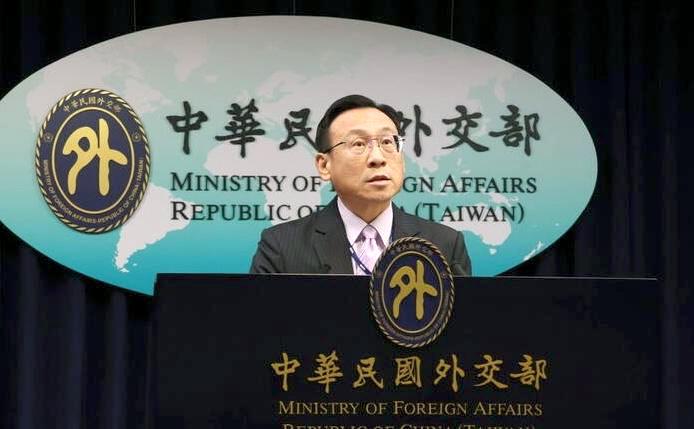
The move would result in Taiwan not purchasing about 500,000 tonnes of LNG from Papua New Guinea, Department of East Asian and Pacific Affairs Director-General Michael Lin (林昭宏) told a news conference in Taipei today.
Taiwan’s long-term contract to import 1.2 million tonnes of LNG annually from Papua New Guinea would remain in effect, with the suspension limited to spot market purchases for the time being, he said.
Photo: Huang Ching-hsuan, Taipei Times
As Taiwan accounts for about one-third of Papua New Guinea’s LNG exports, the move is expected to have significant consequences for the Pacific island nation’s economy, he said.
The government would determine whether to resume spot LNG imports or adopt additional retaliatory measures depending on Papua New Guinea’s formal response to Taiwan’s action, he added.
Papua New Guinea Minister of Foreign Affairs Justin Tkatchenko on July 16 announced that his government would immediately close Taiwan’s representative office in Port Moresby.
The immediate cessation of operations and the formal closure of the physical presence of Taiwan’s representative office was an “administrative action” to underscore Papua New Guinea’s “one China” policy, a statement posted on Tkatchenko’s Facebook page said.
The move was “highly appreciated” by Beijing, the Chinese Ministry of Foreign Affairs said.
That same day, MOFA lodged a formal protest, saying that the decision was made unilaterally and without prior consultation.
Taiwan does not accept the decision and its representative office would continue normal operations, MOFA said.
On July 17, Minister of Foreign Affairs Lin Chia-lung (林佳龍) said that Taiwan was reassessing its economic ties with Papua New Guinea, including the annual purchase of large amounts of LNG, which is a major source of revenue for the country.
MOFA “strongly protests Papua New Guinea’s unilateral decision,” Michael Lin said today.
Tkatchenko bypassed the civil service decisionmaking process and issued a statement directly from his office, forcing Taiwan to close its representative office without prior consultation — an action that severely damaged bilateral relations, he said.
Over the years, Taiwan has promoted cooperation projects in Papua New Guinea, including in the healthcare, agricultural technology and talent development sectors, and Taipei has always been willing to discuss further cooperation in trade and energy with the government in Port Moresby, Michael Lin said.
“Taiwan continues to make efforts to communicate with the Papua New Guinea government, to help them understand that enhancing bilateral cooperation and exchanges would better serve the national interests of both sides,” he said.
Taiwan has prepared response measures for any potential outcomes, but specific details cannot be disclosed at present and would be revealed to the public at an appropriate time, he added.
Taiwan is one of Papua New Guinea’s top five export destinations, particularly for LNG, he said.
Taiwan would continue to review its overall energy demand and supply allocation to determine whether to further adjust its total LNG procurement from Papua New Guinea, he said.
Taiwan’s LNG spot market purchases from Papua New Guinea in the first half of this year totaled about 500,000 tonnes, he said, citing data provided by the Ministry of Economic Affairs and CPC Corp.
Asked if suspending LNG spot market purchases from Papua New Guinea could result in a supply shortage in Taiwan, Michael Lin said that CPC Corp made assessments before coming to the decision.
CPC Corp also has a long-term contract with supplier ExxonMobil for 1.2 million tonnes of LNG per year, which is not only sourced from Papua New Guinea, he added.
Regarding Taiwan’s aid programs in Papua New Guinea, including technical agricultural missions, medical referrals and scholarship programs, he said they would continue for now to demonstrate Taiwan’s goodwill and the advantages of transparent cooperation and mutual benefit.
However, rolling reviews would be conducted depending on Papua New Guinea’s response, he added.
Facing China’s growing pressure, the possibility of Port Moresby adopting further detrimental measures cannot be excluded, Michael Lin said.
MOFA would continue to consult with like-minded nations to voice support for Taiwan, and protect the safety of the representative office staff and Taiwan’s overall diplomatic interests, he added.
Additional reporting by CNA
Credit: Source link