

Starlink Is Live in Equatorial Guinea

Equatorial Guinea just became Starlink’s 30th African country. On August 29, 2026, both the official Starlink account and Elon Musk confirmed on X that the satellite internet service is now available in the country, with an order page live at starlink.com. It’s a milestone for a nation that has spent years near the bottom of Africa’s connectivity rankings, and the fine print on how Starlink got there is arguably the more interesting story.
The launch, and the catch
Starlink’s arrival didn’t happen through a standard, permanent license. The launch follows a provisional approval granted by Vice President Teodoro Nguema Obiang Mangue on July 29, 2026, exactly one month before the public go-live.
Oversight rests with GITGE (Telecomunicaciones de Guinea Ecuatorial), the state-owned digital infrastructure company, which is tasked with assessing Starlink’s operations and determining which regulatory conditions should apply in the longer term. In other words, the government is treating this as a trial run, not a settled market entry, and it can still tighten the terms or walk them back once the evaluation period ends.
That caution has history behind it. Starlink talks with Equatorial Guinea date back to at least March 2026, when the service was floated mainly as backup connectivity for a papal visit that April. And an earlier regulatory framework had confined authorised Starlink access almost entirely to the oil and gas sector and “strategic infrastructure,” with ordinary residents needing separate government sign-off to even apply. Whether that restrictive posture fully carries over now that a consumer order page is live is exactly what GITGE’s review period is meant to determine, so residents who order today are technically buying into a market whose long-term rules haven’t been finalised.
What it actually costs
Pricing pulled directly from Starlink’s website shows two hardware options and two residential service tiers, both priced in Central African CFA francs (FCFA/XAF):
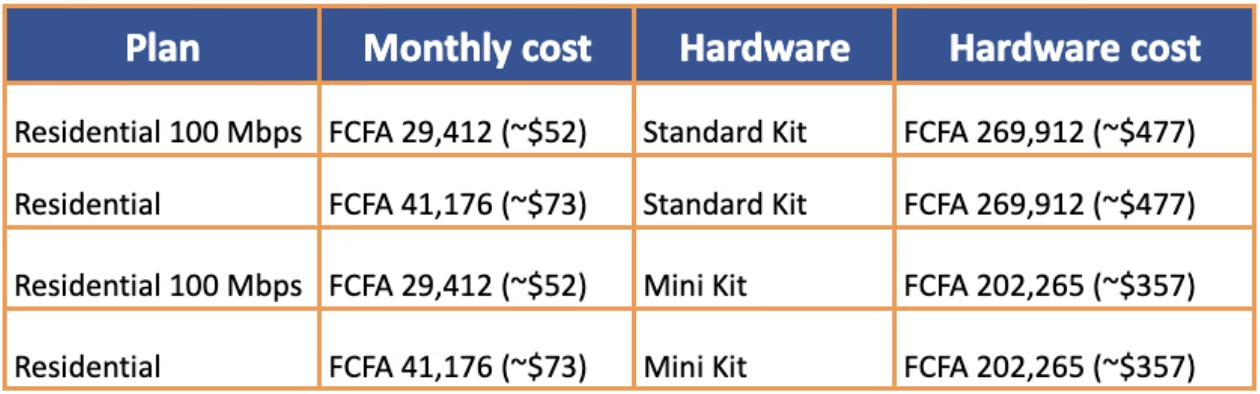
The pattern is familiar from other Starlink markets: the service tier you pick, capped at 100 Mbps versus the uncapped “Residential” plan, determines the monthly bill, while the hardware choice is independent of that. The Mini Kit undercuts the Standard Kit by roughly FCFA 67,600 (~USD 120) up front, at the usual tradeoff of a smaller dish and lower peak throughput.
For context, that puts entry-level Starlink in Equatorial Guinea in a similar band to what it costs in several of SpaceX’s other recent African launches, not cheap by local income standards, but broadly in line with the company’s regional pricing pattern rather than an outlier.
The bigger picture
Equatorial Guinea had roughly 1.18 million internet users at the end of 2025, an online penetration rate of 60.4%, according to DataReportal’s Digital 2026 report, and most of that runs through infrastructure that’s expensive to extend into the country’s more rural and forested terrain. A low-earth-orbit alternative that doesn’t depend on last-mile fibre or cell towers is, on paper, exactly the kind of thing that closes gaps fast.
Whether it actually will depends on what happens after this “testing period” ends. If GITGE’s review leads to full, permanent authorisation, the current consumer pricing table becomes the real starting point for household adoption. If it doesn’t, or if the government reimposes sector-specific restrictions once the evaluation is complete, this launch may be remembered as a soft opening rather than the real one.
Either way, as of this week, Starlink is live, orderable, and priced for residential customers in Equatorial Guinea. The part worth watching isn’t the launch; it’s what the government decides once the trial period is over.
Credit: Source link